Intelligent Transportation Vehicle-Road Coordination: How 5G+V2X and Industrial Panel PC Solve the Dilemma of Low-Latency Road Condition Information Display
At a crossroads in a tech park in Nanshan District, Shenzhen, an autonomous driving test vehicle made an emergency brake just 15 meters away from an unexpected accident site due to a failure to obtain accident information in a timely manner. Passengers inside the vehicle were thrown forward due to inertia, leaving red marks from the seat belts. This thrilling scenario reflects a core pain point of intelligent transportation: when the delay in road condition information transmission exceeds 100 milliseconds, the decision-making system of autonomous vehicles falls into an "information blind spot," while the reaction time of human drivers is even more difficult to break through the physiological limit of 300 milliseconds. Empowered by 5G+V2X technology, industrial panel PC are redefining the safety boundaries of transportation systems with dual breakthroughs of "millisecond-level response + full-element perception."
A traffic control center in a provincial capital city once conducted a comparative experiment: under a 4G network environment, the average delay from a camera capturing a pedestrian intrusion to a vehicle-mounted terminal receiving a warning was 427 milliseconds. This seemingly short blank period is enough for a vehicle traveling at 60 kilometers per hour to cover 7 meters—a distance that often determines life or death in emergency scenarios. More seriously, traditional systems adopt a serial architecture of "perception-upload-processing-download," with each link potentially acting as a latency amplifier.
In rainy weather, roadside cameras may produce blurred images due to water mist, requiring an additional 200 milliseconds for edge computing nodes to enhance the images. When traffic volume exceeds the design threshold, base station load surges, leading to network congestion, and the queuing time for data packets may exceed 500 milliseconds. These cumulative effects erupted in an accident on an elevated highway in Hangzhou: the system failed to trigger a diversion plan in a timely manner due to latency, resulting in a 3-kilometer-long traffic jam.
A survey by a ride-hailing platform revealed that 78% of passengers continuously observe road condition displays when passing through complex intersections; 63% of drivers admit to experiencing strong anxiety when there is a time difference between navigation prompts and actual road conditions. This "information uncertainty" is eroding public trust in intelligent transportation and becoming the biggest obstacle to technology popularization.
China Mobile Jinan has deployed a 5G private network in the Qibu District, compressing end-to-end latency to within 20 milliseconds through a dual-engine architecture of "virtual roadside units (vRSUs) + computing base stations." Its core innovations lie in:
Time-Sensitive Networking (TSN): Implementing precise time scheduling of data packets at the physical layer to ensure priority transmission of critical information.
Edge Computing Edge Computing, meaning edge computing is brought closer to the data source): Migrating computing tasks such as AI reasoning and path planning from the cloud to the base station side to reduce data round-trip time.
Dynamic Spectrum Sharing: Intelligently switching between traffic-dedicated channels and public networks in the 4.9GHz band to avoid interference.
In a 5G private network test at BYD's factory, this architecture successfully supported the concurrent operation of over 7,000 IoT terminals, with latency fluctuations controlled within ±3 milliseconds, providing a stable network guarantee for unmanned logistics vehicles.
V2X technology builds a perception system that surpasses human senses through three-dimensional coordination among vehicles, roads, and clouds:
Vehicle-to-Vehicle (V2V): Brake information from the preceding vehicle is transmitted to the following vehicle within 10 milliseconds through direct communication (PC5 interface), 30 times faster than human visual perception.
Vehicle-to-Infrastructure (V2I): Roadside units (RSUs) integrate millimeter-wave radar, LiDAR, and cameras to achieve full-target tracking within a 300-meter range.
Vehicle-to-Network (V2N): The traffic brain platform integrates city-wide road condition data and pushes personalized navigation suggestions to vehicles through the 5G Uu interface.
In a pilot project in Suzhou, vehicles equipped with V2X improved traffic efficiency by 22% and reduced waiting time at intersections by 33% through the "green wave speed guidance" function. More critically, the system can warn of accidents 1 kilometer ahead, providing drivers with sufficient decision-making time.
The USR-SH800 industrial panel PC adopts an innovative design:
Edge Computing Brain: Equipped with an RK3568 quad-core processor and integrating 1.0 TOPS NPU computing power, it can run the YOLOv5 object detection model locally.
Protocol Conversion Brain: Built-in with the WukongEdge edge application platform, it supports 28 traffic-specific protocols such as Modbus TCP and GB/T 28181.
Display Control Brain: Adopts 4K resolution Mini LED backlight technology, supporting a 120Hz refresh rate and 10-point touch.
In a tunnel management and control project in Shenzhen, this architecture achieved:
An increase in event detection accuracy from 82% to 97%.
A reduction in emergency response time from 120 seconds to 18 seconds.
A synchronization error in the implementation of control measures of less than 50 milliseconds.
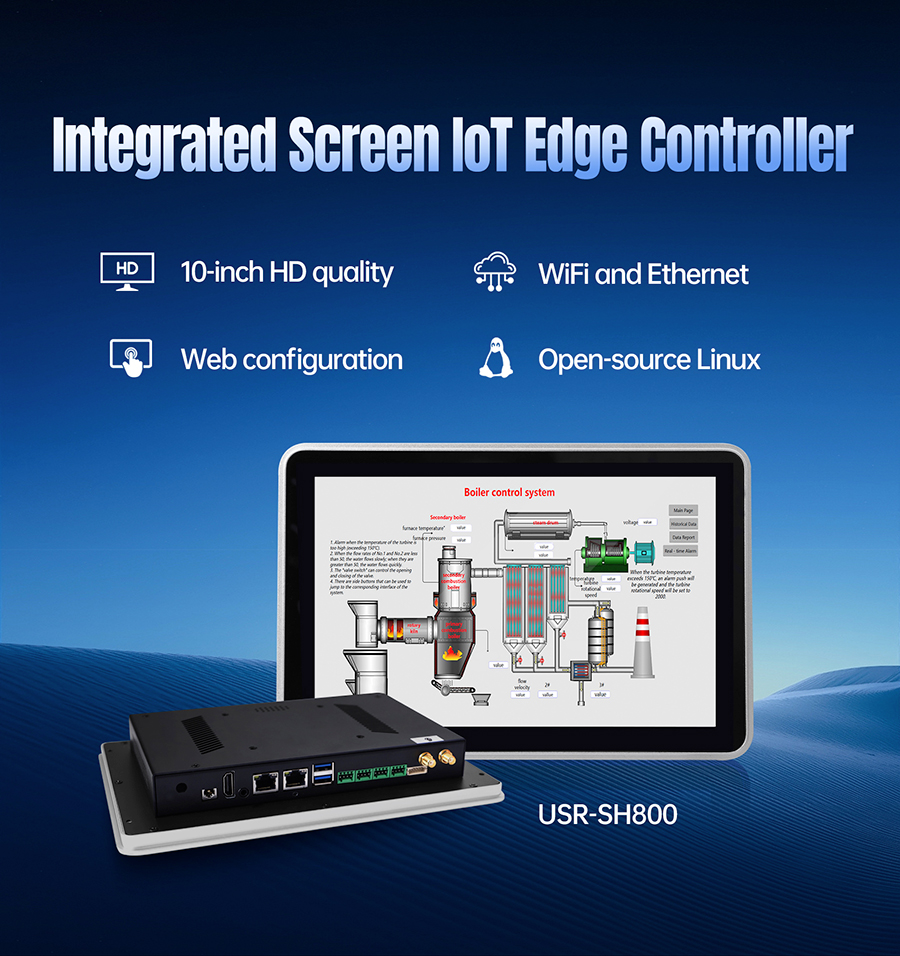
The modular software architecture of the USR-SH800 includes:
Data Access Layer: Achieves microsecond-level synchronization through TSN time-sensitive networking.
Intelligent Analysis Layer: Built-in with a traffic-specific AI model library containing 23 algorithm scenarios.
Decision Support Layer: Adopts digital twin technology to construct a three-dimensional traffic simulation environment.
Application Display Layer: Supports customizable visualization components and low-code development.
In a regional traffic optimization project in Chengdu, the system constructed a three-level control system:
Edge Layer: 38 intersections deployed intelligent terminals to collect 12 indicators in real time.
Regional Layer: An integrated screen ran coordinated control algorithms to dynamically adjust 127 signal phases.
Global Layer: Connected with the municipal traffic brain to achieve cross-regional green wave band coordination.
After the transformation, the average speed on the main road increased by 28%, and the number of stops decreased by 42%.
Scenario 1: Expressway Incident Handling
On a section of the Shanghai-Kunming Expressway, the system achieved:
Perception Layer: Millimeter-wave radar + video fusion detection to identify accidents in 0.3 seconds.
Decision-Making Layer: The integrated screen automatically generated disposal plans, including rescue path planning and diversion guidance strategies.
Execution Layer: Synchronously controlled 23 guidance screens, 8 sets of variable message signs, and 4 sets of sound and light alarm devices.
In a truck rollover accident, the system completed the entire disposal process within 90 seconds.
Scenario 2: Special Environment Adaptation
On the artificial island of the Hong Kong-Zhuhai-Macao Bridge, the USR-SH800 solved three major problems:
Multi-standard Fusion: Simultaneously processed the mainland's GB/T 28181 video protocol and Hong Kong's HKTSP traffic protocol.
Extreme Environment Adaptation: Featured a wide temperature design of -40°C to 85°C and an anti-salt spray rating of IEC 60068-2-52 Severe.
Multilingual Interaction: Supported Chinese, English, and Portuguese operation interfaces.
Over the past two years of operation, the system has improved incident handling efficiency by 60% and reduced cross-border traffic coordination time by 75%.
The next-generation integrated screen with built-in V2X communication modules will achieve real-time interaction with intelligent connected vehicles. In the construction of Xiong'an New Area, this technology has been able to:
Reduce the time for new device access from 72 hours to 2 hours.
Achieve a cross-system data consistency rate of 99.999%.
Automatically generate emergency plans at a rate of 90%.
Adopting federated learning technology to achieve model sharing and optimization while protecting data privacy. After six months of operation in a project, the event detection accuracy rate automatically increased to 99.2%, and the false alarm rate decreased to below 0.3%.
Constructing a traffic environment model with centimeter-level precision to support virtual rehearsals of construction plans. In a pilot project in the Nansha Free Trade Zone in Guangzhou, this technology reduced on-site debugging time by 70% and shortened the scheme verification cycle from 2 weeks to 3 days.
When we see in Yizhuang, Beijing, that an industrial panel PC is simultaneously directing an autonomous driving test fleet, traditional motor vehicles, and non-motorized traffic flows, we suddenly realize that the true value of this device lies not in how many functions it integrates but in the new possibilities it creates for connecting transportation systems. With its "one-screen integrated management" design concept, it breaks down barriers between data, systems, and devices, enabling traffic control to shift from "passive response" to "active prevention" and from "single-point optimization" to "system reconstruction."
This transformation originates from that seemingly ordinary industrial panel PC. Through hardware reconstruction, software decoupling, and scenario innovation, it redefines the control methods of intelligent transportation and the future landscape of urban travel. When transportation systems truly achieve "full-element perception, full-process coordination, and full-scenario intelligence," what we look forward to is not only smoother commutes but also a safer, more efficient, and greener urban future.


















