Monitoring in Smart Agricultural Greenhouses: How Can Industrial Panel PC Achieve Visualization of Environmental Parameters via 4G/LoRa?
In Shouguang, Shandong, Lao Zhang, a vegetable farmer with 20 years of experience, enters his greenhouse at 5 a.m. every morning. He uses a thermo-hygrometer to measure data in each area and then adjusts the fans, sunshades, and irrigation systems based on his experience. However, during a prolonged heatwave in the summer of 2025, he failed to promptly detect localized temperature anomalies, resulting in a 40% reduction in the yield of three acres of tomatoes due to heat damage. Lao Zhang's predicament is not unique—traditional agriculture relies on manual inspections, experience-based judgments, and localized control, often suffering losses due to delayed responses and fragmented data when faced with extreme weather, equipment failures, or large-scale farming.
The key to breaking through in smart agriculture lies in upgrading from "experience-driven" to "data-driven" practices through IoT technology. Among these, the industrial panel PC, serving as the core control hub, transforms environmental parameters into visual decision-making bases through 4G/LoRa dual-mode communication and edge computing capabilities, reshaping the efficiency and model of agricultural production.
Traditional greenhouses rely on manual recording of data such as temperature, humidity, and light, which is not only inefficient but also has two critical flaws:
Insufficient Spatiotemporal Coverage: It takes two hours to inspect a 10-acre greenhouse, during which environmental parameters may have changed dramatically.
Cumulative Subjective Errors: Differences in measurement techniques and recording habits among personnel reduce data reliability.
A survey of an agricultural cooperative revealed that the data deviation rate from manual inspections was as high as 15%, directly leading to a 23% increase in irrigation decision errors.
When sensors detect high temperatures, traditional systems transmit data to a central control room via wired networks, followed by manual operation of fans for cooling. This process involves three types of delays:
Data Transmission Delay: Wired networks have a 30% failure rate during the rainy season, causing data interruptions.
Decision Delay: Manual data analysis takes 5-10 minutes, missing the optimal intervention window.
Execution Delay: Mechanical control response times exceed 30 seconds, exacerbating environmental fluctuations.
In 2024, a 10,000-acre farm in Jiangsu suffered a 50% reduction in rice yield across 300 acres due to control delays caused by low temperatures.
As planting areas expand, the marginal costs of traditional solutions rise exponentially:
Wiring Costs: Deploying wired networks in each acre of a greenhouse costs over 2,000 yuan and is susceptible to damage from rodents and corrosion.
Labor Costs: A 100-acre greenhouse requires three full-time inspectors, with annual labor expenses exceeding 150,000 yuan.
Maintenance Costs: Equipment fault localization takes an average of two hours, intensifying production interruption losses.
In greenhouse scenarios, LoRa technology achieves stable communication through three key characteristics:
Ultra-Long Range: Transmission distances of 3-5 kilometers in open environments, maintaining 500 meters of effective communication even after penetrating concrete walls.
Extremely Low Power Consumption: A single battery can power sensors for 3-5 years, reducing maintenance costs from frequent battery replacements.
Massive Access: A single gateway can connect thousands of sensors, meeting large-scale farming demands.
At a flower base in Yunnan, the LoRa network successfully penetrated a 3-meter-thick steel-frame greenhouse, achieving a 98.7% data collection success rate, a 40% improvement over traditional wired networks.
When LoRa signals are obstructed (e.g., by extreme weather or underground pipeline construction), the 4G network automatically switches as a backup link:
Millisecond-Level Switching: Primary and backup link switching delays are below 50 milliseconds, ensuring zero interruption of control commands.
Wide-Area Coverage: Data transmission is possible even in remote mountainous areas via operator base stations.
Cloud Collaboration: Seamless integration with platforms like Alibaba Cloud and Huawei Cloud enables remote monitoring and AI analysis.
In a pasture greenhouse on the Inner Mongolian grasslands, the 4G network maintained a 99.9% online rate at -40°C, supporting remote control from 200 kilometers away.
Through a 4G/LoRa dual-link design, the system provides triple protection:
Data Transmission Redundancy: When the primary link fails, the backup link automatically takes over data transmission, preventing data loss.
Control Command Redundancy: Critical equipment (e.g., fans, irrigation pumps) receives commands from both links, ensuring execution reliability.
Fault Warning Redundancy: Network anomalies are detected and alerts are sent by comparing data consistency across both links.
In a vegetable base in Zhejiang, practical tests showed that dual-mode redundancy design increased system availability from 92% to 99.98%, reducing annual fault downtime from 72 hours to less than one hour.
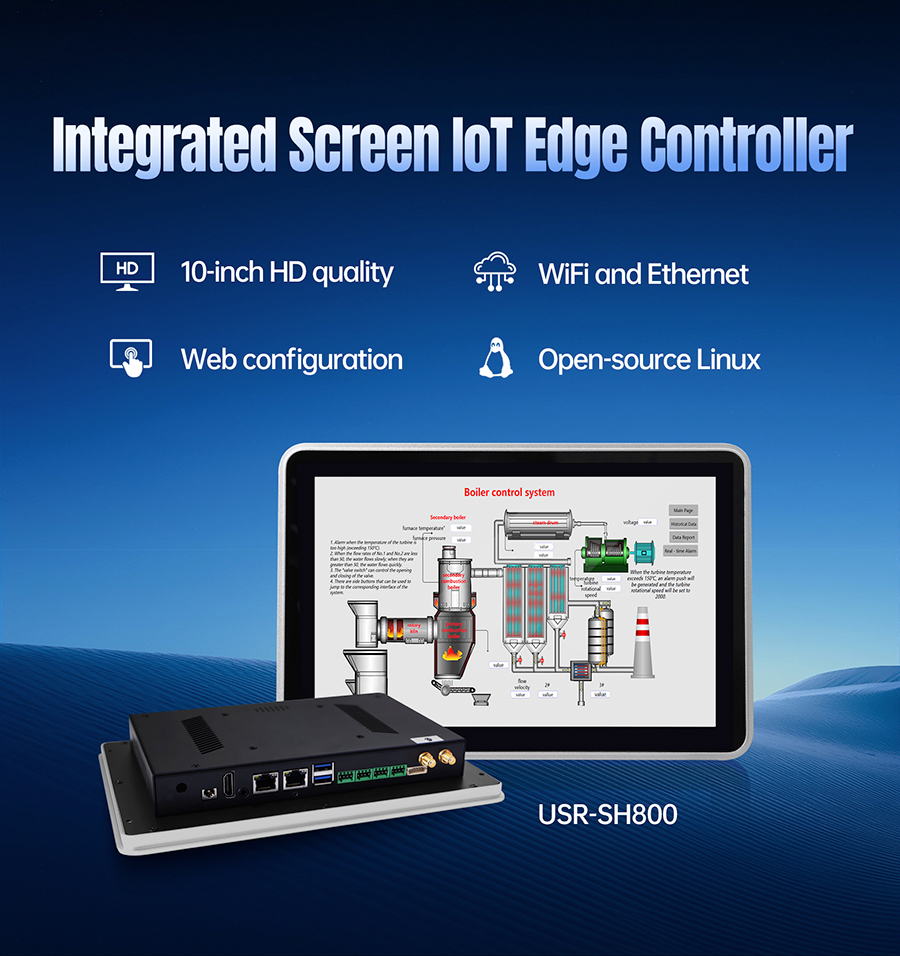
The USR-SH800 is equipped with an RK3568 quad-core processor and 1.0 TOPS AI computing power, enabling three major edge functions:
Data Preprocessing: Filters outliers and compresses data locally, reducing cloud transmission volume by 30%.
Protocol Conversion: Supports over 200 industrial protocols such as Modbus, CAN, and BACnet, seamlessly integrating with legacy equipment.
Real-Time Control: Automatically triggers equipment actions based on threshold rules (e.g., starting fans when temperature exceeds 35°C), with response times below 100 milliseconds.
In a citrus orchard in Sichuan, the USR-SH800 reduced irrigation decision time from 15 minutes to 3 seconds through edge computing, improving water efficiency by 45%.
Through its built-in WukongEdge edge application platform, the USR-SH800 supports drag-and-drop configuration design:
Multi-Dimensional Dashboards: Integrates parameters such as temperature, humidity, light, and CO₂ concentration to generate dynamic curves and heatmaps.
Device Status Mapping: Converts the operational status of fans, sunshades, and other equipment into visual icons, supporting click-to-operate functionality.
3D Digital Twins: Constructs virtual greenhouses using Three.js, allowing real-time sensor data to be viewed by clicking on any area.
In a smart agriculture demonstration zone in Shandong, key metrics displayed on a large-screen command center improved management decision efficiency by 60% and reduced inspection time by 80%.
The USR-SH800 integrates an LSTM neural network prediction model to implement three early warning mechanisms:
Threshold Early Warning: Automatically sends irrigation reminders to a mobile app when soil moisture falls below 40%.
Trend Early Warning: Predicts temperature changes over the next 24 hours and generates proactive strategies (e.g., "Suggest opening sunshades at 2 p.m. tomorrow when temperature reaches 38°C").
AI Diagnostic Early Warning: Identifies crop leaf lesions through cameras, combines environmental data to determine pest and disease types, and sends prevention plans.
In a wheat base in Henan, the AI early warning system reduced pest and disease incidence by 65% and pesticide use by 38%.
In greenhouses, the USR-SH800 connects to over 200 sensors via 4G/LoRa networks, enabling:
Precise Environmental Control: Automatically links fans, wet curtains, and supplemental lights when temperature and humidity exceed thresholds, keeping environmental fluctuations within ±1°C.
Smart Irrigation and Fertilization: Dynamically adjusts the flow rate of water-fertilizer integrated machines based on soil EC values and crop nutrient requirements, increasing nitrogen fertilizer utilization from 30% to 65%.
Energy Consumption Optimization: Generates irrigation strategies during off-peak electricity hours by analyzing historical data, saving over 20,000 yuan in annual electricity costs.
In a strawberry plantation in Liaoning, precise environmental control increased fruit sugar content by 8% and selling prices by 25%.
In large-scale farmland, the USR-SH800 connects to soil moisture monitoring stations via LoRa networks, enabling:
Zonal Irrigation Management: Automatically adjusts irrigation pump flow rates based on soil moisture in different plots, increasing irrigation water utilization from 50% to 85%.
Disaster Early Warning Response: Combines meteorological satellite data to provide 72-hour advance warnings of rainstorms, droughts, and other disasters, guiding farmers in taking protective measures.
Yield Prediction Analysis: Predicts wheat ear count per acre and thousand-grain weight based on parameters such as plant height and stem diameter, with an error rate below 5%, providing a basis for harvest and storage plans.
In a rice base in Heilongjiang, the yield prediction system reduced the risk of post-harvest oversupply by 70%.
In livestock barns, the USR-SH800 connects to ammonia sensors and smart cameras via 4G networks, enabling:
Air Quality Control: Automatically activates exhaust fans and spray dust suppression systems when ammonia concentration exceeds 25 ppm, reducing the incidence of respiratory diseases.
Behavior Analysis Early Warning: Uses AI to identify abnormal feeding and lying behaviors in livestock, enabling early detection of disease signs.
Traceability Management: Records data such as feed delivery and vaccine administration, generating unique traceability codes to enhance product premium capabilities.
In a dairy farm in Inner Mongolia, air quality control increased milk yield per cow by 12%, generating additional annual revenue of over 500,000 yuan.
As 5G and digital twin technologies mature, agricultural IoT will enter a new phase:
Omni-Domain Sensing: Constructs 3D models of greenhouses using UWB + laser SLAM fusion solutions, achieving precise synchronization between virtual and physical worlds.
Autonomous Decision-Making: Systems automatically optimize environmental parameters based on crop growth models using reinforcement learning algorithms, reducing manual intervention.
Energy Internet: Interacts bidirectionally with power grids, automatically adjusting electricity usage strategies based on photovoltaic output forecasts and prioritizing clean energy use.
When the screen of the USR-SH800 lights up, temperature and humidity curves intertwine with crop growth models, reconstructing the underlying logic of agricultural production—from "fuzzy management" reliant on experience to "precision decision-making" based on data; from "firefighters" passively responding to disasters to "smart stewards" proactively preventing risks. In this transformation, the industrial panel PC is not just a technological tool but a bridge connecting agricultural practitioners to the digital world. When every crop has its own "digital life," the blueprint for rural revitalization will finally transition from imagination to reality.