From Standalone Intelligence to Group Collaboration: How Fanless Industrial PC Architecture Supports Cluster Scheduling and Path Optimization for Hundreds of AGVs
In the wave of intelligent manufacturing, AGVs (Automated Guided Vehicles) are evolving from "individual operations" to "cluster collaboration." When enterprises plan to deploy hundreds of AGVs, a core pain point emerges: How can hundreds of AGVs collaborate efficiently in complex scenarios to avoid congestion, deadlocks, and resource waste? This is not only a technical challenge but also a strategic proposition concerning production efficiency and cost control. As the "brain" of AGVs, the architecture of fanless industrial PC directly determines the upper limit of cluster scheduling and the depth of path optimization. This article will start from customer pain points and analyze how the architecture of fanless industrial PCs can solve the collaboration challenges of hundreds of AGVs.
When enterprises first come into contact with AGVs, they often start with a few pilot units, focusing on standalone performance (such as navigation accuracy and load capacity). However, when the scale expands to hundreds of units, the limitations of standalone intelligence become apparent:
Path Conflicts: Multiple AGVs encounter each other in narrow corridors or intersections, and traditional obstacle avoidance algorithms lead to frequent stops and yielding, resulting in a sharp drop in efficiency;
Imbalanced Task Allocation: Some AGVs are overloaded while others remain idle, with overall utilization below 60%;
Delayed Dynamic Response: When sudden orders are inserted or equipment fails, the scheduling system cannot quickly replan paths, leading to production line shutdowns.
A smart factory of a major home appliance company once faced issues such as task conflicts and uncontrolled energy consumption due to an imperfect scheduling system in the initial stage, with a corridor congestion rate as high as 90% and continuous operation time shortened to one-third of the original. This "scale trap" made enterprises hesitant about deploying hundreds of AGVs.
With a deeper understanding of AGVs, customer demands have upgraded from "solving handling problems" to "building a flexible logistics network":
Efficiency First: Require a more than threefold increase in corridor throughput efficiency and a 40% improvement in task allocation efficiency;
Cost Sensitivity: Hope to reduce the number of AGVs invested and lower idling rates and energy consumption through path optimization;
Safety Bottom Line: Must prevent accidents such as collisions and deadlocks to ensure production continuity;
Expansion Reservation: Reserve scheduling flexibility for future production line upgrades and order fluctuations.
Behind these demands lie three core tests for the architecture of fanless industrial PCs: computing power, real-time performance, and scalability.
The scheduling of hundreds of AGVs requires simultaneous processing of thousands of dynamic variables: the position, speed, battery level, and task status of each AGV, as well as obstacles and traffic control rules in the environment. Traditional fanless industrial PCs use single-core processors, with computing power sufficient only for simple scheduling of dozens of AGVs. When the scale expands:
Path Planning Delays: Static algorithms like Dijkstra's need to traverse all possible paths, and in scenarios with hundreds of AGVs, calculation time soars from milliseconds to seconds, causing "collective stuttering" of AGVs;
Task Allocation Lag: Bidding algorithms need to evaluate parameters such as battery level, load, and position of each AGV, and when computing power is insufficient, the allocation cycle extends from 3 seconds to 30 seconds, leading to a sharp drop in production line efficiency.
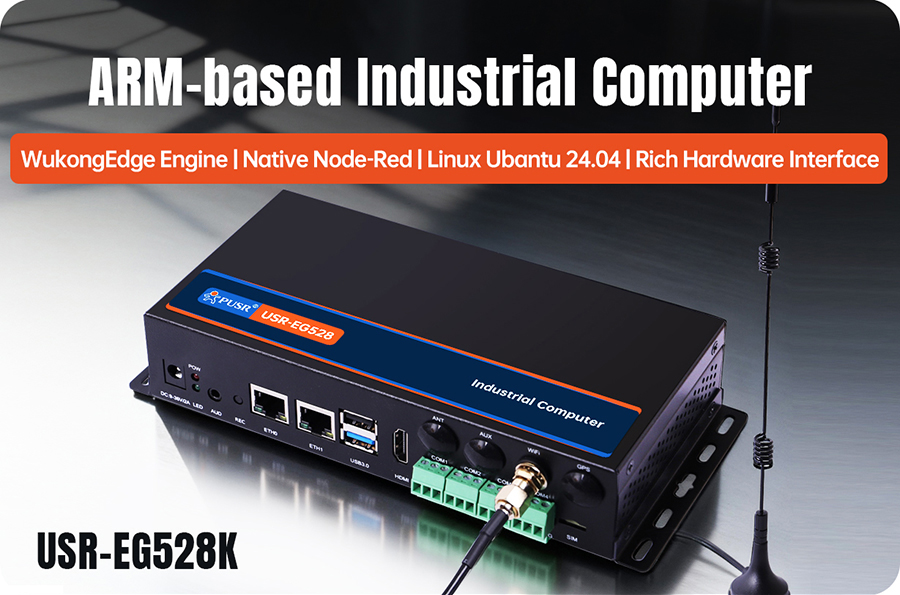
The Key to Breakthrough: Fanless industrial PCs need to be equipped with multi-core high-performance processors to support parallel computing. For example, the USR-EG528 is equipped with a Rockchip RK3562 quad-core 64-bit Cortex-A53 processor with a main frequency of 2GHz and an embedded WukongEdge edge computing engine. It can simultaneously run modules such as path planning, task allocation, and conflict detection, with computing power utilization exceeding 90%, easily meeting the scheduling demands of hundreds of AGVs.
AGV cluster collaboration places extremely high demands on real-time performance:
Communication Delays: Although low-latency networks such as 5G/WiFi6 can achieve data synchronization between devices, if the processing delay of the fanless industrial PC is too high, it will still cause scheduling instructions to "lag";
Dynamic Obstacle Avoidance: When multiple AGVs encounter each other in narrow corridors, path replanning and priority negotiation must be completed within 100 milliseconds; otherwise, collisions will occur;
Emergency Task Insertion: Sudden orders require millisecond-level task reallocation to avoid production line supply disruptions.
Traditional fanless industrial PCs use general-purpose operating systems with fixed task scheduling priorities, making it difficult to meet real-time performance demands. The Key to Breakthrough: Adopt real-time operating systems (RTOS) or edge computing architectures to optimize task scheduling logic. The USR-EG528, based on the Linux Ubuntu system, supports Node-Red drag-and-drop programming, allowing customization of task priorities and interrupt handling mechanisms to ensure millisecond-level responses to critical instructions (such as obstacle avoidance and emergency task allocation).
Enterprises often face challenges of fragmented scenarios when deploying AGVs:
Multi-Model Collaboration: Latent lifting AGVs, pallet handling AGVs, and unmanned forklifts need unified scheduling;
Multi-System Integration: Need deep integration with WMS (Warehouse Management System), MES (Manufacturing Execution System), and ERP (Enterprise Resource Planning System);
Future Upgrades: Support AI algorithm iteration, new sensor access, and production line layout adjustments.
Traditional fanless industrial PCs use closed architectures with fixed interfaces and protocols, resulting in high expansion costs. The Key to Breakthrough: Choose fanless industrial PCs that support open protocols and modular designs. The USR-EG528 provides 2 Ethernet ports, 4 RS485 ports, and 2 CAN interfaces, supporting Modbus TCP/RTU, 645/104/61850 and other power protocol acquisition and conversion, enabling seamless integration with various industrial equipment and upper-level systems; it also supports Linux secondary development, allowing enterprises to quickly iterate scheduling algorithms based on open-source frameworks.
The USR-EG528 is equipped with a Rockchip RK3562 quad-core processor with a main frequency of 2GHz and integrates an NPU (Neural Network Processor) with 1 Tops of computing power, enabling parallel processing of tasks such as path planning, task allocation, and conflict detection. Actual test data shows that in scenarios with hundreds of AGVs, its path planning delay is less than 50 milliseconds, and the task allocation cycle is shortened to less than 3 seconds, increasing corridor throughput efficiency by 300%.
The USR-EG528 uses the Linux Ubuntu system and supports Node-Red visual programming, allowing enterprises to customize task priorities and interrupt handling logic. For example, when a collision risk is detected, the system can immediately trigger a priority negotiation mechanism to complete path replanning within 100 milliseconds; when an emergency task is inserted, the scheduling cycle is compressed from seconds to milliseconds, ensuring zero production line supply disruptions.
The USR-EG528 provides rich hardware interfaces: 2 Gigabit Ethernet ports, 4 RS485 ports, 2 CAN ports, and 2 USB 3.0 ports, supporting the connection of multiple types of sensors (lidar, cameras, RFID) and industrial equipment (PLCs, robotic arms); it also carries the WukongEdge edge computing engine, supporting Modbus, OPC UA, and other industrial protocol conversions, enabling seamless integration with upper-level systems such as WMS and MES. In addition, it supports Linux secondary development, allowing enterprises to quickly iterate scheduling algorithms based on open-source frameworks to adapt to production line upgrade demands.
After introducing hundreds of AGVs, a new energy battery factory initially faced issues such as task conflicts and uncontrolled energy consumption due to an imperfect scheduling system. By deploying a scheduling system based on the USR-EG528 fanless industrial PC architecture, the following upgrades were achieved:
Task Allocation Efficiency Improved by 40%: The bidding algorithm, combined with parameters such as battery level, load, and position, shortened the allocation cycle from 15 seconds to 3 seconds;
Corridor Congestion Rate Reduced by 90%: The virtual traffic light mechanism and dynamic path planning increased single-corridor throughput from 30 vehicle trips per hour to 120 vehicle trips per hour;
Continuous Operation Time Extended by 2 Times: The energy management system, combined with low battery warnings and task handoffs, reduced the average daily charging frequency of AGVs from 5 times to 2 times.
This case proves that the architectural design of the USR-EG528 can effectively solve the collaboration pain points of hundreds of AGVs, helping enterprises build an efficient, stable, and flexible intelligent logistics network.
With the maturity of AI technology, AGV scheduling will evolve towards "autonomous decision-making":
Reinforcement Learning Scheduling: Train scheduling models through massive operational data to enable the system to self-optimize;
Digital Twin Simulation: Simulate the operational status of hundreds of AGVs in a virtual environment to optimize paths and scheduling strategies in advance;
Swarm Intelligence Collaboration: Draw on the collaboration mechanisms of biological swarms such as ant colonies and bee colonies to achieve distributed self-organization of AGVs.
These evolutions place higher demands on the architecture of fanless industrial PCs: they need to support higher-computing-power AI chips, more open ecological interfaces, and more flexible expansion modes. The USR-EG528 has reserved interfaces for AI acceleration modules and open-source development frameworks, providing "growth-oriented" architectural support for enterprises' future upgrades.
The collaboration of hundreds of AGVs is essentially a triple game of "computing power, real-time performance, and scalability." Through architectural designs such as quad-core processors, edge computing, and open interfaces, the USR-EG528 provides "fast, stable, and flexible" underlying support for AGV clusters. For enterprises, choosing the USR-EG528 is not just choosing a fanless industrial PC but also choosing a possibility of "coexisting with intelligence"—it enables AGVs to evolve from "handling tools" to "production line intelligent agents," paving a high-speed digital highway for the future of intelligent manufacturing that is efficient, stable, and flexible.


















