Breaking Free from the "Fence Dilemma": How Fanless Industrial PC Reshape Security Defenses with AI Vision
In the monitoring center of a large logistics park, on-duty staff member Lao Zhang stared at the flashing alarm messages on the screen, his brow furrowed. The system indicated that a freight truck had triggered an abnormal alarm while passing over the weighbridge, yet there was nothing unusual about the truck's appearance in the surveillance footage. Such "false alarms" occurred almost daily—be it the wind rustling the fence, small animals passing by, or even just changes in light, all could set off the shrill alarms of traditional monitoring systems. Lao Zhang and his colleagues had to spend a significant amount of time verifying these "wolf is coming" signals, potentially overlooking real security risks in the process.
This scenario is far from unique. In critical areas such as industrial parks, borderlines, and power facilities, fences serve as the first line of physical defense, with their security directly relating to the safety of personnel, property, and even national interests. However, traditional fence monitoring systems are trapped in a dilemma characterized by "high false alarm rates, significant risks of missed detections, and delayed responses." How can this dilemma be broken? The integration of fanless industrial PC and AI vision is bringing about a revolutionary change in fence security.
In the transportation tunnel of a coal mine, the false alarm rate of the traditional infrared intrusion detection system reached as high as 40%. Seagulls flying by, equipment vibrations, or even sunlight refraction could trigger alarms, leading to a crisis of trust among security personnel akin to the "boy who cried wolf." More seriously, a steel enterprise suffered an emergency production halt due to a false alarm, resulting in a single loss exceeding 2 million yuan. This crude model of "better to err on the side of caution" is consuming corporate resources and trust.
On a certain borderline, traditional sensors failed to detect an illegal crossing due to sand and dust obstruction, ultimately leading to a serious security incident. Such cases expose fatal flaws in traditional technology:
Spatial blind spots: Fixed sensors struggle to cover three-dimensional spaces. In a warehouse fire, the system only detected flames on the ground but missed the spreading fire on the top of shelves.
Temporal blind spots: Equipment aging initially manifests as a gradual decline in performance. Traditional detection methods can only respond when the fault becomes obvious, by which time the damage is often irreparable.
Scenario blind spots: In special environments like waste incineration plants, traditional devices cannot distinguish between real flames and reflected light from high-temperature furnace walls, resulting in a missed detection rate as high as 35%.
Although the inspection system of a certain power company could identify fence breaches, it required manual confirmation before manually activating the alarm device, taking more than 3 minutes from detection to handling. This fragmented state of "detection-alarm-handling" exposes three major flaws:
Data silos: Video surveillance and sensor data belong to different systems and cannot be cross-verified.
Response delays: Cloud-based analysis models result in network transmission delays. In a certain offshore platform project, system response time reached as long as 12 seconds due to satellite link delays.
Maintenance dilemmas: Traditional devices lack self-diagnostic capabilities. In a certain power plant project, sensor aging led to a 70% decrease in detection sensitivity, of which the operation and maintenance personnel were completely unaware.
The AI vision system based on the USR-EG228 fanless industrial PC constructs a three-dimensional protection system through a here means three-dimensional, but as it's followed by "perception network," it might be better to translate it as "stereoscopic" for smoother reading, though "three-dimensional" is also accurate) perception network of "visible light + infrared + radar":
Visible light cameras: Capture the dynamic forms of personnel and use the YOLOv8 algorithm to identify the flickering frequency of target edges, distinguishing real targets from interference sources.
Infrared thermal imaging: Detect the surface temperature distribution of objects. In a certain power plant project, infrared image analysis helped identify overheating risks in cable joints 2 hours in advance.
Millimeter-wave radar: Penetrate obscurants such as dust and rain fog. In a certain coal mine project, it achieved precise ranging within a 500-meter range with a false alarm rate below 0.3%.
This multi-modal fusion technology enables the system to simultaneously obtain information on the shape, temperature, and distance of targets. In a test at a logistics park, the system successfully identified a vehicle crossing the boundary obscured by thick smoke, while traditional devices completely failed.
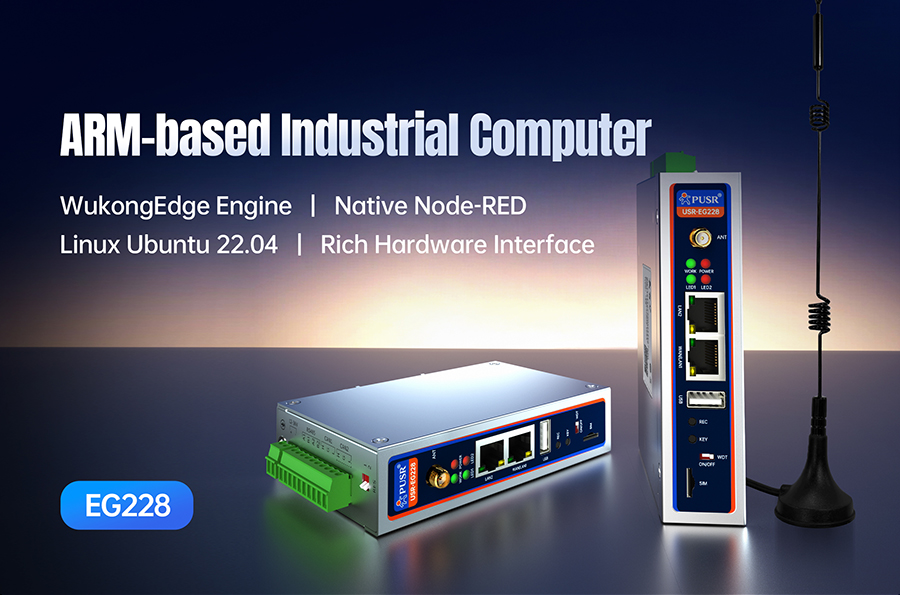
The RK3506J processor and NPU neural network accelerator equipped on the USR-EG228 deploy AI reasoning capabilities directly at the device end:
Localized processing: In a certain port project, localized processing reduced cloud transmission volume by 70%, shortening response time from 3 seconds to 200 milliseconds.
Dynamic threshold adjustment: Through reinforcement learning algorithms, the system can automatically adjust detection parameters based on environmental changes. In a certain coal mine project, the system dynamically optimized algorithm models according to the dust concentration and lighting conditions in different tunnels, improving detection accuracy by 35%.
Lightweight models: Using model compression techniques, the YOLOv8 model volume was reduced from 216MB to 28MB, allowing it to run smoothly in the 4GB memory of the USR-EG228 while maintaining 95% detection accuracy.
This edge computing architecture not only solves network delay issues but also enables the system to operate offline. In a hydropower plant project in a remote mountainous area, the system continued to monitor fence breach risks even during satellite link interruptions.
The unique advantage of the USR-EG228 lies in its integrated PLC control function, which can directly interface with actuators such as fire extinguishing devices and sound and light alarms:
Protocol compatibility: Built-in with over 100 industrial protocols, it can seamlessly connect with mainstream PLCs from Siemens, Mitsubishi, etc. In a certain automobile factory project, direct linkage between the detection system and automatic sprinkler devices was achieved through the Modbus protocol.
Logic control: Supports IEC 61131-3 standard programming, enabling the writing of complex control logic. In a certain warehousing project, the system automatically selected the optimal handling plan based on parameters such as cargo type and environmental wind speed.
Remote operation and maintenance: Through the UCloud platform, device status monitoring, firmware upgrades, and remote parameter adjustments can be achieved. A certain multinational enterprise simultaneously operates and maintains over 500 detection sites worldwide through a unified management platform.
This closed-loop control capability upgrades the system from "passive detection" to "active prevention and control." In a test at a data center, the system activated the alarm device within 0.5 seconds after detecting a boundary violation, minimizing losses.
The practice of a certain medium-sized logistics enterprise provides an answer:
Hardware costs: Adopting the USR-EG228 instead of a combination of traditional fanless industrial PCs, PLCs, and gateways reduced equipment procurement costs by 40%.
Operation and maintenance costs: The system's self-diagnostic function reduced on-site inspection frequencies, lowering annual maintenance expenses by 60%.
Risk costs: After the system went online, the response time to fence breaches shortened from 3 minutes to 20 seconds, avoiding losses exceeding 10 million yuan annually.
This model of "one-time investment + long-term benefits" enabled the project's ROI to reach 200% within 18 months.
The practice of a certain power group offers valuable insights:
Data verification: Before system deployment, retrospective testing was conducted using historical data (including 100,000 images and 2,000 real boundary violation incidents) to ensure a detection accuracy rate of ≥99%.
Scenario adaptation: Special optimizations were made for working conditions such as high dust levels and strong electromagnetic interference. In a certain coal mine project, explosion-proof design + lens cleaning devices enabled stable operation in environments with a dust production rate of 500g/m3.
Redundancy design: A dual-camera + dual-fanless industrial PC architecture was adopted to ensure system operation despite single-point failures. In a certain nuclear power plant project, this design achieved 99.999% system availability.
These measures increased customer trust in AI technology from an initial 30% to over 90%.
The experience of a certain intelligent manufacturing enterprise is worth referencing:
Modular deployment: Adopting a "core system + industry plugin" model, a certain automobile factory project completed system deployment in just 3 days, 80% faster than traditional solutions.
Gradual upgrades: Starting with pilot deployments in key areas before gradual expansion. A certain petrochemical enterprise first deployed the system in the tank farm area, verified its effectiveness, and then promoted it throughout the entire plant.
Ecosystem collaboration: Establishing partnerships with system integrators and algorithm suppliers. In a certain project, the technological strengths of three suppliers were integrated to optimize the entire process from detection to handling to review.
This "small steps, fast pace" strategy reduced project implementation risks by 70%.
In the era of Industry 4.0, fence monitoring is no longer just a compliance cost for enterprises but an important component of their core competitiveness. The integration of the USR-EG228 fanless industrial PC and AI vision technology not only solves the pain points of traditional detection but also creates new value dimensions:
Production efficiency: A certain electronics factory increased production capacity by 15% by reducing downtime caused by false alarms.
Brand value: A certain food enterprise obtained international safety certifications with a zero boundary violation accident record, enhancing its product premium capability by 20%.
ESG performance: A certain energy enterprise reduced fire risks and carbon emissions, elevating its ESG rating to Class A.
These cases reveal a truth: In the field of fence security, the value of technological progress lies not only in avoiding losses but also in creating value. When fences have "wise eyes," enterprises gain not just a security defense line but also a key to unlocking future competitiveness.


















