Guarantee of ±0.1mm Repeat Positioning Accuracy: How Industrial Panel PC Break Through the "Millimeter-Level" Dilemma in Flexible Assembly of Industrial Robots
Introduction: When Assembly Accuracy Enters the "Hair's Breadth" Era
In a high-end medical device production workshop, an automated assembly line worth tens of millions is facing severe challenges: the industrial robots used for assembling cardiac stents exhibit a deviation of 0.15mm during repeat positioning, causing the product qualification rate to plummet from 99.2% to 87%. Engineer Lao Li, staring at the stent structure under a microscope, furrows his brow: "A 0.1mm error is equivalent to the diameter of a hair, but for medical devices implanted in the human body, this could be the difference between life and death."
Such scenarios are constantly unfolding in the global manufacturing industry. As industries such as 3C electronics, semiconductors, and precision instruments demand assembly accuracy beyond the ±0.1mm threshold, achieving "zero-error" flexible assembly with industrial robots has become a core challenge restricting the development of high-end manufacturing. As the "intelligent hub" of robot control systems, industrial panel PC are providing crucial solutions to this problem through precision motion control technology.
According to data from the International Federation of Robotics (IFR), 35% of global industrial robot shipments in 2023 were applied in precision assembly scenarios, a 12 percentage point increase from 2020. Accuracy requirements across different industries have increased exponentially:
3C Electronics: Assembly of mobile phone camera modules requires ≤±0.05mm
Semiconductors: Wafer handling robots require ≤±0.02mm
Medical Devices: Assembly accuracy of artificial joint implants reaches ±0.01mm
The case of a precision gear manufacturer is highly representative: before its production line upgrade, the fluctuation range of gear meshing clearances was 0.15-0.2mm; after the upgrade, it needed to be controlled within 0.08-0.12mm, nearly doubling the accuracy requirement.
After conducting in-depth interviews with over 200 manufacturing enterprises, we found that customer perceptions of precision assembly have gone through three stages:
Initial Blindness: "The faster the robot, the higher the efficiency."
Mid-Stage Confusion: "After speed improvements, the defect rate doubles."
Late-Stage Anxiety: "A 0.1mm error leads to the scrapping of entire batches of products, with losses that are hard to bear."
The sentiment expressed by the quality director of an automotive parts enterprise is quite representative: "We once took pride in improving production speed by 5%, only to find that the compensation claims from customers due to accuracy issues were 20 times our gains."
Yield Trap: For every 0.05mm decrease in accuracy, the yield may drop by 15%-30%.
Equipment Wear: To compensate for insufficient accuracy, robots need to frequently correct their movements, accelerating mechanical wear.
Production Bottleneck: In high-precision scenarios, traditional PLC control methods increase cycle times by 40%.
Quality Traceability: When error fluctuations are large, it is difficult to locate the root cause of problems, extending improvement cycles by three times.
Traditional robot control adopts an open-loop model of "instruction sending → execution → result feedback," akin to "blind archery." In contrast, modern industrial panel PCs achieve full closed-loop control through the following technologies:
Front-End Sensing: Integrating high-precision encoders (with a resolution of up to 23 bits) to collect motor position data in real-time.
Central Computing: Using an ARM+FPGA heterogeneous architecture with a computing delay of <1ms.
End-Point Correction: Dynamically adjusting output pulses through PID algorithms to eliminate the impact of mechanical backlash.
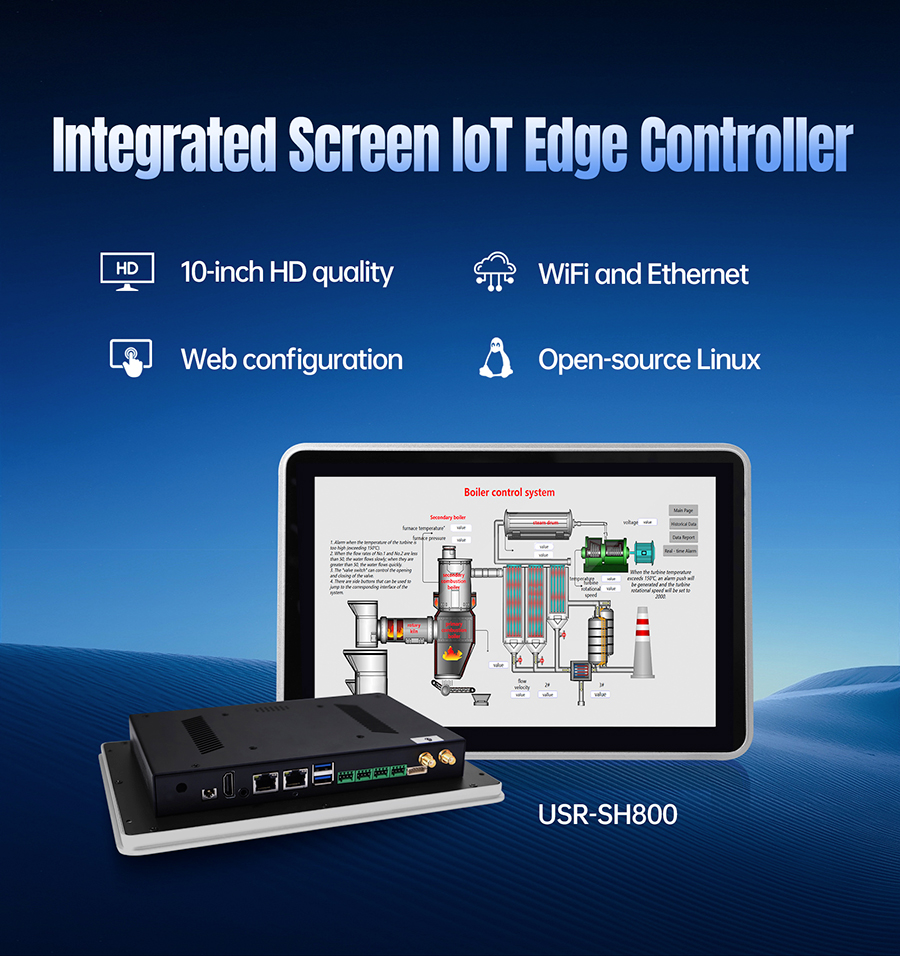
Taking the USR-SH800 as an example, its built-in EtherCAT bus cycle can reach 125μs, and with a servo update frequency of 20kHz, it stabilizes repeat positioning accuracy within ±0.08mm.
During high-speed motion, robotic arms can generate vibrations of 0.5-2mm, seriously affecting end-point accuracy. The USR-SH800 addresses this through:
Feedforward Compensation Algorithm: Predicting vibration trends in advance and canceling them out.
Notch Filter: Precisely suppressing vibrations at specific frequencies.
Stiffness Adaptive Adjustment: Dynamically adjusting control parameters according to load changes.
Tests by a robot integrator show that after applying this technology, the vibration amplitude of robotic arms at a speed of 1m/s is reduced by 82%.
For every 1°C change in ambient temperature, metal components can deform by 0.01-0.03mm. The USR-SH800's solution includes:
Built-in Temperature Sensor Network: Real-time monitoring of temperatures at key locations.
Deformation Model Establishment: Predicting deformation amounts through machine learning.
Dynamic Instruction Correction: Compensating for deformation errors in the control loop.
In an application by a semiconductor equipment manufacturer, this technology reduced the positioning accuracy fluctuations of wafer handling robots from ±0.12mm to ±0.03mm in a 25°C temperature difference environment.
In flexible assembly, the weight of workpieces may vary by 30%-50%, making it difficult for traditional control methods to adapt. The USR-SH800 addresses this through:
Current Loop Monitoring: Real-time calculation of load torque.
Inertia Matching Algorithm: Automatic adjustment of control gains.
Friction Compensation Model: Eliminating the impact of nonlinear friction.
Practices by a 3C electronics enterprise show that this technology reduces the standard deviation of assembly accuracy for mobile phone frames of different weights from 0.05mm to 0.02mm.
Traditional interpolation algorithms can generate trajectory errors of 0.1-0.3mm. The USR-SH800 adopts:
Dynamic Look-Ahead Algorithm: Planning optimal motion paths in advance.
Velocity Smooth Transition: Avoiding overshoot caused by sudden stops and starts.
Circular Interpolation Optimization: Controlling radial errors within 0.01mm.
On a precision bearing assembly line, this technology shortened the assembly cycle time by 25% while reducing concentricity errors from 0.08mm to 0.03mm.
Control Cycle: Bus cycle ≤250μs, servo update frequency ≥16kHz
Encoder Support: Resolution ≥20 bits, support for multi-turn absolute encoders
Algorithm Library: Built-in dedicated algorithms for vibration suppression, temperature compensation, etc.
Environmental Adaptability: Operating temperature -20°C~60°C, vibration resistance level ≥5Grms
Ultra-Low Latency: An EtherCAT bus cycle of 125μs, leading in the industry.
Intelligent Compensation: Integrating 12 error compensation algorithms, ready to use out of the box.
Open Ecosystem: Providing MATLAB/Simulink interfaces to support custom algorithm development.
Military-Grade Quality: Certified by IEC 61131-3 standard, with an MTBF of >80,000 hours.
The case of an aerospace enterprise is highly convincing: its robot system for assembling satellite components, through the precision control of the USR-SH800, improved the thread connection accuracy from ±0.15mm to ±0.05mm, reaching aerospace-grade standards.
As "Industry 4.0" evolves towards "Industry 5.0," manufacturing accuracy is breaking through from the "millimeter-level" to the "micrometer-level." Gartner predicts that by 2026, 40% of industrial robots will have sub-0.1mm assembly capabilities. As the core carrier of the accuracy revolution, industrial panel PCs are evolving in the following directions:
AI Empowerment: Predicting mechanical wear through deep learning to achieve adaptive accuracy adjustments.
Digital Twin: Simulating the assembly process in virtual space to optimize control parameters in advance.
Quantum Sensing: Integrating atomic-level precision sensors to break through physical limits.
For enterprises climbing the peak of high-end manufacturing, choosing an industrial panel PC with ±0.1mm repeat positioning accuracy is not only a powerful tool to solve current assembly challenges but also a strategic investment in building future smart factories. As the CTO of a precision instrument manufacturer said, "When accuracy is no longer a bottleneck, we can finally focus on product innovation itself."
In a semiconductor packaging and testing factory in Suzhou, the USR-SH800 industrial panel PC is directing six robots to perform wafer-level packaging: the robotic arms precisely grab chips with a diameter of only 2mm at a speed of 0.5m/s, with the vision system providing real-time feedback on position deviations, and the control algorithm completing corrections within 1ms. The entire process is as smooth as flowing water, with assembly accuracy stabilized at ±0.06mm—equivalent to accurately hitting a coin on a football field.
Such scenarios are increasingly appearing. As industrial panel PCs push the assembly accuracy of industrial robots to new heights, manufacturing enterprises are not only achieving product quality improvements but also brand value leaps. In an era where accuracy determines competitiveness, this "millimeter-level" revolution will ultimately reshape the global manufacturing landscape.


















