From Hazardous Operations to Unmanned: How Industrial PC Computer Turn AGVs Into "Safety Guardians" for the Oil and Gas Industry
Last winter, at an oil and gas station in Tarim, a veteran team leader with twenty years of experience said something to me.
He said: "Xiao Chen, you know what I fear most? It's not the fatigue, it's not the cold. It's when you walk into the tank farm and don't know—with the next step—whether the ground beneath you is solid or hollow."
The "hollow" he meant was a gas accumulation layer formed by an underground pipeline leak. Invisible to the naked eye, undetectable by smell—at low concentrations, hydrogen sulfide and methane mix together, paralyzing the olfactory sense. By the time you smell it, it's already too late.
That winter, there were three poisoning incidents among inspection personnel in the Northwest Oilfield. Two were saved. One wasn't.
I asked the team leader: "What if no one goes in?"
He paused, then gave a bitter smile: "We tried robots. They lost connection three minutes into the tank farm. When they came out, the cameras were all fogged up—couldn't see a thing. Then the boss said: send the people in."
When he said "send the people in," his tone wasn't brave—it was resignation.
I remembered that sentence for a long time. Because it precisely describes the biggest barrier to unmanned operations in the oil and gas industry—it's not that the technology isn't good enough. It's that the trust isn't there. If you send a machine into the tank farm instead of a person, it has to be more reliable than a person. Even a little less won't do.
And the confidence to be "more reliable than a person" ultimately comes down to something most people overlook: that unremarkable industrial PC computer sitting inside the AGV's belly.
Let's do the math first.
A medium-sized oil and gas station conducts tank farm inspections at least four times a day, two people per inspection, with roughly 40 minutes of exposure risk per person per inspection. Over a year, the cumulative exposure time for inspection personnel in hazardous areas exceeds 1,900 person-hours.
According to oil and gas industry safety statistics, the probability of a major accident per 100,000 person-hours of hazardous area work is approximately 0.3–0.5. That means this station alone carries roughly a 0.6%–1% annual probability of a major accident just from inspections.
Doesn't sound high? But it's a probability. And when probability lands on a specific person, it becomes 100%.
That's why oil and gas companies don't not want to use AGVs to replace manual inspections. They've run the numbers: an AGV costs roughly 300,000–800,000 RMB to purchase, with a five-year lifecycle cost of 1–1.5 million RMB. A single major safety accident typically causes direct losses (shutdown, compensation, fines) exceeding 5 million RMB, with indirect losses (reputation, qualifications, downtime duration) incalculable.
From an economic standpoint, AGVs aren't optional—they're mandatory.
So why are they still sending people in?
Because the AGVs of the past couldn't get in.
Not couldn't get through the tank farm gate—couldn't get through the tank farm's "network." Signals couldn't get in, data couldn't get out, video feeds came back all garbled. The moment the connection dropped, the AGV became an unmanaged metal box sitting in the tank farm—more dangerous than a person inside, because a person can run, but it can't.
The oil and gas industry's requirement for AGVs boils down to one thing: it must be safer than a person. And to achieve that, it first must not cause trouble for people.
That line held the entire industry back for three years.
Most people think the core challenge for AGVs is navigation. True—inside a tank farm, pipes are dense, the floor is oily, the lighting flickers. Navigation isn't easy.
But the navigation problem has been largely solved by LiDAR plus SLAM. What truly makes oil and gas companies hesitate are three deeper issues:
The explosion-proof structure of oil and gas tank farms is lethal to wireless signals. 5G attenuates by over 40dB once inside. Wi-Fi vanishes after two walls. LoRa doesn't have enough bandwidth for video. Once an AGV enters the core tank farm area, communication basically depends on "fate."
After disconnection, what does the AGV do? Stop and wait? Keep moving? Sound an alarm on the spot?
If it stops, it blocks the tank farm passage—follow-up vehicles can't enter, the entire logistics chain breaks. If it keeps moving, it can't see the path or receive commands—hitting a pipe means a leak incident. If it alarms on the spot, who rescues it? A person goes in? Then what's the point of not sending a person in in the first place?
Tank farms have steam, fog, oil splatter. A regular camera goes in, and the lens fogs up in three minutes. The AGV's "eyes" go blind—no algorithm in the world can compensate.
Worse, the AGV doesn't just need to "see"—it needs to "understand." It has to distinguish whether the liquid on the ground is water or oil, whether the frost on a pipe is normal condensation or leak icing, whether a valve is fully closed or half-open. This isn't an image recognition problem—it's an edge AI inference problem. It needs to run models locally in real time, not wait for cloud results.
Wait for the cloud? There's no signal in the tank farm—what are you waiting for?
Oil and gas projects have lifecycles starting at ten years, some twenty. The AGV you buy today—in five years, the industrial PC computer is discontinued, the processor is a generation behind, the OS stops getting updates. What then?
Swap the whole unit? The AGVs in a tank farm aren't desktop PCs you unplug and plug back in. Each AGV's deployment, commissioning, and certification cycle takes months. Swap out a batch of industrial PC computers, the entire fleet goes dark for three months—who bears the loss?
On the surface, these three problems look like a communication issue, a vision issue, and a lifespan issue. But dig one layer deeper, and they all point to the same thing: the AGV's "brain"—that industrial PC computer—can it hold up day after day, year after year, in the harshest environment, without ever dropping the ball?
Let's start with a counterintuitive fact: the oil and gas industry was actually among the first to try AGVs. In the 1990s, North Sea oilfields used the earliest AGVs for pipeline inspection. Why did they stop?
It wasn't that the technology failed—it was that the industrial PC computers of the time failed.
Back then, they used ordinary industrial PCs—fan-cooled, wired, running Windows XP. Inside the tank farm, the fan kicked in the moment the temperature rose, the hard drive failed the moment vibration spiked, the system updated every three years, and every update required a shutdown. After two years, the failure rate was so high the ops team was on-site every day—more exhausted than manual inspection.
That's how the oil and gas industry lost trust in AGVs. To win it back, they first had to get the industrial PC computer right.
Today's industrial-grade industrial PC computers are a completely different species from ten years ago.
Take the most core capabilities:
The mainstream communication solution for oil and gas scenarios is now dual-mode or even tri-mode—5G for bandwidth, LoRa for coverage, Wi-Fi as backup. But the key isn't how many modes—it's whether those modes can switch seamlessly inside one machine.
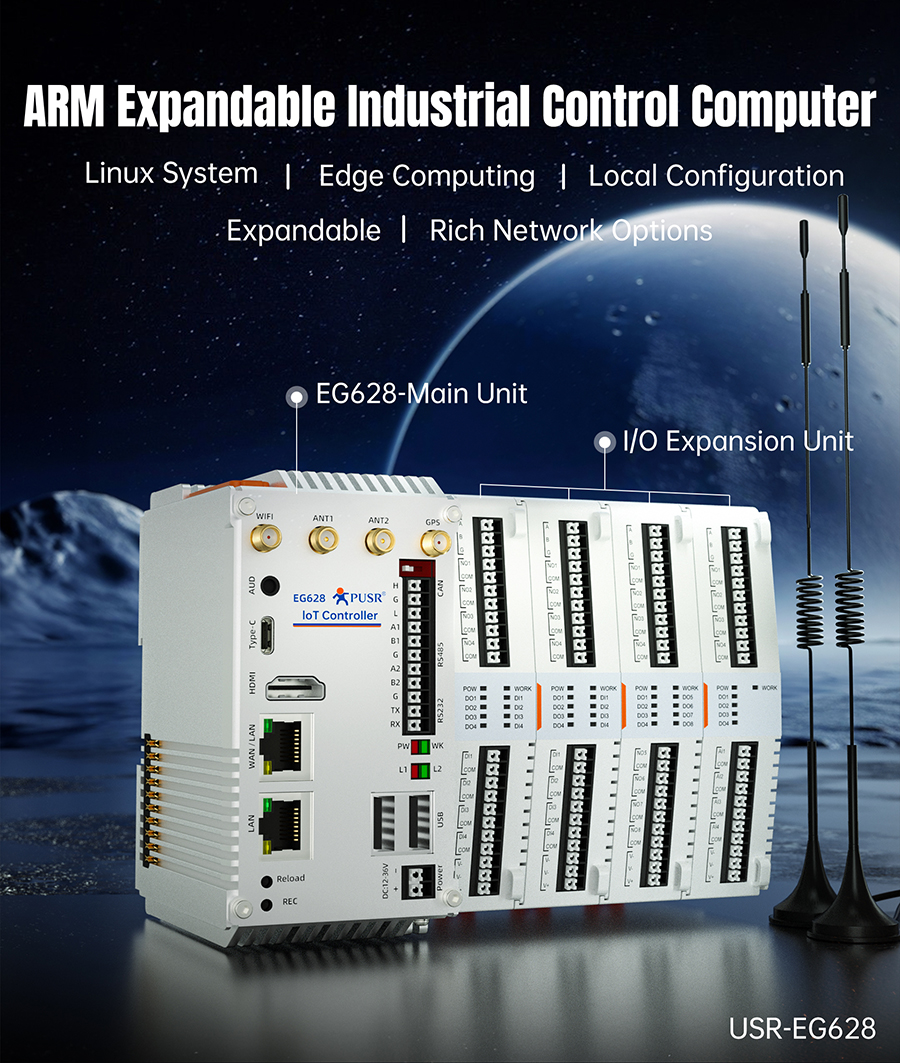
A good industrial PC computer—like the modular USR-EG628 series—doesn't treat 5G and LoRa as two add-on modules. They're two channels within the same I/O architecture. The moment the signal weakens, the edge side switches automatically, with handover time compressed to under 50 milliseconds. The AGV's main control program doesn't even feel the switch—no data loss, no command interruption.
No disconnection entering the tank farm, no jamming leaving it—that's what "more reliable than a person" means.
Today's industrial PC computer isn't just a "box that runs programs"—it's an edge AI platform in its own right. Intel and NVIDIA embedded processors come with hardware-level AI acceleration—not brute-forcing it on the CPU, but dedicated NPU and GPU cores.
What does that mean? It means the footage the AGV's camera captures inside the tank farm doesn't need to be sent to the cloud for analysis. Inference models run locally. Pipe leaks, valve anomalies, liquid pooling on the ground—millisecond-level recognition, millisecond-level decision.
And because of the heterogeneous computing architecture, it can simultaneously process LiDAR point clouds, IMU data, temperature sensors, gas concentration sensors—fusing all sensor data together to make judgments more accurate than any single sensor could.
A person entering a tank farm relies on experience and intuition. An AGV entering a tank farm relies on billions of edge computations per second. On "seeing clearly and understanding," machines no longer lose to humans.
This is the easiest to overlook, but the most important for the oil and gas industry.
A consumer PC has a lifecycle of 3–5 years. An industrial-grade industrial PC computer is designed for 10–15 years. That's not just a spec you label—it requires alignment from chip to system to software.
The processor platform must follow an embedded roadmap—Intel's Edge series, AMD's Ryzen Embedded—not consumer rebadges, but platforms designed for long-term supply with clear ten-year roadmaps. The OS must be a long-term servicing version like Windows 11 Enterprise IoT LTSC—no chasing new features, just stability.
Industrial PC computer manufacturers also need to do one more thing: notify customers two years in advance about the next generation's migration path, giving you time for compatibility validation—so you never suddenly receive an email saying "Your product has been discontinued."
When an oil and gas company buys an AGV, it's not buying a vehicle—it's buying ten years of safety assurance. The lifecycle of the industrial PC computer is the foundation of that assurance.
Oil and gas tank farms are Zone 1 or even Zone 0. All electronic equipment must pass explosion-proof certification.
The traditional approach is to make the entire industrial PC computer explosion-proof—thickened enclosure, sealed treatment, flameproof design. It can be done, but the cost is enormous: double the weight, worse cooling, doubled cost. And if any internal module needs upgrading, the entire explosion-proof certification has to be redone.
The smarter approach now is modular explosion-proofing: the industrial PC computer's core compute module is itself flameproof-rated, while the communication module and I/O modules each carry independent explosion-proof certifications. Want to swap the 5G module? Unplug the old one, plug in the new—no impact on the overall explosion-proof rating.
The USR-EG628 series follows exactly this path—modular I/O, each module certified independently, the assembled unit doesn't need to re-run explosion-proof tests. For oil and gas AGVs, this means you don't have to shut down for three months waiting for certification just because you swapped a communication module.
Explosion-proofing isn't a one-time hurdle—it's a ten-year ongoing ops cost. Get the architecture right, and you can cut that cost in half.
I know what you're thinking.
You're thinking: our station used AGVs for three years—they broke four times, caused two shutdowns, and we ended up switching back to manual. I've heard all this before.
You're thinking: no matter how good the industrial PC computer is, it still loses connection once it enters the tank farm.
You're thinking: who believes in a ten-year lifecycle? We don't even know if this company will still exist in five years.
You're thinking: forget it—manual is manual. If something goes wrong, there's insurance.
I understand all of this. Because three years ago, that veteran team leader in Tarim thought the same way.
But then he told me something else. He said: "Last winter, Xiao Liu went in for an inspection. When he came out, his face was white. I asked him what happened. He said when he got under Tank #3, he suddenly heard a 'hiss' from under his feet. He looked down—the ground was exhaling white vapor. When he ran out, his legs were shaking."
"Xiao Liu is only twenty-four."
You can disbelieve the industrial PC computer. But you can't disbelieve a twenty-four-year-old's shaking legs.
Technology is never the goal. The goal is to stop sending people into the tank farm—to stop twenty-four-year-olds from running out with shaking legs.
And to achieve that, you don't need a more expensive AGV. You need a more right industrial PC computer—one that won't disconnect, won't go blind, won't quit, won't become obsolete inside the tank farm, quietly serving as the "brain" for ten years.
The USR-EG628 series isn't the only option. But its modular architecture, dual-mode communication, embedded long-lifecycle support, and modular explosion-proof design are indeed built for these exact oil and gas pain points.
You don't have to decide today. But you can start by asking yourself one question:
If the answer is "yes"—you're just waiting for the next "hiss."
If the answer is "no more"—what you're missing isn't an AGV. It's an industrial PC computer that gives you the confidence to stop sending people in.
The most expensive thing in a tank farm isn't the oil. It isn't the gas. It's the person willing to walk in.
Letting a machine walk in for him is what this industry owes him.