The "Last Mile" of Environmental Monitoring: How Industrial Panel PCs Break the Data Dilemma of Pollution Sources
In a steel plant in Handan, Hebei, environmental engineer Mr. Zhou stares at the data stream on the monitoring screen. Three days ago, during a rainy night, the 4G signal suddenly cut out, causing three hours of pollution source data loss and nearly resulting in a million-yuan environmental fine for the enterprise. Such scenarios repeat daily in over 2,000 industrial parks nationwide. As environmental regulation shifts from "manpower-based" to "technology-based," ensuring real-time visibility, intelligent control, and value extraction of pollution source data has become a core challenge for both environmental authorities and enterprises.
A chemical park invested millions in a smart monitoring system but fell into the dilemma of "affordable to build but unaffordable to use": 50 monitoring points generate 200GB of data daily, with monthly 4G data costs reaching 120,000 yuan, accounting for 40% of system maintenance expenses. More critically, in remote parks, unstable 4G signals result in data upload success rates below 80%. During sudden environmental inspections, the system often displays "old data" from 15 minutes prior, failing to reflect real-time emissions.
"It's not that we don't want to use smart systems; we're afraid we can't afford or use them properly," said Wang Fang, the group's environmental director, echoing the sentiments of most enterprises. Traditional monitoring systems suffer from three fatal flaws:
High transmission costs: 4G data fees have become unbearable, trapping enterprises in a vicious cycle of "more data, higher costs."
Lack of real-time capability: The average delay from data collection to cloud processing is 3-5 minutes, failing to meet the "second-level response" demands of sudden pollution incidents.
Poor environmental adaptability: In industrial sites with high temperatures, humidity, and strong electromagnetic interference, ordinary monitoring devices fail three times a month on average, skyrocketing maintenance costs.
Environmental authorities also face deep-seated contradictions. A city's ecological environment bureau attempted to deploy a smart monitoring platform but encountered new "data silos" due to incompatible protocols across different manufacturers' devices. When pollution incidents occurred, the system couldn't automatically trace sources, relying instead on manual investigations that took hours. More worryingly, in remote areas, the high cost of satellite communication and unstable 4G signals made data transmission seem "impossible."
Behind this anxiety lies a fundamental contradiction in environmental monitoring: the misalignment between technological advancement and scenario adaptability. While urban smart environmental platforms enjoy the benefits of 5G private networks and edge computing, industrial sites still struggle with the basic challenge of "transmitting data reliably and timely."
In the smart environmental demonstration zone of Taihu Lake Basin, Jiangsu, a monitoring system based on the industrial panel PC USR-SH800 is quietly changing the rules of the game. Through a dual architecture of "4G upload + edge computing," the system achieves three breakthrough innovations:
The USR-SH800 integrates a high-performance edge computing module, performing three core tasks locally:
Real-time threshold control: When PM2.5 concentrations exceed set values, it directly triggers local alarms without cloud intervention, compressing response times from minutes to milliseconds.
Intelligent protocol conversion: Compatible with over 20 industrial protocols, including Modbus, CAN, and RS485, it seamlessly connects various sensors, resolving the "data silo" issue.
Lightweight AI inference: Using its built-in TensorFlow Lite engine, it runs pre-trained pollution source identification models, achieving 92% accuracy in detecting VOCs, ammonia, and other pollutants.
Case Study: In a fertilizer plant in Shandong, the system's edge computing module analyzed ammonia concentration data in real time, providing 48-hour leak warnings with 89% accuracy. When concentrations exceeded thresholds, it automatically activated emergency response devices, limiting leak impacts to within 50 meters and preventing major environmental disasters.
The USR-SH800 features a dual Qualcomm 4G module design, supporting automatic switching between 4G/3G/2G and downgrading to 3G in areas without 4G coverage. Paired with a 5dBi high-gain antenna, its signal coverage triples, maintaining stable connections even in complex terrains. Its innovative dynamic bitrate adjustment technology enables 720P real-time monitoring at 1Mbps bandwidth, reducing data costs by 70%.
Technical Breakthroughs:
In mobile monitoring stations on the Inner Mongolian grasslands, the device maintained a 98% data upload success rate at -35°C. Its built-in signal strength detection algorithm automatically selects optimal network paths, ensuring continuous data transmission. In a coastal chemical park in Guangdong, it withstood a Category 12 typhoon, achieving a 95% data upload success rate—far exceeding traditional devices.
Designed for harsh industrial environments, the USR-SH800 adopts military-grade standards:
Protection Rating: Its IP67 metal casing resists sandstorms and heavy rain, operating fault-free for three years in desert oil fields.
Temperature Range: It operates in temperatures from -40°C to 85°C, suitable for monitoring across latitudes from Mohe to Hainan.
Electromagnetic Compatibility: Passing IEC 61000-4-5 standards, it withstands 8kV lightning surges, operating stably near high-voltage substations.
Power Design: Its 9-36V wide voltage input supports direct connection to solar power systems, enabling "zero mains power" operation in remote areas.
Survival Tests: In a chemical park in Wenchang, Hainan, the device endured 30 consecutive days of 95% humidity without circuit shorts or data loss. In a Daqing, Heilongjiang oil field monitoring station, it started normally at -38°C, boasting a 40% higher low-temperature startup success rate than similar products. In a Gobi monitoring station in Dunhuang, Gansu, it operated continuously for 72 hours during a sandstorm, maintaining a 90% data upload success rate.
When industrial panel PCs transcend mere data collection and deeply integrate into environmental governance processes, their value extends beyond technology, becoming a key hub for reshaping industry ecosystems.
In a printing and dyeing park in Zhejiang, the monitoring system connected to USR-SH800 achieved three breakthroughs:
Precise pollution source location: Through multi-parameter correlation analysis, it pinpoints pollution sources with less than 5-meter error, resolving the "where is the pollution source?" dilemma.
Emission trend prediction: Based on historical data-trained LSTM models, it predicts emission trends 24 hours in advance with 85% accuracy, enabling "proactive" governance.
Intelligent decision support: When abnormal emissions are detected, it automatically triggers a three-tier response mechanism: alert → manual verification → emergency response, reducing response times from 2 hours to 15 minutes.
This shift from "passive monitoring" to "active governance" has cut enterprise emission costs by 30% and reduced environmental penalty risks by 90%. In an electronics factory in Jiangsu, the system lowered wastewater treatment costs from 15 yuan per ton to 9 yuan, saving over 2 million yuan annually.
In a city in Guangdong, the environmental bureau achieved three major efficiency gains by deploying the USR-SH800 system:
Real-time monitoring coverage: Data from 2,000 monitoring points uploads in real time, increasing coverage from 60% to 95% and resolving the "invisible" issue.
Automatic source tracing: When pollution incidents occur, the system automatically traces sources, reducing investigation times from hours to minutes.
Data value mining: Through big data analysis, it uncovered correlations between pollution emissions and meteorological conditions, providing scientific bases for policy formulation.
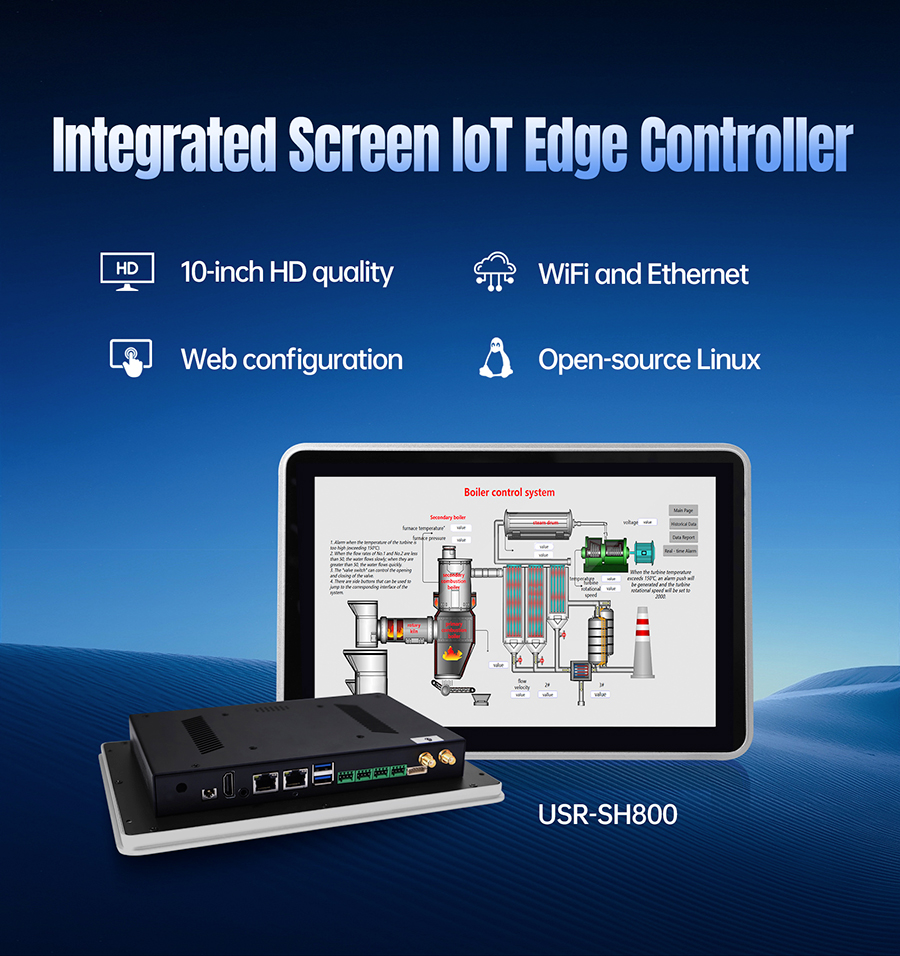
The USR-SH800's edge computing + 4G upload architecture optimizes cost structures in three ways:
Reduced transmission costs: Dynamic bitrate adjustment cuts data costs by 70%, resolving the "unaffordable" issue.
Lower maintenance costs: Industrial-grade protection reduces device failure rates by 80%, saving 500,000 yuan in annual maintenance.
Savings on expansion costs: Intelligent protocol conversion allows new sensors to integrate without system modifications, reducing expansion costs by 90%.
Addressing the pain points of smart environmental pollution source monitoring requires building a closed-loop system of "monitoring-analysis-optimization-verification," divided into four stages:
Stage 1: Demand Analysis and Scenario Modeling
Before project initiation, conduct detailed demand analysis, including monitoring point distribution, data types, transmission requirements, and environmental conditions. Use scenario modeling to determine optimal technical solutions and device selection.
Stage 2: System Deployment and Parameter Tuning
Deploy USR-SH800 devices at key monitoring points and tune parameters, including 4G upload settings, edge computing algorithms, and protocol conversion configurations. Adjust parameters in real time based on monitoring data to achieve optimal performance.
Stage 3: Data Governance and Value Mining
Govern collected data through cleaning, integration, and analysis. Use big data platforms to mine data value, uncover pollution patterns, and optimize governance strategies.
Stage 4: Effect Verification and Continuous Optimization
Verify system performance through full-traffic stress tests, ensuring metrics like data upload success rate, real-time capability, and accuracy meet standards. Establish a continuous optimization mechanism to adjust system parameters based on operational feedback and improve performance.
In the digital transformation of environmental regulation, the industrial panel PC USR-SH800 not only solves the foundational issue of "reliable data transmission" but also reconstructs the pollution source monitoring value chain. Through edge computing for local data preprocessing, 4G upload for stable transmission channels, and industrial-grade protection for harsh environment adaptability, it achieves a leap from "data collection" to "value creation."
When facing the challenges of "smart environmental pollution source monitoring" again, consider the three dimensions outlined in this article and leverage industrial panel PCs like USR-SH800, designed specifically for industrial scenarios, to build a monitoring system that is "real-time visible, intelligently controllable, and value-extractable." After all, in the arena of environmental regulation, data has always been the most precious resource, and those who master it will shape the future.


















