Explosion-Proof AGV Costs Too Much? How Modular Industrial Computer Design Cuts Deployment Costs by 30%
When Mr. Zhang first saw the quote for the explosion-proof AGV solution, he thought he'd missed a zero.
Three vehicles. The explosion-proof industrial computer on each vehicle cost 120,000 RMB. Add explosion-proof certification, custom cables, special connectors—the entire system came out nearly twice as expensive as a standard AGV.
He took the quote to the supplier: "Can you make it cheaper? Our warehouse just moves pallets—it's not that complicated."
The supplier smiled: "Mr. Zhang, explosion-proofing isn't just adding a shell. Ex d IIB T4—the certification cycle alone is eight months. This price is already 30% off our competitor's."
Mr. Zhang said nothing. He'd done the math in his head: save 20,000 per vehicle, and that's enough to buy another standard AGV. But without explosion-proofing, the safety inspection won't pass. With it, the budget overshoots by 40%.
He flipped the quote over and wrote on the back: "Is there a way to make explosion-proofing less expensive?"
He wrote that line for three months. Nobody answered.
Until one day, a friend who made industrial computers said to him: "Have you ever thought that half of that extra 60,000 you're paying is for 'redundant design'?"
Mr. Zhang paused.
He didn't quite understand the sentence. But later he understood it completely—and the understanding hurt.
Anyone who's done explosion-proof projects knows the cost of an explosion-proof AGV isn't a number—it's a web.
On the surface, the most expensive part is the explosion-proof certification. An industrial computer going through Ex d IIB T4—test fees, documentation fees, factory audit fees—adds up. But that's just the tip of the iceberg.
What really eats the money is what hides behind the certification—customization.
Think about it. A standard industrial computer comes off the line fully standardized: fixed interfaces, fixed dimensions, fixed cooling solution, fixed I/O configuration. Ready to use. Spare parts are universal. Maintenance is simple.
But explosion-proof AGVs can't do that.
Because it has to be explosion-proof, you need a flameproof enclosure. Once you change the enclosure, the entire internal layout changes—the original fan can't be used, so you switch to passive cooling; the standard connectors can't be used, so you switch to explosion-proof fittings; the original cables can't be exposed, so you route them through sealed cable glands.
Then the problem hits: every AGV has a different mission. Vehicle A needs eight sensors; Vehicle B only needs four. Vehicle A needs PoE power; Vehicle B doesn't. Vehicle A runs a long route and needs 5G backhaul; Vehicle B just circles the warehouse—Wi-Fi is enough.
But because it's "customized," you can't change anything. The flameproof shell already has its holes drilled, the I/O is already soldered in place, the cables are already sealed. You want to change the configuration? Sorry—new mold, re-certification, re-testing. Three-month cycle, double the cost.
This is the truth behind Mr. Zhang's extra 60,000: it's not that explosion-proofing itself is expensive—it's that "every vehicle has to be redone from scratch" that's expensive.
You buy three vehicles, but you're actually buying three different industrial computers. Each one is a "custom model." Each one needs separate certification. Spare parts for each one don't work on the others.
The supplier doesn't not want to be cheaper—he can't be. Because his product architecture determines that this is the only way he can sell.
Mr. Zhang later told me: "What I fear most isn't the cost—it's paying and still not being flexible. Add one more vehicle today, and I wait another three months. My production line can't wait."
This is the deepest pain point for explosion-proof AGV integrators: it's not that one unit is expensive—it's that every additional unit pushes the cost up non-linearly.
Later, Mr. Zhang changed suppliers.
Not because the new supplier had a higher explosion-proof rating, and not because his chips were faster. It was because he did something that looked simple on the surface but actually changed the entire cost structure—
He made the industrial computer modular.
What does that mean?
A traditional explosion-proof industrial computer is one monolithic unit. Enclosure, motherboard, I/O, power supply, cooling—all soldered together, sealed inside one flameproof cavity. Change any one part, and the entire cavity has to be redone.
The modular approach is completely different. It breaks the industrial computer into several independent "function blocks":
Compute module: CPU, memory, storage—core processing power concentrated on one standardized motherboard. The board itself isn't explosion-proof, but it's enclosed in its own independent flameproof sub-cavity.
I/O module: DIO, CAN Bus, RS485, Ethernet ports—made into plug-in interface boards. Need eight ports? Plug in the eight-port board. Need four? Plug in the four-port board. When not in use, the hole on the flameproof enclosure is sealed with a blind plug—no impact on the explosion-proof rating.
Communication module: Wi-Fi, 4G, 5G, PoE—each independent. Need 5G today? Plug in the 5G module. Switch to Wi-Fi tomorrow? Pull it out and swap. No enclosure changes, no rewiring, no re-certification.
Power module: wide-voltage input, 9-60V universal. Whether your AGV runs on 24V or 48V, one power module handles it.
Here's the key: each of these modules has passed explosion-proof certification individually.
What does that mean? It means you don't need to re-certify the entire machine every time you change the configuration. You're just swapping in a module that's already certified—the overall explosion-proof rating stays the same.
When Mr. Zhang first heard this proposal, he asked a very direct question: "What about the flameproof enclosure? Don't you still need to custom-make the shell?"
The supplier said: "The shell only needs standard hole patterns. You plug in eight I/O channels today, four tomorrow—the shell doesn't move. Because the hole patterns are standardized, and the blind plugs are universal. You only need to test all possible hole combinations during the first full-system certification. Everything after that falls within the certified scope."
Mr. Zhang did the math: originally, three vehicles meant three full-system certifications. Now, just one. Originally, every additional vehicle meant a three-month wait. Now, adding a vehicle just means selecting modules, plugging them in, and testing—two weeks, done.
Deployment cost for three vehicles dropped by 30%. Not because any single module got cheaper—but because the two biggest cost black holes, "repeated certification" and "repeated customization," were sealed shut.
Many people hear "modularity saves 30%" and think it's marketing fluff. Let's break it down.
Assume a typical explosion-proof AGV project: ten vehicles, industrial computer cost per vehicle:
| Cost Item | Traditional Custom | Modular | Difference |
|---|---|---|---|
| Explosion-proof cert (full system × 10) | 1.2M RMB | 300K (1 full + module reuse) | -900K |
| Custom cables & connectors | 150K | 50K (standard interfaces + universal cables) | -100K |
| Spare parts inventory (10 different configs) | 200K | 80K (modular universal spares) | -120K |
| Additional vehicle (11th unit) | 180K + 3 months | 60K + 2 weeks | -120K/unit |
| Maintenance labor (non-standard troubleshooting) | 80K/year | 30K/year | -50K/year |
You see, the per-unit purchase price might only differ by ten or twenty thousand. But spread across ten vehicles over the full lifecycle, the savings add up: certification fees, customization fees, spare parts costs, delay costs, maintenance costs—all combined.
The customer thinks he's buying an industrial computer. What he's actually buying is "flexibility for the next five years." Modularity doesn't save today's money—it saves money on every future change.
Mr. Zhang later told me something very down-to-earth: "Before, what I feared most wasn't overpaying—it was not being able to change anything after buying. Now I'm not afraid anymore, because changing is like building with blocks."
Let me tell you what actually happened.
Last year, Mr. Zhang's warehouse needed five extra explosion-proof AGVs for the Double 11 rush. With the old approach, just the industrial computer customization and certification would have waited until after New Year—Double 11 would be long gone.
With the modular approach, he did one thing: he asked the supplier to pre-stock five sets of standard modules—compute module, 8-channel DIO module, CAN Bus module, Wi-Fi module, PoE power module. Five sets of parts, fitted into five standard flameproof enclosures—assembled in two days, tested in one day, live on the line.
No new molds. No re-certification. No rewiring.
Five vehicles—from order to running: fourteen days.
With the old approach, fourteen days wasn't even enough to finish the certification paperwork.
The warehouse operations director said at the Double 11 debrief: "Adding vehicles on short notice didn't miss a beat this year—the industrial computer side deserves full credit."
Mr. Zhang sat there, silent. But he knew the truth behind that "full credit" wasn't that one chip was exceptionally powerful—it was that the entire product architecture's design philosophy had changed. From "building one machine per vehicle" to "building all vehicles from one set of modules."
This shift means delivery cycles go from months to weeks for integrators. For end users, it means production line expansion is no longer a gamble.
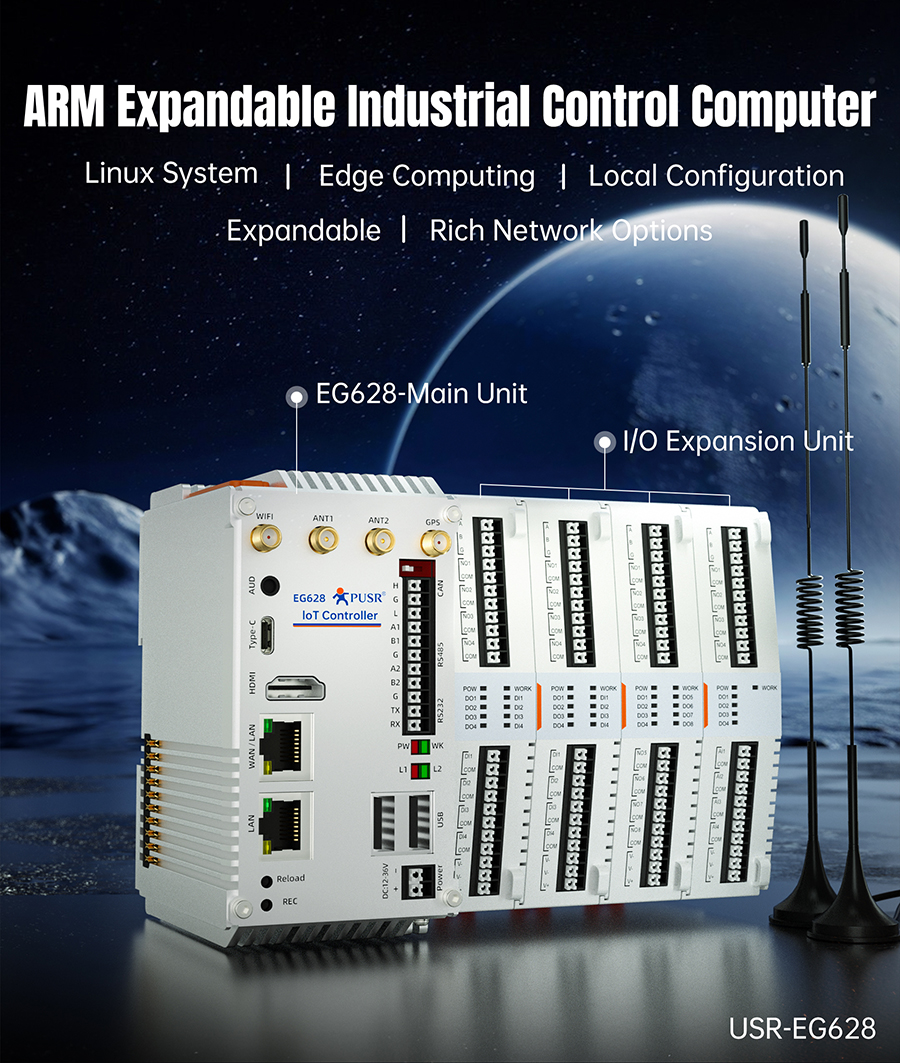
By now, you might be asking: there are plenty of modular explosion-proof industrial computers on the market—how do you choose?
Mr. Zhang's answer comes down to three words: don't overdo it.
He'd looked at some proposals early on where modularity was taken to extremes—one industrial computer split into a dozen modules. It looked flexible on paper, but in practice, interface compatibility, inter-module communication latency, mechanical connection reliability—all became problems. Modularity isn't better the finer you go—it's better at the "right granularity."
He ended up choosing the USR-EG628 series. The reasons were simple:
The compute module uses Intel's mainstream embedded platform—enough performance, mature ecosystem, no need to use obscure chips just for explosion-proofing.
The I/O modules support DIO, CAN Bus, RS485, Gigabit Ethernet—covering 90% of AGV scenarios. The remaining 10% is handled through reserved expansion ports, no extra modules needed.
The communication module supports Wi-Fi, 4G, and PoE—pick one of three, plug-in. No need to pay for 5G if you don't need it.
The power module handles 9-60V wide input—both 24V and 48V AGVs work directly.
The entire series uses unified flameproof enclosure specs—standardized hole patterns, universal blind plugs.
"Not the most powerful, but the best fit." That was Mr. Zhang's assessment.
A good solution doesn't pile on features. It makes sure you don't pay for what you don't use, and don't compromise on what you do.
If you're working on an explosion-proof AGV solution right now—whether you're an integrator or an end user—you're probably stuck in a very awkward spot:
Safety inspection demands explosion-proofing. Finance demands cost control. The production line demands flexibility. The supplier says, "I can't do cheap, fast, and flexible all at once."
You think he's blowing you off. But he might actually not be able to—because his product architecture was never designed for "flexibility" in the first place.
The traditional industrial computer's design logic is "one machine, one purpose": you tell me what you need, I build you one. That machine has no relationship to any other machine—spare parts aren't universal, configurations can't be changed, certifications can't be reused.
The modular logic is "one architecture, a thousand uses": I give you a set of standard blocks. Want a certain function? Build that shape. The blocks themselves are certified—any combination stays within certification scope. Swap one block, and the overall explosion-proof rating is unaffected.
Your pain point isn't "explosion-proofing is too expensive." Your pain point is "every change forces you to pay the full price again."
That's exactly what modularity solves.
It won't make explosion-proof certification cheaper—you still pay what certification costs. But it lets you pay for certification once and cover ten vehicles, twenty vehicles, every vehicle you'll ever add.
It won't make the industrial computer itself cheaper—chips cost what chips cost. But it stops you from repeatedly paying customization fees because "every vehicle is different."
It won't make your AGV run faster—speed depends on motors and algorithms. But it means you don't wait three months to add a vehicle, you don't re-mold to change a configuration, and your production line truly comes "alive."
Later, Mr. Zhang flipped that quote over again—the one with "Is there a way to make explosion-proofing less expensive" written on the back.
Under that line, he added one sentence:
"Found the way. It's not that explosion-proofing got cheaper—it's that I don't have to start from scratch every time."
That sentence might be worth more than any technical specification.
Is your explosion-proof AGV solution paying for "today's three vehicles"—or "tomorrow's thirty"?
Once you answer that question, the cost comes down.


















