Energy Management Module Integration: How all-in-one computer touch screens cut robot line energy consumption by 18%
Anyone who does automation integration knows: robot lines are power hogs.
A 6-axis robot line running at full load easily exceeds 50kW. Add welders, conveyors, vision systems, air compressors — total installed capacity often tops 100kW. At industrial electricity rates of ¥0.8/kWh, that's ¥600,000–700,000 a year per line.
You pay this every month. But you've never really seen where it goes.
Because your line is missing someone who keeps the books.
PLC handles motion. HMI handles display. But no device tracks where every kilowatt-hour goes. You know total consumption is rising, but you don't know which robot wastes power idling, which conveyor runs on standby without shutting down, or which welder's poor power factor drags down the whole line's efficiency.
You don't not want to save. You just can't see.
Until one day, your boss slaps the electricity bill on your desk: "Energy use is up 15%. Fix it."
That's when you realize: swapping LEDs and turning off AC isn't enough. You need an energy management system — and at its core, a reliable all-in-one computer touch screens.
Let's kill a myth first: cutting line energy consumption isn't about making robots do less work. It's about making every kilowatt-hour count.
Energy waste on robot lines hides in three invisible places:
First, idle and standby consumption.Between process switches, robots idle for seconds to tens of seconds. Looks small per cycle, but thousands of switches a day add up to a staggering number. Not to mention conveyors and air compressors running at full power with zero load.
Second, low power factor.Heavy use of VFDs and servo drives can drag the line's power factor down to 0.7 or lower. That means for every ¥100 you pay, only ¥70 actually does work — the other ¥30 is a "reactive power penalty."
Third, peak-valley mismatch.Many factories use tiered electricity pricing, but line loads are flat-out "one size fits all" — full load during peak hours, idle during off-peak. If you can shift high-consumption processes to off-peak hours, you save over ¥100,000 a year.
What do these three problems have in common? They all demand real-time, continuous, multi-channel data collection and analysis. You need to monitor voltage, current, power, power factor, and running status for every device simultaneously — then compute, judge, and schedule at the edge.
This isn't a PLC's job. It isn't a cloud platform's job. This is an all-in-one computer touch screens job.
You might ask: Can't I use a PLC with a power metering module? Can't I use an edge gateway with a cloud platform?
Sure. But not enough.
PLC's problem: "Can't compute."Traditional PLCs excel at logic control but can't handle complex energy analysis. Power factor calculations, load forecasting, optimization algorithms — PLC compute power simply can't keep up.
Edge gateway's problem: "Can't connect everything."Gateways usually have just a few analog inputs. To meter dozens of devices, you need a pile of acquisition modules, cables everywhere in the control cabinet, and a debugging nightmare.
Standard IPC's problem: "Can't survive the environment."High temps, heavy dust, strong vibration — fan-cooled IPCs clog up and crash within six months. You need true industrial-grade hardware.
all-in-one computer touch screens is the optimal solution to all three.
It has enough compute power to run energy analysis algorithms, enough interfaces to connect directly to power sensors and smart meters, and a fanless industrial design that handles line environments. Most critically — it integrates computing, display, control, and communication in one device. No extra HMI. No extra acquisition cards. No extra communication modules.
One machine = one complete energy management node.
That's why more and more automation integrators choose all-in-one computer touch screens as their first option for line energy management projects.
Back to that electricity bill.
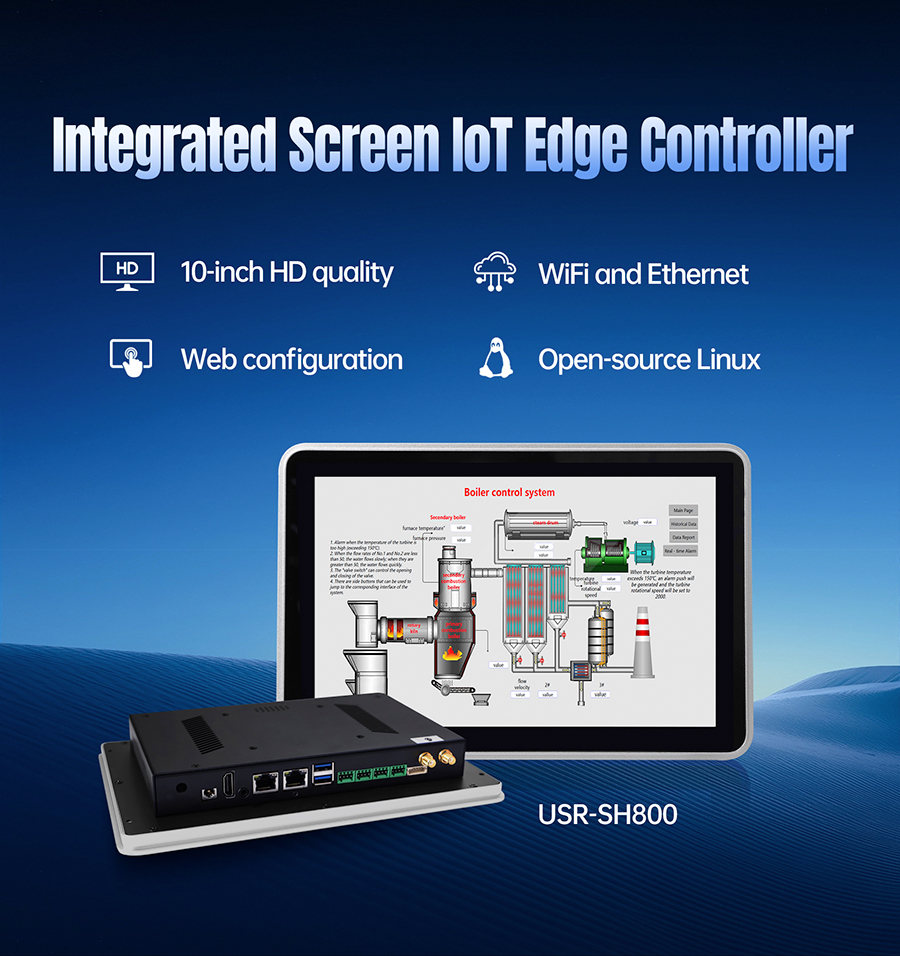
When you deploy an energy management system built around the USR-SH800 on your line, you don't just get 18% savings on electricity.
You get full visibility into every kilowatt-hour. You know which device is idling, which process has the lowest efficiency, when to shift high-load tasks to off-peak hours.
You get a boss who stops slamming the table. Because you can show data, reports, and trend charts: "We saved 12% this month vs. last. At this rate, we'll save back a piece of equipment by year-end."
You get no more 3 AM phone calls. Because the USR-SH800 runs 24/7, 7 days a week, fanless with fully passive cooling, across -20°C to +60°C — no thermal crashes turning your energy management system into a paperweight.
Energy management isn't a tech problem. It's a visibility problem. You can't see it → you can't manage it → you can't save it.
The USR-SH800 is the machine that lets you see.
Stable performance. Rich sizes. Responsive touch. Complete interfaces. Great value. It won't make you agonize over selection, lose your mind during debugging, or get a 3 AM line-down call.
Good equipment lets you focus on your algorithms and your line. It carries everything else.
If your project involves line energy management, equipment efficiency monitoring, or any edge-side multi-channel data collection and real-time analysis scenario, the USR-SH800 deserves your serious evaluation. Contact us for detailed technical specs and selection advice.