A summer broiler barn still gets a night round at two in the morning. With several dozen barns scattered across the site, each round means checking temperature, humidity, ammonia levels, water lines, and fan stages one by one. When a power-loss alarm comes in or a feed line jams, the on-duty shift has little chance of keeping up. That kind of site used to run on foot patrols; an increasing number of operators now hand that round off to an edge device sitting on the wall.
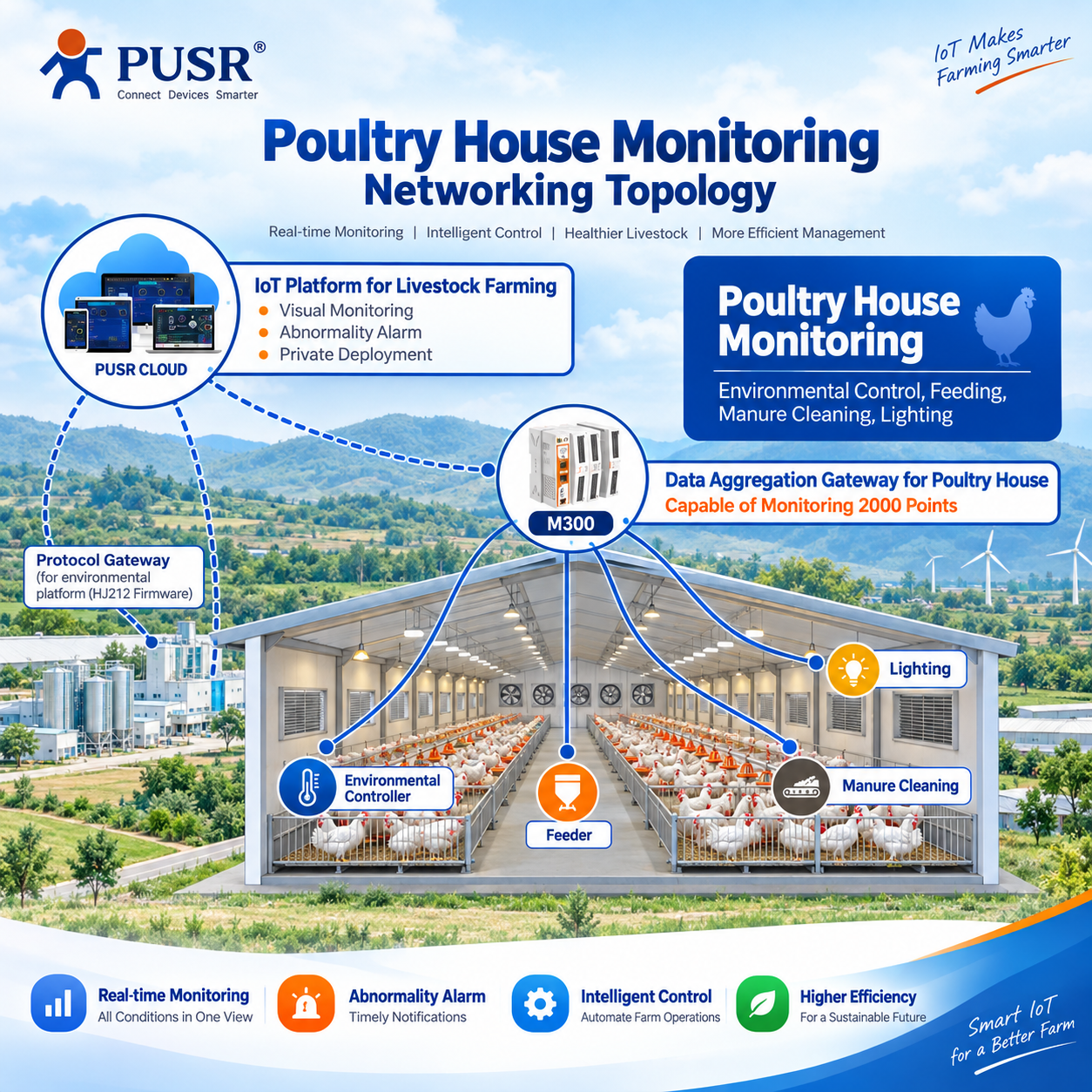
In a livestock deployment, the industrial gateway takes on three jobs. It collects sensor data inside the barn and reports it upstream. It relays platform commands to fans, heat lamps, and curtain motors. When the link or the upstream platform drops, the gateway keeps the local logic and cache running so the barn does not lose its reference signals.
Before any model choice, the working list is short and well known across the industry. Multi-barn livestock networking typically covers four blocks.
① Environmental sensing — temperature, humidity, ammonia, CO2, light, and water flow. RS485 Modbus instruments or analog sensors are the common choice.
② Equipment control — fans, heat lamps, curtain motors, feed lines, and dosing pumps for drinking water. RS485 or 4-20mA with discrete outputs is the typical wiring.
③ Video and access control — entry cameras and card readers ride on a separate network, isolated from the control network through VLAN.
④ Remote inspection and alarms — on-duty staff receives alarms and pulls historical curves through a phone or a PC.
The four blocks have a natural order. Sensing comes first, then control, then video, and finally remote alarms. Trying to roll everything out in one pass usually stalls at protocol hand-off.
The hardware behind the four blocks has a fairly clear split.
At the sensor end sit humidity and temperature transmitters, ammonia and CO2 probes, light meters, flow meters, fan and heat-lamp control boxes, cameras, and card readers. Most of them speak RS485 Modbus or 4-20mA.
At the gateway end sits the device mounted in each barn, or shared across a couple of barns. The typical form factor is an industrial edge-computing gateway: a dual-core processor, a Linux system, on-board RS232/RS485 and Ethernet ports, parallel acquisition of over a thousand data points, Modbus RTU/TCP conversion, and reporting to a cloud platform or a local server over 4G or Ethernet. USR-M300 is a model that fits this slot — dual-core 1.2GHz, Linux plus Node-RED visual programming, Modbus RTU/TCP conversion, an upper limit of 2,000 data points, wide-range DC 9 to 36V supply, -25 to 75°C operating temperature, wall-mount or DIN-rail installation.
The platform layer can be a public cloud such as PUSR Cloud or Alibaba Cloud, or a self-built local SCADA. Its job is to store the data, draw curves, push alarms, and serve up year-over-year comparisons.
The data flow between the three layers looks like this: sensor → gateway (acquisition, local cache, protocol conversion) → platform (storage, display, alarm) → phone or PC (on-duty staff). The gateway is the one piece that cannot be skipped. Without it, sensors cannot talk to the cloud directly. With only the platform, the barn loses local control and local alarm the moment the link drops.
Outdoor work and frequent equipment turnover are common on livestock sites. Two patterns show up in the field.
First, device credentials end up scattered across the on-site engineer's local browser and equipment configuration files. Shared accounts, plaintext passwords, and leftover credentials from retired gear keep the remote-management perimeter open.
Second, night alarms depend on phone push or SMS. A duty engineer at two or three in the morning who misses one push can miss a stalled fan or a failed heat lamp — the kind of incident that compounds within an hour.
A few gateway-level capabilities line up with both problems:
① Centralized access — every barn's gateway comes into the platform through VPN or MQTT, instead of each one exposing itself to the public network on its own.
② Centralized credential management — gateway accounts and remote-access passwords are issued and rotated from the platform side, so the local browser no longer holds the only copy.
③ Edge-side cache and alarm during link loss — when the link or the upstream platform is unreachable, the gateway holds local data and runs local alarm logic.
④ Watchdog and remote restart — long no-response states trigger an automatic reset that can be initiated remotely.
With those four tied to the gateway, remote management actually runs on-site. Foot patrols alone cannot close the gap.
Translated back into model selection, the parameters check off in this order.
① Processing power. For small sites with under a thousand parallel data points, a dual-core 1GHz-plus industrial edge gateway on Linux is enough. Sites past that ceiling shift to an industrial PC.
② Interfaces. At least one RS485, preferably with a backup RS232. At least one WAN/LAN Ethernet port, with a second LAN port for on-site laptop debugging. AI inputs are sized to whether the sensors use 4-20mA or 0-10V.
③ Uplink. 4G or wired Ethernet, one of the two. On Chinese livestock sites, the tolerance for outages is low, so 4G primary with wired backup is the safe choice.
④ Power and temperature. A wide-range DC 9 to 36V input covers most supply variants on-site. Sites outside the cabinet or in open air require coverage below -25°C or above +60°C.
⑤ Mounting. DIN 35mm rail is the mainstream option inside the cabinet; wall-mount fits distribution boxes and pole-side enclosures.
⑥ Certification. Domestic projects look for 3C. Export projects look for CE, FCC, and ROHS on top of the regional list.
Run through this list, USR-M300 lands in the third tier — dual-core 1.2GHz, Linux plus Node-RED, one RS232/485 plus one RS485, dual Ethernet, two DI, two DO, two current-type AI, 4G plus Ethernet uplink, Modbus RTU/TCP, an upper limit of 2,000 data points, DC 9 to 36V, -25 to 75°C, wall-mount or DIN-rail. The certification list covers CE, FCC, ROHS, WEEE, SRRC, TDRA, and other commonly required items in regional markets. A medium-sized site with thirty to forty barns usually fits under one unit; past a hundred barns, splitting across sites with one unit per area is the safer layout, so a single point of failure does not propagate.
In multi-barn livestock networking, the bottleneck usually sits in whether the work has been spelled out on-site, not in the availability of an industrial gateway. Pin down the four jobs — environmental sensing, equipment control, video, and remote alarms — and the industrial gateway falls naturally into its place as protocol conversion plus edge cache plus remote access management. The specific model then lands on its own.


















