OEE Real-Time Calculation Engine: How an Industrial Panel PC Boosts Line Utilization to 92% Through Data Collection
"What exactly is your production line doing every day? It's been busy for 16 hours — how much of that is actual production time?"
You've probably never seriously calculated this. Not because you don't want to — because you can't.
The "Invisible Black Hole" on a Production Line
Last week I visited an auto parts factory. The line manager pulled me over to look at his production schedule:
"This line — 8 CNCs, running 16 hours a day. Theoretical output is 120 pieces per hour, so we should be producing 1,920 pieces a day. But reality? We're only getting about 1,400."
I asked him: "Where did the missing 500 pieces go?"
He paused for a few seconds: "Tool changes, waiting for materials, debugging, line stops for inspection… I can't really explain it. There's just loss."
Not being able to explain it — that's the biggest loss of all.
This is the most common dilemma in manufacturing — you know the line is losing money, but you don't know where, how much, or when.
Because you're missing one thing: real-time OEE data.
OEE (Overall Equipment Effectiveness) = Availability × Performance × Quality.
Everyone can recite this formula. But fewer than 10% of factories can actually collect, calculate, and feed back OEE data in real time.
The other 90% are still relying on manual logs, Excel spreadsheets, and weekly reports. By the time you get last week's OEE data, this week is already wasted.
You don't need a "Monday morning quarterback" reporting system. You need an industrial panel PC that can be mounted on the line and help you calculate in real time: "exactly how much are we losing right now?"
This article is for those who "know they should implement OEE but don't know how to pick the hardware."
What Makes 92% OEE So Hard to Achieve?
Let's start with a benchmark: world-class manufacturers target 85%+ OEE. Those hitting 92% are basically标杆-level (benchmark-level) factories.
Going from 70% to 92% isn't about "tighter management." It's about data granularity.
You need to know:
| Time Granularity | What You Can See | What You Can Do |
|---|---|---|
| Hourly | Today's line OEE is 78% | Discuss at tomorrow's meeting |
| Minute-level | 10:15–10:23, 8 min downtime on Machine #3 for tool change | Optimize tool change process |
| Second-level | Every stop tracked to 0.5s, auto-categorized by cause | Real-time alerts, instant intervention |
The gap from 70% to 92% OEE isn't a management gap — it's a data collection accuracy gap.
And data collection accuracy depends on the capability of the industrial panel PC on your line.
Specifically, it's hard in three places:
On a production line, you need to connect to, but not limited to:
PLC (Modbus/Profinet/EtherCAT)
Sensors (temperature, vibration, pressure)
Barcode scanners / vision inspection (USB, GigE)
MES system (Ethernet)
Touchscreen HMI (needs independent display)
A regular industrial PC might give you 2 serial ports, 2 USB, 1 Ethernet. But for a production line, that's not enough. You need expansion cards, adapters, hubs — every extra piece is an extra failure point.
Temperature, dust, oil mist, vibration on the shop floor — nothing like an office.
Both AAEON and OnLogic's industrial PC solutions repeatedly emphasize one thing: industrial equipment must run stably from -40°C to 85°C, must be fanless, must have no dust intake paths.
If your OEE calculation engine crashes once from overheating, the data lost could be more than a whole week of manual statistics.
Real-time OEE calculation means data coming in every second, computing every second, outputting results every second.
If the industrial panel PC's CPU can't keep up, data backs up, packets drop, latency spikes. The "real-time OEE" you're looking at is actually OEE from 5 minutes ago.
Data from 5 minutes ago can't save a line that's down right now.
Five Questions You Should Really Ask Yourself During Selection
Before we talk products, let me help you clarify the selection logic.
Because I've seen too many people compare prices based on a spec sheet, then buy a machine that either doesn't have enough interfaces, can't handle the heat, or lacks the compute — and then blame the OEE system for not working.
It's not the system. It's that you picked the wrong hardware to run it.
Ask yourself these five questions:
| # | Question | Why It Matters |
|---|---|---|
| ① | How many data collection points does my line have? | Determines how many I/O interfaces you need |
| ② | What's the ambient temperature range? Any oil mist/dust? | Determines if you need fanless, wide-temp design |
| ③ | What refresh rate does OEE calculation need? Second-level or minute-level? | Determines what CPU class you need |
| ④ | Do operators need to operate directly on the line? | Determines if you need a high-sensitivity touchscreen |
| ⑤ | How many years will this project run? | Determines if you need long-term supply guarantee |
If you've thought through these five questions, your selection is 80% done.
The remaining 20% is finding an industrial panel PC that answers all five correctly.
USR-SH800: An Industrial Panel PC Built for Real-Time OEE Calculation
I don't want to use the word "recommend" — because in industrial scenarios, recommending means you have to validate it on your own line.
So let me put it differently: this is a machine we believe answers all five of the above questions. You can check it against your needs.
The USR-SH800 industrial panel PC is designed for production line edge computing.
It's not a "can do everything but does nothing well" general-purpose IPC. It's specifically honed for OEE, MES edge nodes, and line data dashboards.
The USR-SH800 comes standard with rich I/O, covering all production line data collection needs:
| Interface Type | Qty | Covered Scenarios |
|---|---|---|
| RS232/RS485 | Multi-channel | PLC comms (Modbus RTU) |
| Ethernet | 2–4 ports | MES docking, data upload |
| USB | Multi-channel | Barcode scanners, USB drives, vision cameras |
| GPIO/DIO | Multi-channel | Sensor signals, status indicators |
| CAN Bus | Supported | Auto/heavy industry lines |
| HDMI/VGA | Supported | Multi-screen output, dashboard display |
No need to buy expansion cards, no adapters, no hubs. One fewer intermediary on the line means one fewer failure point.
This follows the same logic as OnLogic's emphasis on "helping customers eliminate adapters and dongles" — industrial reliability starts with fewer connection points.
The USR-SH800 is equipped with an Intel mainstream processor platform, supporting multi-core parallel computing.
The real-time OEE data flow looks like this:
Sensors/PLC → Data collection → Cleaning & categorization → OEE formula calculation → Dashboard refresh
All four steps must complete in milliseconds. The USR-SH800's CPU can handle thousands of data points per second, simultaneously running the OEE calculation engine, HMI display, and MES communication — three tasks in parallel, no lag.
The "real-time" you need isn't "close enough to real-time." It's "every second is the latest."
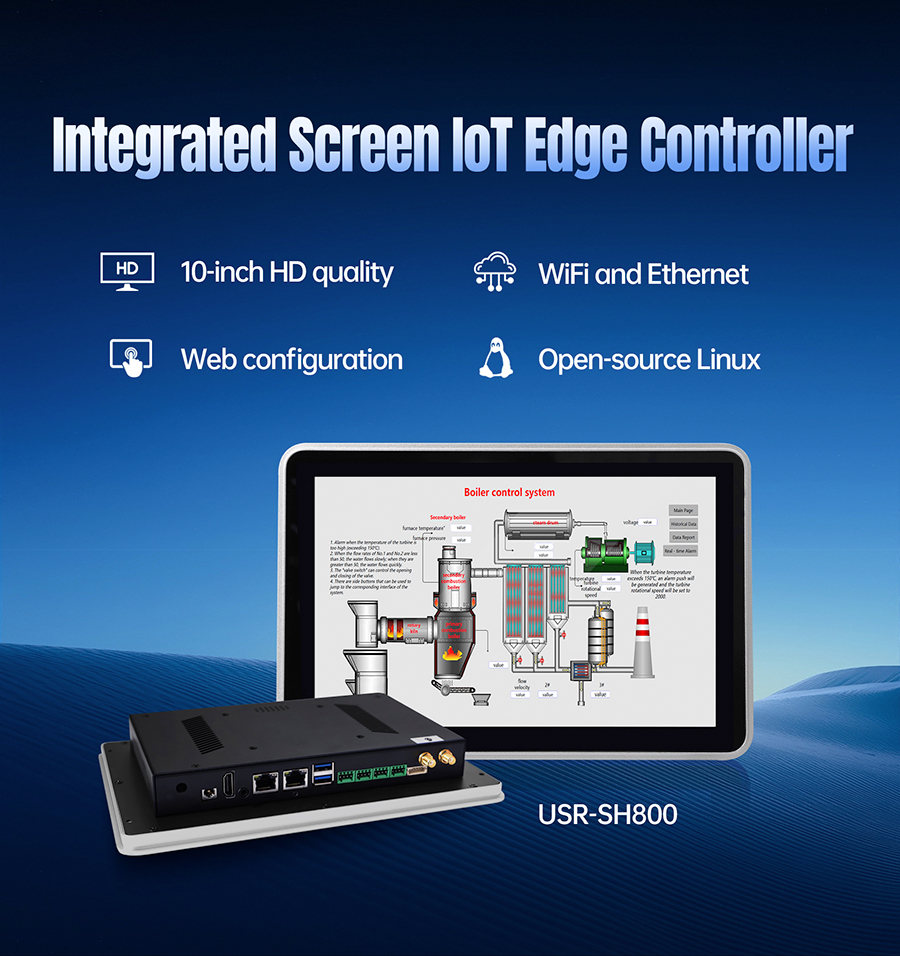
Installation space on a production line is never standard.
Some spots can only fit a 7-inch screen. Others need a 15-inch display so operators can see every line's OEE numbers clearly.
The USR-SH800 offers multiple size options (7"/10"/15"/21.5"), from compact to large dashboard — full coverage.
You don't need to modify your line to fit the machine. The machine fits your line.
This follows the same thinking as AAEON's emphasis on "modular design adapting to various deployment scenarios."
This detail — most people overlook it during selection, but once they use it, they care a lot.
Line operators wear gloves, their hands are oily. If the touchscreen isn't sensitive, every operation means removing gloves, wiping hands — 200 operations a day, that action alone wastes half an hour.
The USR-SH800 uses a high-sensitivity capacitive touchscreen, supporting wet-hand and gloved-hand operation, fast response, low mis-touch rate.
A good HMI doesn't make people "adapt" to the machine. It makes the machine "adapt" to people.
Fanless passive cooling — zero dust intake, zero noise, zero vibration.
Operating temperature range covers common line environments.
Based on Intel's mainstream chip roadmap, 5+ year supply guarantee.
These aren't flashy selling points. They're the baseline your OEE engine can't afford to violate.
As OnLogic says: "Industrial PCs are engineered from the ground up with the features necessary to survive in the type of industrial automation environments that might destroy off-the-shelf computers."
Your OEE data can't be lost because an IPC overheated and rebooted.
Industrial panel PCs with the same config on the market typically cost 30–50% more.
The USR-SH800 spends money where you actually need it: compute, interfaces, screen, reliability.
You're not paying for features you won't use.
Let's Do the Math: What's 70% to 92% OEE Worth?
Let's go back to that auto parts factory example.
Assumptions:
8 CNCs, 120 pcs/hr theoretical, 16 hrs/day
Current OEE 70%, actual output 1,344 pcs/day
Target OEE 92%, actual output 1,766 pcs/day
Profit per piece: 15 yuan
| Metric | OEE 70% | OEE 92% | Improvement |
|---|---|---|---|
| Daily output | 1,344 pcs | 1,766 pcs | +422 pcs |
| Daily profit | 20,160 yuan | 26,490 yuan | +6,330 yuan |
| Annual profit (300 days) | 6.048M yuan | 7.947M yuan | +1.899M yuan |
1.899 million yuan — that's your annual incremental profit from moving OEE from 70% to 92%.
And it all starts with the industrial panel PC on the line that can collect, calculate, and display in real time.
The price of one USR-SH800 might be less than one month of your incremental profit.
But what it gives you is the ability to see exactly what your line is doing every minute, every second.
Everyone in manufacturing knows one thing: if you can't control it, you can't profit from it.
Materials, people, equipment — equipment is the easiest to turn into a "black box." You don't know when it's running, when it's stopped, when it's idling.
Real-time OEE calculation is what opens that black box.
And the key to opening it isn't some fancy software platform. It's the industrial panel PC on the line — running 24/7, with enough interfaces, enough compute, a good touchscreen, and won't crash from overheating.
The USR-SH800 isn't a miracle machine. But when it comes to "real-time OEE calculation," it gets everything right.
If you're considering implementing OEE on your line but aren't sure what hardware to pick — send us your line details. We'll help you figure out the interfaces, compute, and size in one go.
Data doesn't lie. Your line is generating data every second. All it's missing is a machine that can catch it.