Multi-Dimensional Vibration Analysis: How industrial panel pc Predicts Robot Joint Wear Risk via Spectrograms
Anyone who does equipment integration has probably lived through this.
3 AM. Your phone rings. The line is down. A robot joint is making abnormal noise, the entire line is dead, and every minute is burning money. You rush to the site, open the control cabinet — eyes full of cables and sensors — and realize: not a single sensor can tell you what's actually wrong with that joint.
You can hear the noise, but you can't tell if it's bearing wear, gear backlash, or a gearbox low on oil. You just replace parts, shut down, wait, and pray it doesn't happen again.
This isn't a tech problem. It's a selection problem.
The root cause: your line is probably missing an industrial panel pc that "understands vibration."
Here's something most people overlook: a robot joint is "talking" long before it fails.
Early-stage bearing pitting produces faint impact signals at specific frequencies. Increased gear mesh backlash raises sideband energy around the mesh frequency. Lubricant film breakdown lifts the high-frequency noise floor across the board. All these signals are hidden in vibration data — but whether your system can "hear" them depends on whether your computing platform is powerful enough, fast enough, and stable enough.
The traditional approach? Send vibration sensor data back to a PLC. The PLC does a threshold check — exceed the limit, trigger an alarm. Does this catch problems? Yes. But only problems that have already happened. By the time the threshold triggers, you've usually missed the optimal maintenance window.
What are the pros actually doing? Running FFT (Fast Fourier Transform) directly at the edge, converting time-domain signals into spectrograms in real time, then doing feature extraction and trend comparison on the spectrum. Same joint — put last month's spectrogram next to this month's. The 2× harmonic amplitude is up 15%. You don't need to wait for the noise to show up. You already know: it's time to replace it.
That's the core difference between "predictive maintenance" and "reactive repair." And the prerequisite for all of this? You need an industrial panel pc on-site with enough compute power, enough interfaces, and enough reliability.
By now, you probably realize you need an industrial panel pc. But when you open a search page and see hundreds of models, the real pain begins.
We've talked to tons of customers doing equipment integration and line retrofits. Their selection anxiety basically boils down to these:
First: "I need to run FFT and spectral analysis, but I don't know what processor to pick."
Spectral analysis is not light on compute. A 6-joint robot, 3 vibration axes per joint, sampling rate at least 10kHz+, one 1024-point FFT — that's hundreds of thousands of floating-point operations per second. A regular embedded controller can't handle it, but a full IPC feels like overkill — cost won't hold.
Second: "My site environment is brutal — heavy dust, high temps. My last device kept crashing for no reason."
Many factory environments hit 50°C+ in summer, with metal dust and coolant mist everywhere. Regular IPCs use fans for cooling — within six months the fans clog, then thermal throttle, then crash, then the line stops. You need true fanless design, but many machines on the market labeled "industrial-grade" just added a dust filter.
Third: "I need to connect vibration sensors, encoders, PLCs, vision cameras — are the interfaces enough?"
On-site protocols are a mess: vibration sensors on 4-20mA analog, encoders on RS485, PLCs on Modbus RTU, cameras on GigE Vision… You need one machine that can "swallow" all of them natively — not a new acquisition card, a new cable, and a new failure point for every device.
Fourth: "I know I should do edge computing, but edge solutions cost tens of thousands. My boss won't approve it."
This might be the most realistic pain point. Edge computing is the trend — everyone knows that. But between the trend and the budget, there's a canyon. You need a machine powerful enough to run edge algorithms, but cheap enough that you won't hesitate at the quote stage.
If any of these hit home, what follows is worth five minutes of your time.
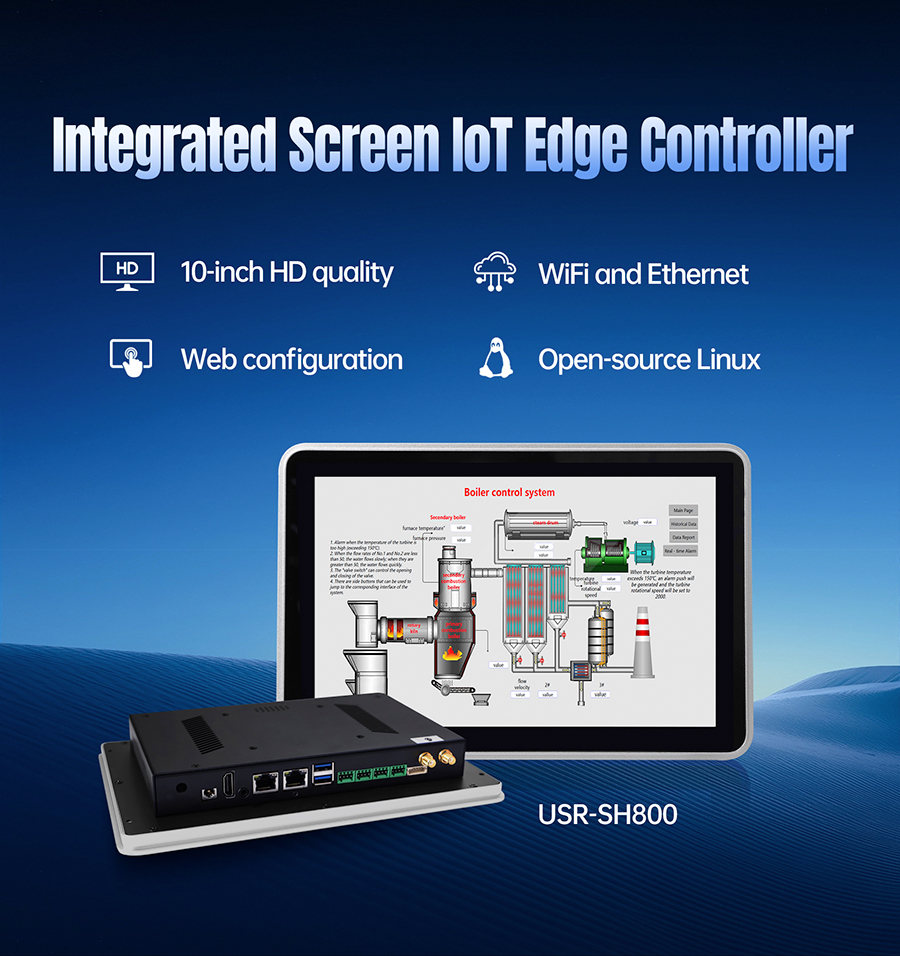
Let's go back to the opening scene.
If your line already has a USR-SH800 running real-time spectral analysis, that 3 AM phone call may never ring. Because 72 hours before the failure, the system already caught the abnormal peak on the spectrogram. The maintenance work order was generated. The spare part is already on the way.
You don't need to wait for the machine to "speak" before you listen. You need the machine to listen for you.
That's the real value of an industrial panel pc in vibration analysis and predictive maintenance — not replacing your judgment, but making the judgment for you before you even notice.
And the USR-SH800 is the choice worth putting in your proposal. Stable performance. Rich sizes. Responsive touch. Complete interfaces. Great value. It won't make you agonize over selection, lose your mind during debugging, or get a 3 AM phone call.
Good equipment is the kind you forget is there. The USR-SH800 is the kind you install, then focus on your algorithms and your line — it carries everything else.
If your project involves robot joint health monitoring, line vibration analysis, or any scenario requiring real-time signal processing at the edge, the USR-SH800 deserves your serious evaluation. Contact us for detailed technical specs and selection advice.


















