Triple Tests of Computing Power, Stability, and Scalability: How to Match Fanless Industrial PC Selection with AGV/AMR Evolution Needs
In the wave of intelligent manufacturing and smart logistics, AGVs (Automated Guided Vehicles) and AMRs (Autonomous Mobile Robots) are evolving from "tools" to "intelligent agents." They navigate through factories, warehouses, and ports, undertaking core tasks such as hazardous material handling, flexible sorting, and unmanned delivery. However, when enterprises decide to introduce AGVs/AMRs, an invisible "triple gate" emerges: Is computing power sufficient for complex scenarios? Can stability withstand industrial environments? Does scalability meet future upgrade needs? These pain points, like the Sword of Damocles hanging over decision-makers, fill the selection process with anxiety.
In high-risk scenarios like oil and gas storage and chemical production, every operation of AGVs/AMRs concerns life and environmental safety. Customers have experienced collision accidents due to traditional AGVs relying on magnetic strip navigation, unable to autonomously avoid obstacles. They have also faced delayed emergency braking commands due to insufficient computing power in fanless industrial PC, unable to process lidar data in real-time. These lessons have shifted customer demands for "safety" from "post-accident handling" to "pre-risk warning." They yearn for fanless industrial PCs to act like "intelligent brains," sensing the environment, predicting risks, and resolving crises in milliseconds.
In high-intensity scenarios like e-commerce warehousing and automotive manufacturing, AGV/AMR efficiency directly determines productivity. Customers have faced production rhythm disruptions due to frequent downtime of AGVs in high-temperature environments caused by unstable fanless industrial PCs. They have also encountered "traffic jams" among dozens of AGVs in narrow aisles due to limited scalability, unable to integrate multi-machine scheduling systems. These pain points have shifted customer aspirations for "efficiency" from "single-point optimization" to "global intelligence." They hope fanless industrial PCs can act like "traffic controllers," dynamically allocating tasks and optimizing paths to maximize the efficiency of every AGV/AMR.
For small and medium-sized enterprise customers, cost remains a core consideration in selection. They have faced high initial investments due to blindly pursuing high-end fanless industrial PCs, when only basic computing power was needed in actual scenarios. They have also incurred secondary waste by being forced to replace equipment during business upgrades due to ignoring scalability. These lessons have shifted customer sensitivity to "cost" from "single procurement" to "full lifecycle." They hope fanless industrial PCs can act like "LEGO blocks," meeting current needs while reserving upgrade space to generate long-term value from every investment.
In the evolution of AGVs/AMRs, computing power demands are growing exponentially. Take AMRs as an example; they need to simultaneously run complex algorithms such as laser SLAM mapping, dynamic path planning, and multi-sensor fusion. For instance, an AMR in an automotive factory needs to identify and avoid obstacles within 10 meters in 0.1 seconds, imposing extremely high GPU computing power requirements on fanless industrial PCs. Insufficient computing power will trap AMRs in a vicious cycle of "lag—delay—accidents."
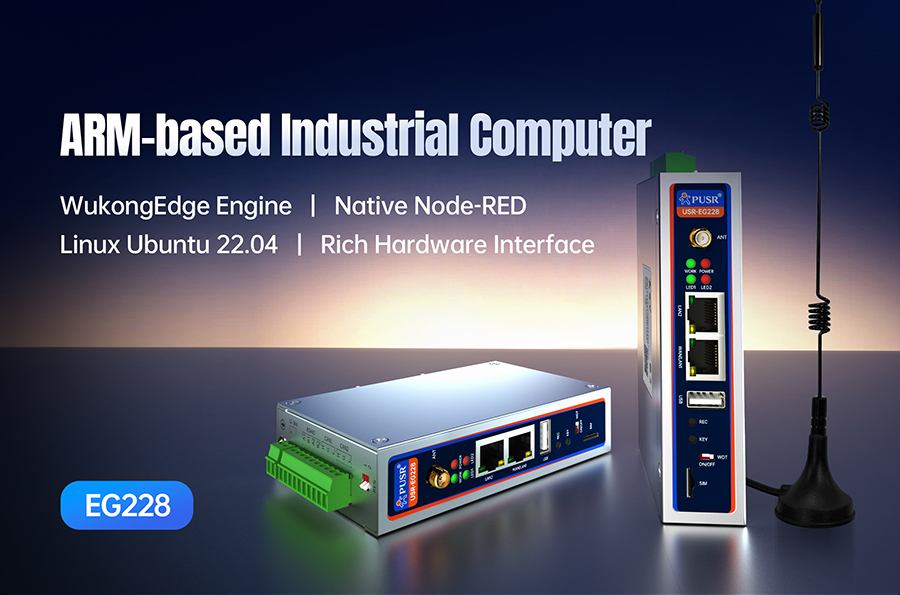
Selection Advice: Prioritize fanless industrial PCs equipped with multi-core processors (e.g., 4-core Cortex-A7) and support GPU acceleration or NPU (Neural Network Processor) integration. For example, the USR-EG228, equipped with an industrial-grade RK3506J triple-core processor at 1.2GHz and an embedded WukongEdge edge computing engine, can easily handle high-load tasks like laser SLAM and visual recognition, reserving computing power space for future algorithm upgrades.
The complexity of industrial environments far exceeds ordinary scenarios. In oil and gas storage scenarios, AGVs need to operate in extreme temperatures ranging from -40°C to 75°C. In chemical workshops, fanless industrial PCs need to resist salt spray corrosion and electromagnetic interference. At port terminals, AGVs need to withstand stable operations under 8-level winds. Insufficient stability will lead to frequent failures in fanless industrial PCs, causing production interruptions and cost increases.
Selection Advice: Choose fanless industrial PCs that have passed IP65 protection rating certification, support wide-temperature operation (-40°C to 85°C), and feature redundant designs (e.g., dual power modules, dual network port backups). The USR-EG228 adopts a full-metal fanless design, supports wide-temperature operation from -20°C to 70°C, integrates 4G/WiFi dual-mode communication and dual network port backups, ensuring stable networking even in remote oil fields or offshore platforms to guarantee task continuity.
The evolution of AGVs/AMRs is dynamic. Today, they may only need to interface with PLCs; tomorrow, they may need to integrate robotic arms, visual sensors, and even deeply link with MES (Manufacturing Execution Systems). Insufficient scalability in fanless industrial PCs will trap enterprises in the dilemma of "equipment replacement—system modification—production halt."
Selection Advice: Prioritize fanless industrial PCs that support rich interfaces (e.g., RS485, CAN FD, USB) and open protocols (e.g., Modbus, OPC UA) and reserve secondary development space. The USR-EG228 provides 2×RS485, 2×CAN FD, and 1×USB interfaces, supports Node-Red drag-and-drop programming and a Linux Ubuntu development environment, enabling enterprises to quickly develop customized functions based on existing systems without relying on vendors.
Among numerous fanless industrial PCs, the USR-EG228 stands out as an ideal choice for AGV/AMR evolution with its balanced design of "computing power, stability, and scalability."
The USR-EG228 embeds a WukongEdge edge computing engine, supporting multi-source data fusion processing. For example, in an AMR project at a chemical enterprise, the EG228 simultaneously ran laser SLAM mapping, gas concentration monitoring, and path planning algorithms, achieving 85% computing power utilization, while traditional fanless industrial PCs could only support a single algorithm, wasting over 40% of computing power.
The USR-EG228 has passed IP65 protection certification, supports wide-temperature operation from -20°C to 70°C, and integrates explosion-proof design (optional). In an AGV project at an offshore oil field, the EG228 operated continuously for 18 months without failure in an environment with a salt spray concentration of 5%, tripling the lifespan compared to traditional fanless industrial PC.
The USR-EG228 provides rich hardware interfaces and a software ecosystem. For example, an AMR at an automotive factory needed to integrate a robotic arm for loading and unloading. The EG228 connected to the robotic arm controller via a CAN FD interface and developed motion control algorithms through a Linux system, completing system integration in just 2 weeks, shortening the time by 60% compared to traditional solutions.
The evolution of AGVs/AMRs will not stop, and the role of fanless industrial PCs will also shift from "hardware support" to "ecosystem co-construction." In the future, fanless industrial PCs need to deeply integrate with AI large models, digital twins, 5G, and other technologies to endow AGVs/AMRs with stronger autonomous decision-making capabilities. For example, through the collaboration of edge computing in fanless industrial PCs and cloud AI, AMRs can achieve a closed-loop evolution of "learning—optimization—iteration," upgrading from "task execution" to "value creation."
In this evolution, the USR-EG228 has taken a crucial step. It is not just a fanless industrial PC but also an "intelligent bridge" between AGVs/AMRs and industrial scenarios—supporting intelligence with computing power, safeguarding safety with stability, and embracing the future with scalability. For enterprises, choosing the USR-EG228 is not just choosing a product but also choosing a possibility of "symbiosis with intelligence."
On the evolution path of AGVs/AMRs, customer pain points remain unchanged: they yearn for safety but have to face risks; they pursue efficiency but are constrained by technological bottlenecks; they control costs but fall into the "upgrade trap." The selection of fanless industrial PCs is the key to unlocking these pain points.
The emergence of the USR-EG228 makes this key more "attuned" to customers—it unleashes intelligent potential with computing power, safeguards production continuity with stability, and embraces future needs with scalability. It is not just cold hardware but a partner that empathizes with customers: understanding their anxieties, satisfying their aspirations, and resolving their sensitivities.
As AGVs/AMRs evolve from "tools" to "intelligent agents," the role of fanless industrial PCs will also upgrade from "supporters" to "enablers." And the USR-EG228 is the starting point of this upgrade.


















