The PLC still running on the shop floor are often the hardest to touch. Control cabinets only have serial and Ethernet cables. Operation manuals say "local HMI." The production numbers, temperatures, and alarm logs managers want to see stay locked inside the cabinet — you have to be there to know. Industrial IoT gateway untangles this: connect first, send out next, keep data when offline, detect anomalies locally.
"Gateway" in a factory often means "a box that goes online." What actually shapes the solution is what each of three layers delivers:
Buying all three bundled together often means paying for compute you never use, or arriving at the cloud platform only to find the interfaces do not match.
1. Connect in.First, inventory port types and counts. RS485 differential buses can daisy-chain devices over hundreds of meters. RS232 point-to-point runs only tens of meters. They cannot be cross-linked with a simple adapter cable. When in doubt about the protocol, connect directly with a USB-to-serial cable and read once. The gateway should read serial, Ethernet, and IO ports in parallel — the model sheet states the concurrent collection limit. Modular IO expands DI/DO/AI/AO. When the point list is not finalized, choose a model with switchable serial ports.
2. Send out.Choose the uplink based on site conditions — wired if Ethernet is available, cellular as the primary link, not a fallback. Push data with standard MQTT or TCP to a cloud platform of choice, including PUSR Cloud, Alibaba Cloud, AWS, or ThingsBoard. Configure reporting conditions and alerts. The remote management platform allows parameter changes, reboots, and firmware upgrades.
3. Keep data when offline.Cache data locally, resume push when the link recovers. Confirm whether resume-push happens on the device side or the platform side — this determines whether the logic needs to be rebuilt when changing platforms.
4. Alert on anomalies.Set thresholds on the gateway, not on the cloud polling cycle. Push alerts via standard MQTT/TCP to your platform. Anomalies are detected locally — no need to send someone to the cabinet to check indicator lights.
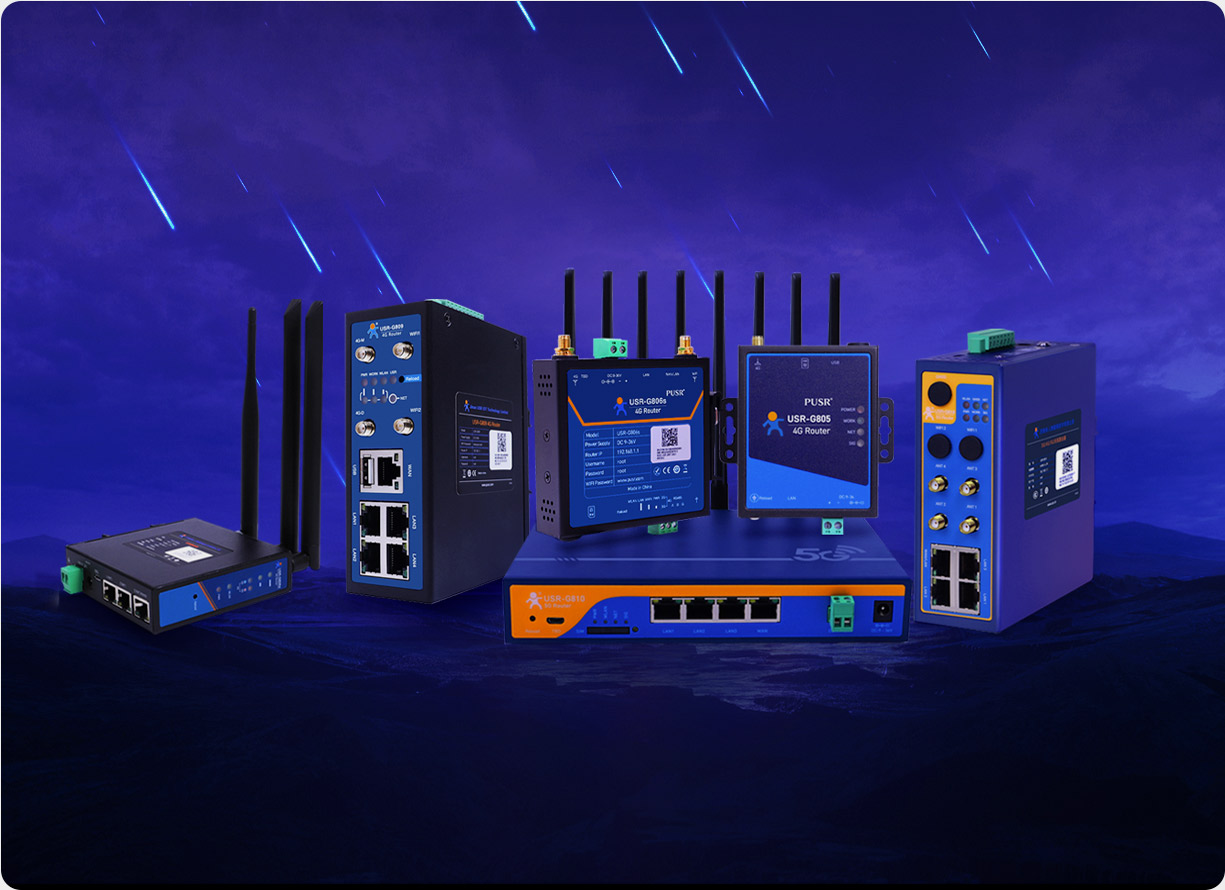
USR-M300.Dual-core up to 1.2GHz running Linux. Serial ports: 1×RS232/485 + 1×RS485. Ethernet: 1×WAN/LAN + 1×LAN. IO: 2DI/2DO/2AI current type. Concurrent collection limit across serial, Ethernet, and IO: 2000 points. Node-RED visual programming. Supports Modbus RTU/TCP conversion and common PLC protocols. Uplink: LTE 4G/3G + Ethernet + ADSL. Compatible with PUSR Cloud, Alibaba Cloud, AWS, ThingsBoard, and Azure. Configurable reporting conditions and alerts. Grade 3 EMC. Operating temperature: -25 to 75°C. DIN rail and wall mount. Wide-voltage power supply. Modular IO expansion available.
Inventory device ports and protocols → build point table → configure uplink and reporting interval → set alert thresholds → test offline resume-push.