In-depth Application of Industrial Panel PC in Smart Agriculture: The Solution to Breakthrough in Real-time Monitoring of Soil Temperature and Humidity
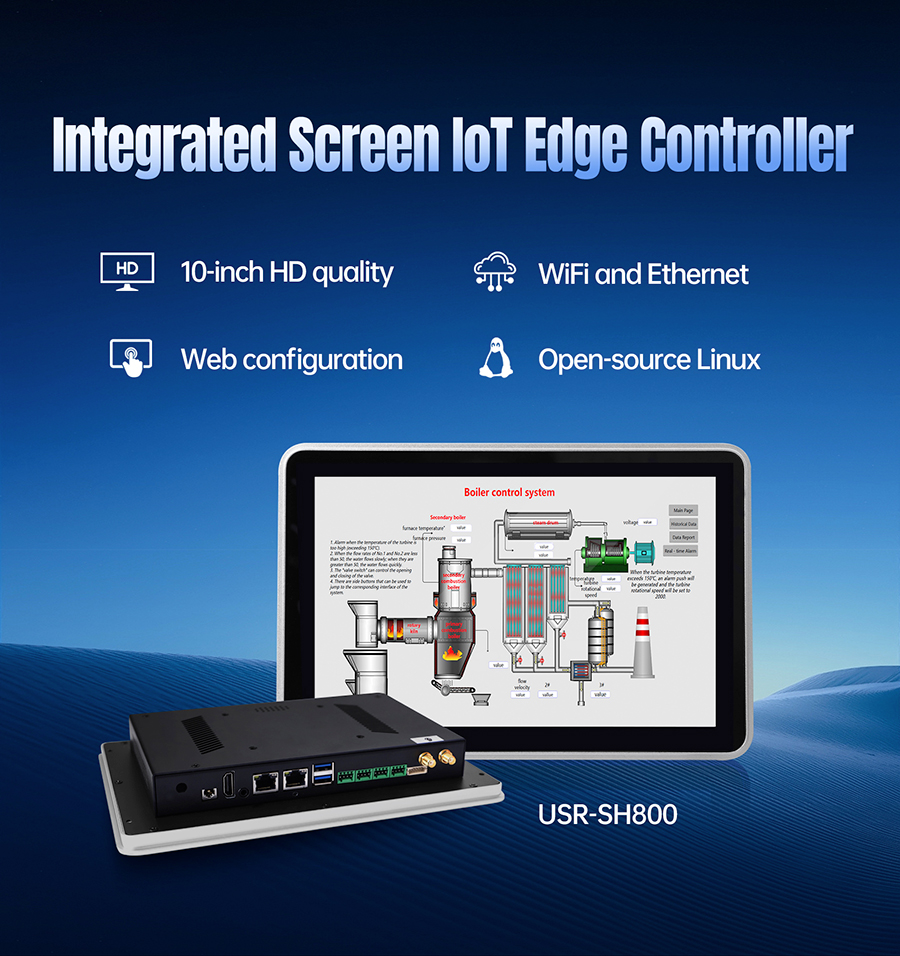
In the wave of transformation from traditional agriculture to smart agriculture, soil temperature and humidity monitoring, as a core component of precision agriculture, is undergoing a revolutionary change from "experience-based judgment" to "data-driven" decision-making. However, agricultural practitioners currently face three major pain points: sensor data silos, high equipment deployment costs, and complex system operations. The emergence of the industrial panel PC USR-SH800 provides a low-cost and efficient solution for real-time monitoring of soil temperature and humidity through the full-chain integration of "sensing-transmission-decision-making-execution."
Traditional agricultural monitoring often adopts a "single-point" sensor layout. For example, a vegetable planting base once deployed 20 independent temperature and humidity sensors, but due to the lack of a unified management platform, the data was scattered across five different branded apps. This fragmented model leads to three core issues:
Data Fragmentation: It is impossible to achieve cross-regional and cross-device data correlation analysis. For instance, it cannot determine whether temperature and humidity differences in adjacent plots are caused by irrigation system failures.
High Maintenance Costs: Each sensor requires separate configuration of gateways, power supplies, and SIM cards. An orchard project incurred an average annual communication cost of RMB 32,000 as a result.
Delayed Response: When soil humidity falls below the threshold, manual login to multiple platforms is required to view data, followed by manual activation of the irrigation system, resulting in an average response time exceeding 4 hours.
Some agricultural IoT solutions claim to be "intelligent," but in reality, they only provide data display functions. For example, a smart greenhouse project adopted a "sensor + PC-end software" model, but its operation interface contained 17 parameter setting items, requiring professional technical personnel for maintenance. This "pseudo-intelligent" system leads to:
High Usage Threshold: 60% of farmers abandon using it due to complex operations, rendering the equipment as "digital decorations."
Experience-Dependent Decision-Making: The system only provides raw data and lacks decision-making suggestions based on crop growth models. For example, it cannot dynamically adjust humidity thresholds according to different growth stages of tomatoes.
The USR-SH800 adopts an integrated design of "sensor + gateway + display screen," with its core innovation lying in:
Multi-Sensor Fusion: It incorporates high-precision soil temperature and humidity sensors (accuracy ±2%RH, ±0.5℃) and supports external expansion modules for pH value, electrical conductivity, etc., enabling "one-screen management of multiple parameters."
Self-Organizing Network Communication: It integrates a LoRa wireless module, with a single device capable of covering a 2-kilometer radius area. A project covering 10,000 acres of farmland achieved full-area coverage with 12 USR-SH800 devices, saving 78% of wiring costs compared to traditional solutions.
Solar Power Supply System: Equipped with a 15W monocrystalline silicon solar panel + a 20,000mAh lithium battery, it can operate continuously for 15 days in rainy weather, solving the power supply problem for field equipment.
The smart agriculture cloud platform loaded on the USR-SH800 achieves in-depth data value mining through four functional modules:
Real-Time Monitoring Dashboard: It displays the distribution of soil temperature and humidity in the form of 3D heat maps and supports multi-dimensional screening by plot, crop type, growth stage, etc. For example, at a grape planting base, the system automatically identified abnormal humidity areas in Plot 3 and precisely located drip irrigation pipe blockages.
Intelligent Early Warning System: Users can customize threshold rules (e.g., "trigger an alert when soil humidity of soybeans in the pod-setting stage falls below 60%"), and the system pushes alert information through three channels: WeChat, SMS, and APP. A rice planting project reduced drought loss rates from 12% to 3% through this function.
Decision Support Engine: It incorporates over 200 crop growth models and generates irrigation suggestions in combination with meteorological data (e.g., the probability of rain in the next three days). In a wheat demonstration field, the irrigation volume calculated by the system based on soil humidity and evaporation was 31% more water-efficient than the empirical method.
Equipment Linked Control: It supports seamless connection with equipment such as water pumps, valves, and fans, enabling automated regulation. For example, when soil humidity falls below the threshold, the system automatically activates the drip irrigation system and adjusts the flow rate to a preset value.
At a 100,000-acre corn planting base in Shandong, the USR-SH800 system achieved three major breakthroughs:
Zoned Precision Management: The farmland was divided into 200 monitoring units, and 15 waterlogging-prone areas were identified through soil humidity heat maps. After guiding the renovation of the drainage system, the corn lodging rate decreased by 40%.
Variable Irrigation Optimization: Irrigation quotas were dynamically adjusted in combination with soil texture data (e.g., the ratio of sandy soil to clay soil). Tests showed that this mode saved 28% more water and increased yield by 9% compared to traditional uniform irrigation.
Disaster Early Warning Response: During the drought in the summer of 2024, the system issued an early warning 48 hours in advance when soil humidity fell to a critical level, guiding farmers to initiate emergency irrigation in advance and avoiding production losses exceeding RMB 5 million.
In an intelligent greenhouse in Jiangsu, the USR-SH800 system established a "environment-crop-equipment" linkage system:
Microenvironment Regulation: Through 10 integrated screens monitoring temperature and humidity gradients in different areas, the wet curtain-fan system was linked to control the temperature difference within the greenhouse within ±1℃, reducing the incidence of hollow tomato fruits from 18% to 5%.
Integrated Water and Fertilizer Management: The system automatically proportioned water and fertilizer solutions based on soil humidity and EC value (electrical conductivity), achieving precise supply of "small amounts but multiple times." Tests showed that this mode saved 45% more water and increased nitrogen fertilizer utilization by 22% compared to traditional fertilization.
Energy Consumption Optimization: By analyzing historical data, the system generated an "irrigation strategy during off-peak electricity hours," reducing greenhouse electricity costs by 31%.
The Chinese Academy of Agricultural Sciences developed a "Soil Health Assessment System" based on the USR-SH800, achieving three major scientific research breakthroughs through long-term monitoring:
Soil Degradation Early Warning: A correlation model between soil humidity and organic matter content was established to provide early warnings of potential degradation risks six months in advance.
Variety Adaptability Evaluation: By comparing the growth performance of different rice varieties under the same soil humidity conditions, flood-tolerant varieties were selected, shortening the trial period by 50%.
Carbon Sequestration Capacity Assessment: Combining soil humidity and microbial activity data, the carbon fixation capacity of agricultural soil was quantified, providing data support for carbon trading.
Cost Savings: Compared to traditional models, the USR-SH800 solution reduces overall equipment procurement, installation, and maintenance costs by 62%. A 500-acre farm saves RMB 87,000 in annual expenses.
Efficiency Enhancement: Data collection frequency increases from "once a day" to "once every 10 minutes," and decision-making response time shortens from "hour-level" to "minute-level."
Quality Improvement: Through precise regulation, the commodity rate of agricultural products increases by 15%-25%. For example, the proportion of Grade A strawberries at a strawberry base increases from 68% to 89%.
Brand Premium: A full-process data traceability system helps agricultural products pass green food certification, with product prices at a tea cooperative increasing by 30%.
Financial Empowerment: Soil health data has become an important basis for banks to assess agricultural loan risks. A breeding enterprise obtained a RMB 2 million low-interest loan with monitoring data.
Service Extension: "Agricultural Technology Service Packages" developed based on monitoring data achieve knowledge payment, with annual service revenue on a certain platform exceeding RMB 5 million.
Faced with the urgent demand for agricultural digital transformation, the USR-SH800 industrial panel PC provides not just equipment but a complete "sensing-decision-making-execution" solution. Contact us, and you will receive:
Free Customized Solutions: Design a exclusive monitoring network layout based on your planting scale, crop type, and budget requirements.
30-Day Trial Experience: Provide an opportunity to test sample machines on-site to intuitively feel the data-driven agricultural management transformation.
Exclusive Discount Packages: The first batch of consulting customers can enjoy equipment procurement subsidies and extended warranty services.
Faced with the dual challenges of climate warming and resource constraints, smart agriculture has become the inevitable path to ensuring food security. The USR-SH800 industrial panel PC redefines soil monitoring with technological innovation, allowing every inch of land to unleash its data value. Take action now to propel your farmland into a new era of "precise sensing and intelligent decision-making"!


















