An industrial PC for AGV/AMR is different from a conventional industrial computer.
It is installed on a moving machine and has to deal with battery-powered operation, motor start/stop cycles, vibration, limited installation space, and wireless communication. At the same time, it may need to communicate with CAN devices, RS485 equipment, and Ethernet networks while handling data processing or edge computing locally.
So when choosing an industrial PC for AGV, don't start with the CPU model. Start with these key requirements.
AGVs are usually battery-powered. During operation, the input voltage can fluctuate because of battery conditions, motor startup, braking, and other load changes.
For a vehicle-mounted industrial PC, check:
For example, the PUSR EG228 supports9–36V DC input and reverse-polarity protection, while the EG628 also supports a9–36V wide DC input range.
For AGVs using a compatible battery voltage system, this can reduce the need for additional power conversion.
However,wide-voltage input does not mean that an industrial PC can be connected directly to any AGV battery. The actual battery voltage, peak voltage, and power protection design should always be checked before deployment.
An AGV has limited internal space, and the industrial PC may be installed close to batteries, motors, or other electronic components.
With a fan-cooled computer, long-term operation also raises concerns such as:
This is why a fanless industrial PC can be a practical choice for many AGV/AMR applications.
The EG228 uses a fanless design and supports an operating temperature range of-25°C to +75°C. The EG628 operates from-20°C to +70°C. Their metal enclosures also help with heat dissipation.
For indoor warehouse AGVs that need to operate continuously with minimal maintenance, this type of design can be particularly useful.
However, if the AGV needs to run intensive vision or AI workloads, fanless design alone is not enough. Thermal performance must be evaluated together with the actual computing load.
An AGV industrial PC is not simply a computer running an application. It may also act as a communication hub for the vehicle.
For example:
CAN/CAN FD:
Used to communicate with vehicle-side controllers and other CAN bus devices.
RS485:
Suitable for connecting meters, sensors, and other serial devices.
Ethernet:
Used for industrial networking and communication with other onboard or supervisory systems.
The EG228 provides2×RS485, 2×CAN FD, and 2×Ethernet, while the EG628 provides2×RS485, 1×CAN, and 2×Ethernet, along with USB connectivity.
This is an important point for PUSR:
Instead of simply putting a computer on an AGV, PUSR combines computing and industrial communication interfaces in one edge device.
That can simplify the architecture when the AGV needs both local computing and communication with industrial equipment.
This is one of the easiest places to overspend on an AGV project.
If the onboard computer mainly handles:
then a low-power ARM-based platform may already be sufficient.
For example, the EG228 is an ARM-based platform running Ubuntu 22.04 and can be used for Node-RED, edge data collection, and protocol conversion.
The EG628 provides higher computing capability and supports applications such as Docker, Node-RED, PLC programming, and industrial protocols.
On the other hand, if an AGV needs to run complex vision algorithms, SLAM, or large AI models, you should not select an ARM industrial PC simply because it has enough interfaces.
Define the computing workload first. Then decide whether ARM, x86, or an AI-accelerated platform is appropriate.
Many AGV projects specify that communication must have low latency.
But communication latency does not come from the industrial PC alone. It can also be affected by:
A more practical approach is to let the industrial PCprocess time-sensitive data locally whenever possible, instead of sending every operation to a remote server or cloud platform.
This is where edge computing becomes useful in AGV systems: data can be processed on the vehicle first, while only the required information is sent to the fleet management system or cloud platform.
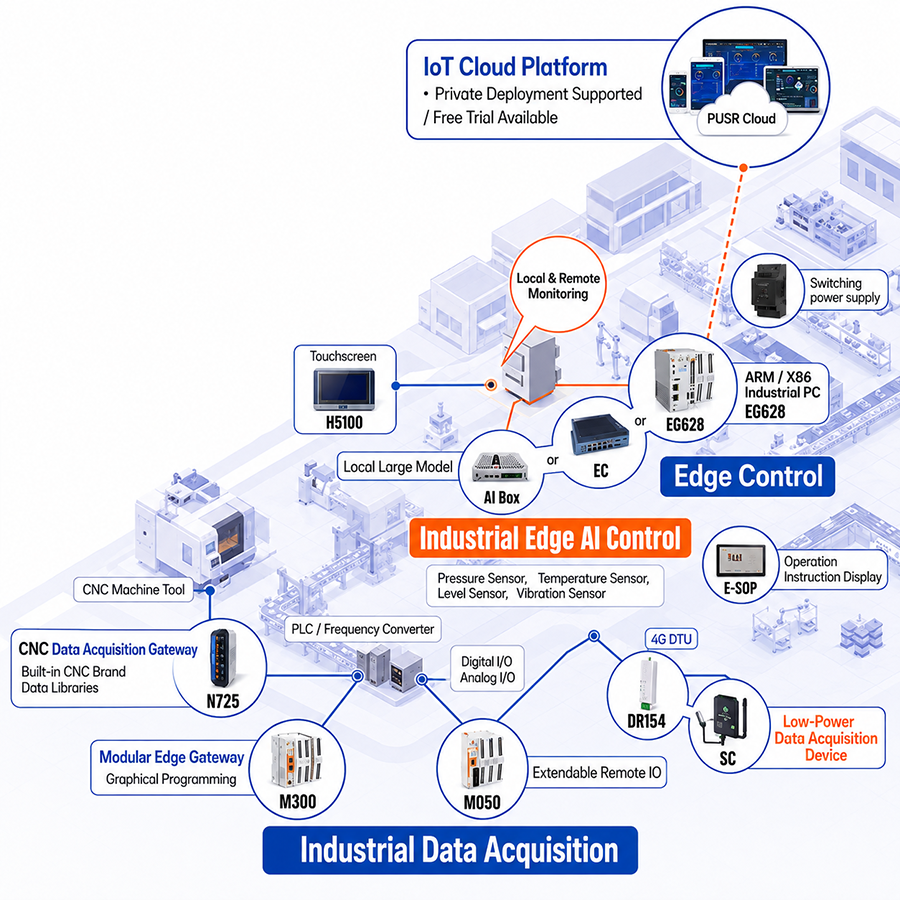
Based on their computing and industrial communication capabilities, PUSR industrial PCs are particularly relevant to AGV/AMR applications such as:
Light-duty AGVs and AMRs:
For data acquisition, communication, protocol conversion, and edge applications.
Industrial logistics AGVs:
When CAN, RS485, and Ethernet connectivity are required and the design aims to reduce additional communication modules.
Robots requiring onboard edge computing:
For processing data locally and communicating with upper-level systems through Ethernet, Wi-Fi, or cellular connectivity.
OEM platforms requiring Linux, Node-RED, or Docker:
For teams that want a flexible Linux environment for application development rather than a closed control platform.
If the main workload involves multi-camera vision, advanced SLAM, or large-scale AI inference, the priority should be sufficient GPU/NPU computing performance rather than simply the number of industrial interfaces.
Q: Does an AGV always need an industrial PC?
Not necessarily. The right computing platform depends on the required processing performance, industrial interfaces, environmental conditions, and reliability requirements. For simple control tasks, other platforms may be sufficient.
Q: Is a fanless industrial PC suitable for AGVs?
It can be a good choice for many onboard applications, especially where continuous operation, limited space, and reduced dependence on mechanical cooling are important. The actual ambient temperature and computing load should still be checked.
Q: What should I consider if my AGV requires CAN?
First determine whether you need CAN or CAN FD. Then check the required number of CAN channels and whether RS485, Ethernet, or other I/O interfaces are also required.
Q: How do I choose between the EG228 and EG628?
If the workload focuses on low-power data acquisition, protocol conversion, and lightweight edge computing, the EG228 can be considered. If you need higher computing performance, broader software applications, or PLC and edge computing capabilities, the EG628 may be more suitable.
Q: Can an industrial PC replace the AGV's safety controller?
This should not be assumed. Functions such as emergency stops, safety laser scanners, functional safety, and motion safety should be designed and validated according to the complete machine safety architecture and applicable safety requirements.
Choosing an industrial PC for AGV is not simply about finding the most powerful CPU. The more important question is whether the computer can reliably perform its intended tasks within the vehicle's power, thermal, communication, and computing environment.
For AGV/AMR applications centered on industrial communication, data acquisition, and edge computing, a combination ofwide DC input, fanless design, CAN/RS485, Ethernet, and Linux-based edge computingcan be more valuable than simply choosing the highest CPU performance.


















