Selection Guide for the "Brain" of High-Precision SLAM Navigation AGV: Matching Rules for Performance Parameters of Embedded Single Board Computer
In the wave of intelligent manufacturing and smart logistics, high-precision SLAM (Simultaneous Localization and Mapping) navigation AGVs (Automated Guided Vehicles) are gradually becoming core equipment in scenarios such as factories and warehouses. They act like autonomous "porters," precisely navigating between shelves and efficiently completing material handling tasks. However, for AGVs to truly achieve "intelligence" and "efficiency," the selection of their "brain"—the embedded single board computer—is crucial. This article will delve into the performance parameter requirements of high-precision SLAM navigation AGVs for embedded single board computers, gain insight into customers' pre-selection psychology, empathize with their pain points, and provide a practical selection guide.
When selecting an embedded single board computer for high-precision SLAM navigation AGVs, customers first expect high-performance computing capabilities. SLAM algorithms involve extensive data processing and computation, including sensor data fusion, path planning, real-time localization, etc., which impose extremely high demands on the CPU, GPU, or NPU performance of the embedded single board computer. At the same time, customers also hope that the embedded single board computer has high reliability, enabling stable operation in harsh industrial environments and reducing failure rates and maintenance costs. Additionally, ease of integration is a key concern for customers, as they hope the embedded single board computer can seamlessly interface with existing AGV hardware and software systems, reducing development difficulty and cycle time.
However, alongside their expectations, customers also have concerns. They worry whether high-performance embedded single board computers will come with high costs and how to find the optimal balance between performance and cost. They are also concerned about the compatibility of the embedded single board computer with hardware devices from different brands and models, such as sensors and actuators. Furthermore, as AGV functions continue to expand, customers hope that the embedded single board computer has good expandability to support potential future functional modules, such as visual recognition and voice interaction.
Traditional AGVs often rely on external positioning systems, such as magnetic strips, QR codes, and RFID, for path planning and navigation. While this method is simple and reliable, it has limited flexibility and struggles to adapt to complex and changing industrial environments. Once the external positioning system is damaged or altered, the AGV's navigation function will be severely affected or even cease to operate.
In certain scenarios with extremely high positioning accuracy requirements, such as precision assembly and microelectronics manufacturing, the positioning accuracy of traditional AGVs often falls short. Excessive positioning errors may cause collisions between the AGV and shelves or equipment, resulting in losses.
Traditional AGVs mostly follow preset paths and lack autonomous decision-making capabilities. When encountering emergencies, such as obstacles or personnel blocking, AGVs often cannot respond promptly, leading to task interruptions or reduced efficiency.
The navigation and control systems of traditional AGVs are often independent of each other, making system integration difficult. Developers need to spend a significant amount of time and effort on system debugging and optimization, resulting in long development cycles and high costs.
SLAM algorithms involve extensive data processing and computation, including sensor data fusion, feature extraction, map construction, path planning, etc. Therefore, the embedded single board computer needs to have high-performance computing capabilities to support the real-time operation of SLAM algorithms. Specifically, the embedded single board computer should be equipped with high-performance CPUs, GPUs, or NPUs with multi-core parallel processing capabilities to quickly process large amounts of data.
High-precision SLAM navigation AGVs need to connect to various sensors and actuators, such as LiDAR, cameras, IMUs (Inertial Measurement Units), encoders, etc. Therefore, the embedded single board computer needs to have a rich variety and quantity of interfaces to support the connection of different devices. At the same time, the embedded single board computer should also have good expandability to support potential future functional modules, such as visual recognition modules and voice interaction modules.
Industrial environments are often harsh and complex, with various interference factors such as high temperatures, low temperatures, humidity, dust, and vibration. Therefore, the embedded single board computer needs to have high reliability and stability, enabling long-term stable operation in harsh environments. Specifically, the embedded single board computer should adopt an industrial-grade design with dustproof, waterproof, vibration-resistant, and anti-interference capabilities, while also supporting a wide temperature operating range to meet the needs of different industrial scenarios.
AGVs are usually battery-powered, so the power consumption of the embedded single board computer is also a key concern for customers. A low-power embedded single board computer can extend the AGV's battery life, reducing charging frequency and maintenance costs. At the same time, an embedded single board computer with a high energy efficiency ratio can reduce power consumption while ensuring performance, improving energy utilization efficiency.
The embedded single board computer not only needs to have hardware performance advantages but also needs to provide strong software support and development tools. This includes operating systems, drivers, development libraries, debugging tools, etc. Comprehensive software support and development tools can reduce development difficulty and cycle time, improving development efficiency and quality.
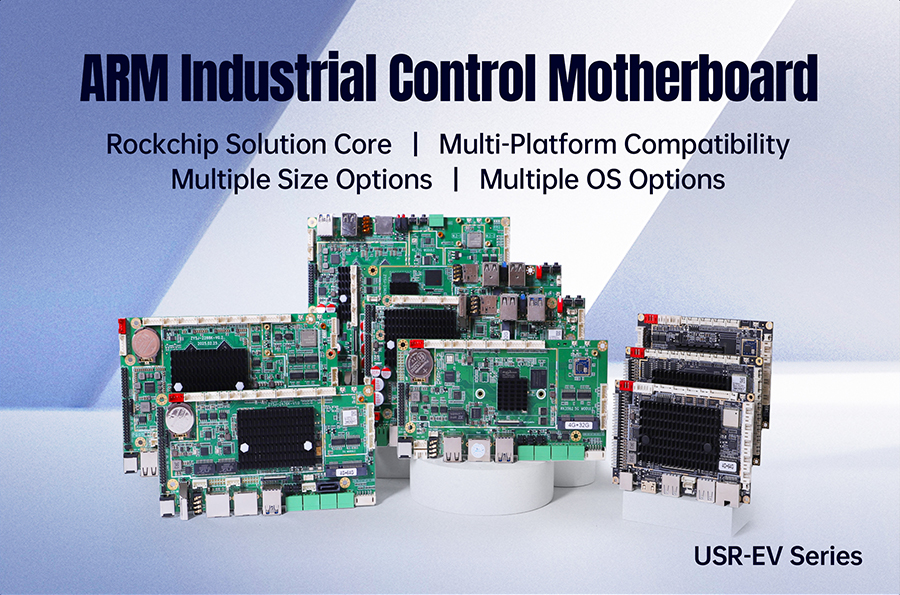
Among numerous embedded single board computer products, the USR-EV series stands out with its outstanding performance, stability, and ease of use, making it the ideal choice for high-precision SLAM navigation AGVs. The USR-EV series embedded single board computer is equipped with a high-performance processor, featuring powerful computing capabilities and multi-core parallel processing capabilities, easily meeting the complex computational requirements of SLAM algorithms. At the same time, it provides a rich variety and quantity of interfaces, supporting the connection of various sensors and actuators, with good expandability.
The USR-EV series embedded single board computer adopts an industrial-grade design with dustproof, waterproof, vibration-resistant, and anti-interference capabilities, enabling stable operation in harsh industrial environments. It also supports a wide temperature operating range to meet the needs of different industrial scenarios. In terms of power consumption, the USR-EV series embedded single board computer adopts a low-power design, effectively extending the AGV's battery life and reducing maintenance costs.
Additionally, the USR-EV series embedded single board computer provides comprehensive software support and development tools, including operating systems, drivers, development libraries, debugging tools, etc. These tools can reduce development difficulty and cycle time, improving development efficiency and quality. At the same time, the USR-EV series embedded single board computer also supports customized development services, allowing functional customization and expansion according to customers' specific needs.
The high-performance computing capabilities of the USR-EV series embedded single board computer can support the real-time operation of high-precision SLAM algorithms, improving the navigation accuracy and flexibility of AGVs. It no longer relies on external positioning systems but uses its own sensors for real-time localization and map construction, adapting to complex and changing industrial environments.
The USR-EV series embedded single board computer supports advanced path planning and obstacle avoidance algorithms, enabling AGVs to have stronger autonomous decision-making capabilities. When encountering emergencies, the AGV can respond promptly, adjusting its driving path or stopping to avoid task interruptions or reduced efficiency.
The USR-EV series embedded single board computer provides comprehensive software support and development tools, reducing system integration difficulty and development cycle time. Developers can quickly complete the integration and debugging of the AGV's navigation and control systems, improving development efficiency and quality.
The USR-EV series embedded single board computer adopts an industrial-grade design with high reliability and stability. It can operate stably for long periods in harsh industrial environments, reducing failure rates and maintenance costs. At the same time, its low-power design can also extend the AGV's battery life, reducing charging frequency and maintenance costs.
High-precision SLAM navigation AGVs are important equipment in the fields of intelligent manufacturing and smart logistics. To truly achieve "intelligence" and "efficiency" in AGVs, the selection of their "brain"—the embedded single board computer—is crucial. The USR-EV series embedded single board computer, with its outstanding performance, stability, and ease of use, is the ideal choice for high-precision SLAM navigation AGVs. It not only improves the navigation accuracy and flexibility of AGVs, enhances autonomous decision-making capabilities, reduces system integration difficulty and development cycle time, and improves reliability and stability but also brings customers higher return on investment and lower maintenance costs. Selecting the right "brain" makes AGVs smarter and more efficient!