Robotic arms and AGV run steadily on an automated factory floor. Yet as operations scale, communication between devices begins to falter: WiFi signals weaken through walls, network handoffs delay when robots pass charging zones, and interference intensifies as more devices operate simultaneously.
These are not isolated occurrences but common networking challenges encountered during large-scale deployment of mobile robots.
AGVs and collaborative robots move continuously within factory environments, imposing three Rigid requirements on the network:
Signal coverage continuity.Robots traverse production areas, charging zones, and warehouse spaces. A single WiFi access point cannot achieve full coverage across such physical spaces.
Roaming handoff speed.Extended communication interruption during access point transitions causes control command latency or execution failure.
Multi-device concurrency stability.As the number of simultaneously operating robots increases, co-channel interference worsens, making dual-band operation a necessity rather than an option.
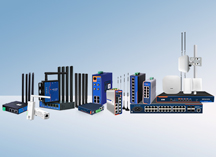
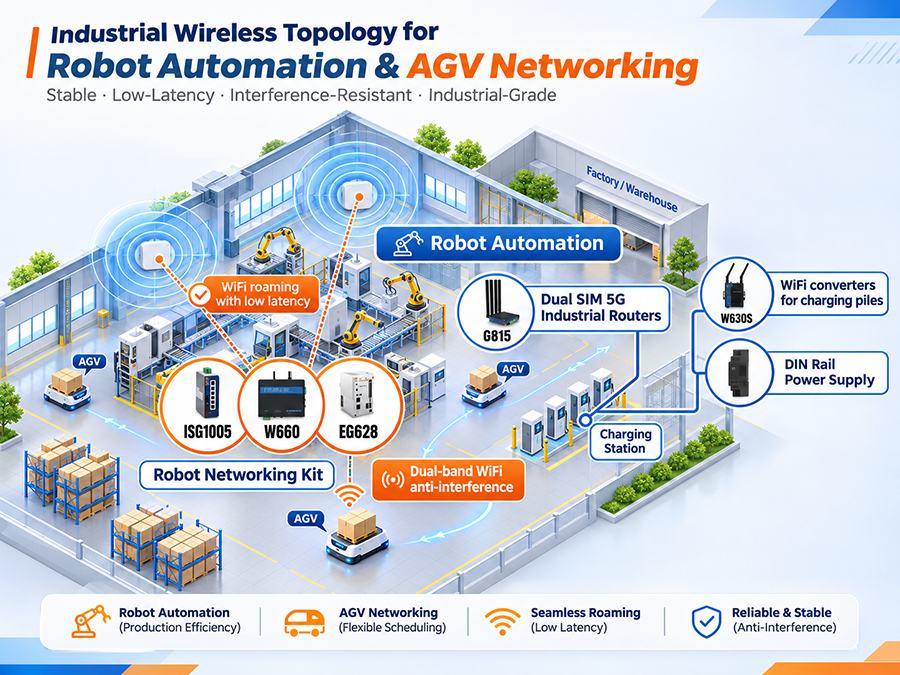
PUSR's mobile robot networking solution employs a layered architecture, with each device layer assuming a Clarify network role from central control to edge access.
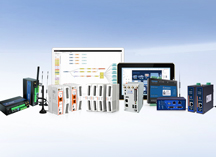
Central control layer.The USR-EG628 industrial PC serves as the system control core, running local data acquisition and application logic. Powered by the RK3562J industrial-grade chip—a quad-core Cortex-A53 processor—it supports 4G/5G/Ethernet multi-network redundant backup. Dual RS485, single RS232, and CAN interfaces connect field sensors and actuators, while two Ethernet ports handle communication with switches and routers. Built-in Node-RED and Docker enable data preprocessing and protocol conversion at the edge.
Wide-area connection layer.The USR-G816 5G industrial router provides core network backhaul via 5G SA/NSA, supporting dual SIM card backup. A Qualcomm quad-core processor paired with an X62 modem covers global mainstream frequency bands. When wired networks fail, the 5G link automatically switches to a backup channel, ensuring uninterrupted communication between the control center and edge devices. The router supports multiple VPN protocols including PPTP, L2TP, IPSec, and OpenVPN to secure data transmission.
Local switching layer.The USR-ISG/ISF gigabit industrial Ethernet switch connects fixed equipment such as PLCs, vision inspection systems, and charging controllers. Operating from -40°C to +85°C with 6KV lightning protection and dual power supply redundancy, it withstands electrically noisy automated factory environments. IP40 ingress protection and DIN-rail mounting simplify control cabinet deployment.
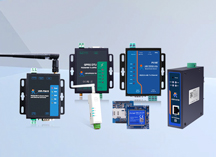
Edge access layer.The USR-W630S dual-band wireless client deploys at charging zones and mobile nodes, supporting 2.4GHz and 5.8GHz bands with transmission rates up to 1267Mbps. Built on Qualcomm WiFi 5 silicon, it offers four operation modes—AP, STA, AP+STA, and bridge—allowing flexible configuration as a data aggregation node at charging stations. Built-in edge data acquisition supports 1,000-point local data collection, enabling Modbus protocol conversion and data reporting without an external PC.
Adopting a layered wireless topology produces three observable changes in mobile robot networking systems:
Controllable roaming latency.Dual-band WiFi combined with the edge layer's built-in signal scanning function allows engineers to assess signal strength across zones during installation, enabling rational access point placement. Communication interruption during access point transitions shortens to the second level.
Improved concurrency stability.The 2.4GHz band offers wide coverage and strong penetration, suitable for basic control channels; the 5.8GHz band provides higher bandwidth with less interference, reserved for high-volume data transfer. Dual-band separation reduces co-channel conflict probability.
Edge preprocessing reduces cloud pressure.USR-W630S and USR-EG628 handle data acquisition and protocol conversion locally, uploading only processed critical data to the platform. This reduces cloud communication bandwidth consumption and improves overall system response speed.
When selecting a networking solution for mobile robots, focus on these areas:
Central control devices must support multi-network redundancy and edge computing frameworks.The USR-EG628 provides a foundation for secondary development through modular expansion interfaces and the Linux open-source ecosystem.
Wide-area links must support dual SIM backup and multiple VPN protocols.The USR-G816 features automatic WAN failover switching and real-time alarm functionality.
Edge access must support multiple operation modes and dual-band capability.The USR-W630S offers four modes and built-in signal scanning, simplifying on-site commissioning.
Switches must deliver wide temperature range, lightning protection, and dual power supplies.The USR-ISG/ISF series operates from -40°C to +85°C and provides 6KV surge protection.
The combination of USR-EG628, USR-G816, USR-ISG/ISF, and USR-W630S forms a complete mobile robot networking solution covering the full chain from central control to edge access. All products hold international certifications including CE, FCC, ROHS, and 3C, supporting global deployment.