Oil and Gas Scenario AGV Communication Dilemma: Analysis of the 5G+LoRa Dual-Mode Solution for Industrial PC
The email arrived at 2 a.m., sent by a Chinese project manager stationed in Abu Dhabi.
The subject line had only one line: "17th disconnection, 3rd collision with tank farm fence."
The body was short, but every sentence carried exhaustion:
"Mr. Li, our AGV fleet has been dropping connections continuously for a week in the oil and gas storage area. 5G signals can't penetrate the explosion-proof walls, LoRa bandwidth isn't enough for video, and Wi-Fi disappears after two walls. Today, Vehicle #3 lost all communication entering the storage area—it only avoided the isolation fence thanks to the last layer of laser obstacle avoidance.
The client has issued a final ultimatum: one more safety incident next week, and the entire project gets a new supplier.
I know this isn't a communication module issue, but I don't know who to turn to now. The 5G vendor says it's an environment problem, the LoRa vendor says it's a bandwidth problem, the AGV integrator says it's the industrial PC's problem.
What do I actually do?"
Mr. Li forwarded this email to me.
He added no comments—just one sentence: "Have you ever been to an oil and gas site?"
I hadn't. But I knew what lay behind this email wasn't just a communication problem.
It was the suffocation of a project manager in a foreign land at 2 a.m., who after seventeen failures still dared not tell his boss back home: "I can't do this."
Anyone who has worked on oil and gas AGV projects has a physiological aversion to the word "communication."
It's not because the technology is complex—complexity plagues every industry. Oil and gas communication is hard because it simultaneously hits three "impossibles":
The first impossible: signals can't penetrate.
The architecture of oil and gas storage areas is designed for explosion-proofing and leak prevention—not for communication. Thick explosion-proof concrete walls, metal sealed doors, stainless steel pipes dense as spider webs—5G signals attenuate by over 40dB passing through. You test full bars outdoors; step inside the storage area, and even a phone turns into a brick, let alone an AGV.
The second impossible: bandwidth isn't enough.
An AGV isn't just sending an "I've arrived" signal. It needs to stream multiple camera feeds in real time, LiDAR point clouds, IMU data, vehicle status. One AGV's video stream alone requires 10-20Mbps; a fleet of ten vehicles means 200Mbps. LoRa bandwidth is only tens of kbps—it can't even handle one standard-definition video feed.
The third impossible: safety can't wait.
When a warehouse AGV drops connection, it at worst stops and waits. When an oil and gas AGV drops connection, it keeps moving. Behind it: storage tanks. Beside it: pipe racks. Under it: the boundary between explosion-proof and non-explosion-proof zones. When communication dies, it becomes a lump of iron running blind in a hazardous area.
Three "impossibles" stacked together form a dead knot:
Use 5G—disconnects the moment you enter the storage area. Use LoRa—jams the moment you leave. Use Wi-Fi—vanishes the moment you change rooms.
The project manager tried every single-mode solution. 5G base station pulled up to the storage area entrance—signal still couldn't get in. LoRa gateways hung all over the area—bandwidth couldn't support video. Wi-Fi roaming configured—AGV switching from Zone A to Zone B took 800ms, enough to hit two walls.
He wasn't lazy. He tried seventeen times, and every time, he was just a little short.
In the oil and gas industry, "a little short" means "a major disaster."
Later, I talked to several oil and gas AGV integrators and discovered something interesting:
They weren't unaware that 5G+LoRa could solve the problem. In fact, the industry had long proposed the concept of "dual-mode communication"—use 5G for bandwidth, LoRa for coverage.
But the problem was "who installs it."
The 5G module belongs to one telecom vendor; the LoRa module to another. Two sets of antennas, two protocol stacks, two driver sets—all needing to fit inside one industrial PC.
Traditional industrial PCs have fixed I/O. Add 5G—it takes an M.2 slot or a PCIe slot. Add LoRa—it takes a serial port or USB port. Not enough space, not enough power, not enough thermal headroom. Worse: who writes the handover logic between the two communication systems? In the AGV's main control program, the communication module is just a peripheral—it doesn't know when to switch to 5G or when to switch to LoRa.
So integrators either wrote the handover logic themselves—resulting in switchover times starting at two seconds, by which time the AGV had long since gone off course—or handed the logic to the telecom vendors—who only care about communication, not AGV safety policies, so late handover still caused accidents.
At its core, this isn't a communication problem. It's a "system integration" problem.
Whoever can put 5G and LoRa into the same industrial PC, make them switch automatically in milliseconds, schedule them uniformly at the edge, and run reliably within explosion-proof ratings—that person solves the last kilometer of oil and gas AGV communication.
The Right Way to Open a Dual-Mode Solution: Not "Two Modules Stitched Together," but "One Brain Managing Two Roads"
I later saw a well-executed solution that thought differently from most on the market.
It didn't treat 5G and LoRa as two independent communication modules to be "stitched together." Instead, it treated them as two "roads" within the same communication architecture—one is a highway (5G): high bandwidth, fast speed, but limited coverage; the other is a country lane (LoRa): low bandwidth, slow speed, but everywhere.
When the AGV runs outside the storage area, it takes the highway—5G streams video and point clouds at full speed. When it enters the storage area and the highway cuts off, the system automatically switches to the country lane within 50ms—LoRa guarantees basic heartbeat signals and command downlink. When it exits, it switches back to 5G, and the video stream resumes seamlessly.
Throughout the entire handover, the AGV's main control program is completely unaware. It doesn't need to know what communication method it's using. It only needs to know—"my data is flowing, my commands are arriving, I haven't dropped."
The key to making this work isn't how good the 5G module is or how strong the LoRa module is. It's the industrial PC that houses them.
Specifically, this industrial PC must simultaneously meet several conditions:
First, enough physical space. It must fit the compute board, 5G module, LoRa module, PoE power supply, CAN Bus interface, DIO—and still leave thermal headroom. This requires the industrial PC's internal structure to be modular—not the traditional "motherboard soldered down, I/O fixed" design, but one where each function block is independently plug-in and expandable.
Second, fast enough handover logic. The 5G-to-LoRa switch can't rely on software polling—it needs hardware-level signal detection and automatic routing. This requires the industrial PC's communication interfaces not to be simple "transparent passthrough," but to have edge computing capability—it can judge signal quality on its own, make link selection on its own, and buffer data packets during handover without loss.
Third, hard enough explosion-proof rating. Oil and gas storage areas are Zone 1 or even Zone 0—the industrial PC must pass Ex d IIB T4 or higher certification. And because the communication modules are plug-in, swapping one module must not affect the explosion-proof rating—which brings us back to modular certification logic: each module certified individually, no recertification needed for the assembled unit.
Fourth, long enough lifecycle. Oil and gas projects run for ten years minimum. The industrial PC's processor platform must have 10+ years of embedded support; the OS must be a long-term servicing version like Windows 11 Enterprise IoT LTSC—not something that changes every three years or gets discontinued every five.
Miss any one of these four conditions, and the solution won't run.
Last year, two teams ran AGV tests in the same oil and gas storage area. Area: 12,000 sqm. Explosion-proof rating: Zone 1. AGV fleet: 8 vehicles. Requirement: real-time return of 4 camera feeds.
Team A used the traditional approach: industrial PC with 5G module, supplemented by LoRa gateways inside the storage area for coverage. Two sets of equipment, two power supplies, two management platforms. Handover done by AGV main control software polling—switchover time: 1.2 seconds.
Day one of testing: 11 disconnections. Day three: one AGV lost video stream during Zone A to Zone B handover; safety officer manually emergency-stopped. Day five: client halted the test.
Team B used a modular dual-mode industrial PC solution: 5G and LoRa in the same machine, handover logic running at the industrial PC edge—switchover time: 38ms. No extra gateways inside the storage area; all communication originated from the AGVs themselves.
Day one: zero disconnections. Day seven: 168 continuous hours with no communication faults. Day fourteen: client signed the acceptance form.
Both teams used the same 5G module vendor and the same LoRa module vendor. The only difference: Team B's industrial PC had the two roads "grown together."
Not a technology gap—an architecture gap.
If you're currently working on oil and gas AGV communication solutions, you're probably in a very contradictory state:
On one hand, you know 5G+LoRa is the right direction. It's in the papers, presented at industry summits, drawn in countless architecture diagrams in PowerPoints.
On the other hand, you cram all this into an industrial PC and find: not enough space, not enough cooling, not fast enough handover, certification won't pass, integrators can't handle it.
You start wondering: is this direction just not mature yet?
It's not that the direction is immature. It's that the "box" meant to carry it isn't ready.
Dual-mode communication isn't the hard part. The hard part is finding an industrial PC that can fit dual-mode comms, edge handover, explosion-proof certification, modular expansion, and a ten-year lifecycle—all into one unified platform that doesn't require you to do secondary development.
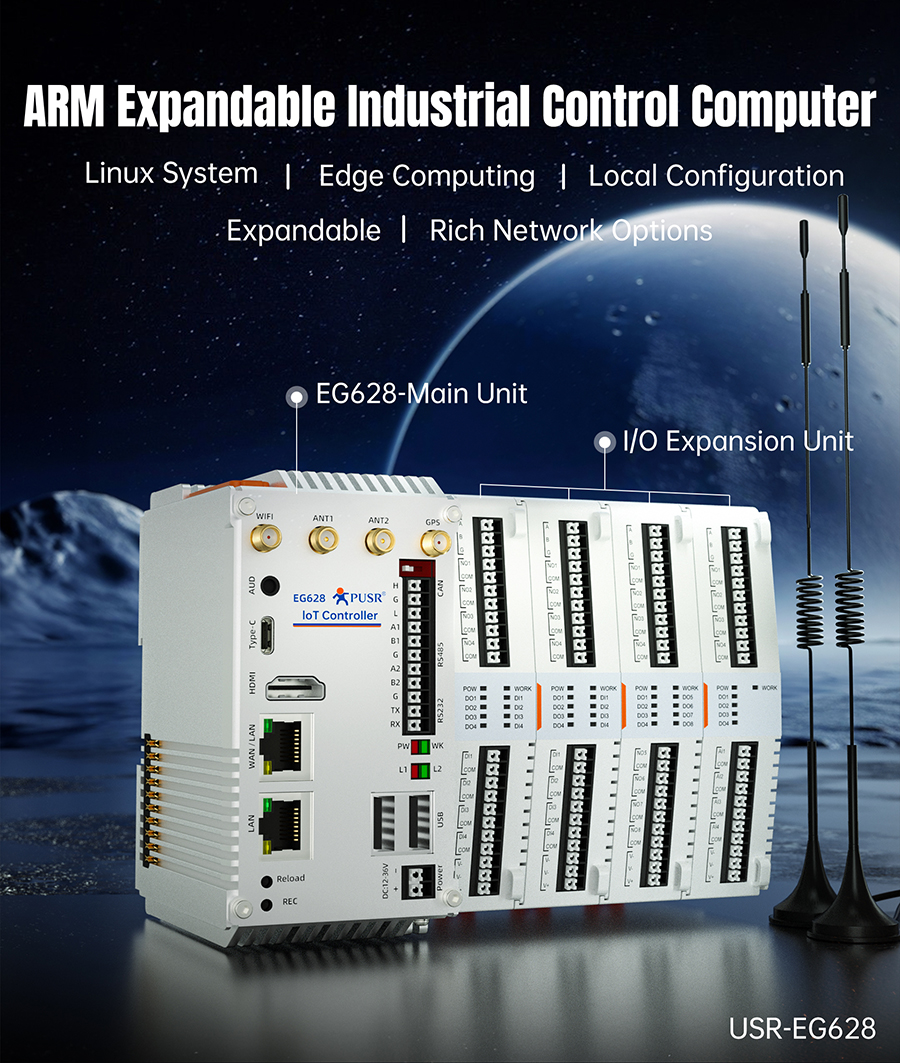
Such industrial PCs do exist. Take the USR-EG628 series, for example. Its modular I/O architecture is naturally suited for communication expansion—5G, LoRa, Wi-Fi, PoE each as independent modules. The compute platform uses Intel embedded processors with guaranteed long-term supply. The enclosure supports explosion-proof retrofit. The whole design is built for "one box solves all scenarios."
It's not the most expensive industrial PC on the market, nor the one with the strongest specs. But in the specific context of oil and gas AGVs, it might be that "just right" choice—just enough space, just fast enough switching, just enough for ten years, just enough that you don't need to coordinate three suppliers.
Mr. Li didn't reply to that email directly.
He sent me to Abu Dhabi with two samples of the modular dual-mode industrial PC.
When the project manager received the samples, he first touched the enclosure, then asked a very small question: "If I pull out the LoRa module, can the 5G still run?"
I said: "Yes. Once pulled out, it becomes a pure 5G industrial PC—no impact on any certification."
He was silent for a few seconds, then said one sentence:
"Then I don't need to write any more explanation emails to the client."
You see, technology never solves just technical problems.
It solves a project manager's despair at 2 a.m. It solves an integrator's confidence after the 17th disconnection. It solves an oil and gas client's patience after the 18th safety report.
5G+LoRa isn't a communication solution. It's a sentence: I'm here, I'm connected, I won't drop.
And what makes that sentence true isn't the base station, isn't the gateway—it's the industrial PC sitting inside the AGV, the one you probably never looked at closely.
Is your oil and gas AGV "running fast where there's signal," or "not stopping even where there's no signal"?
The answer to that question isn't in the communication module's datasheet. It's in the industrial PC's architecture.