"With dozens of townships and hundreds of devices, it is impossible to cover them all manually."
This is one of the most realistic challenges in rural environmental governance. One environmental protection company, based on PUSR Cloud, transformed "running around exhausted" into "one-screen control" — 440 devices, 302 video channels, and 71 management scenarios integrated into a unified supervision system covering three prefecture-level cities.
Rural water treatment is shifting from "people finding problems" to "problems proactively finding people."
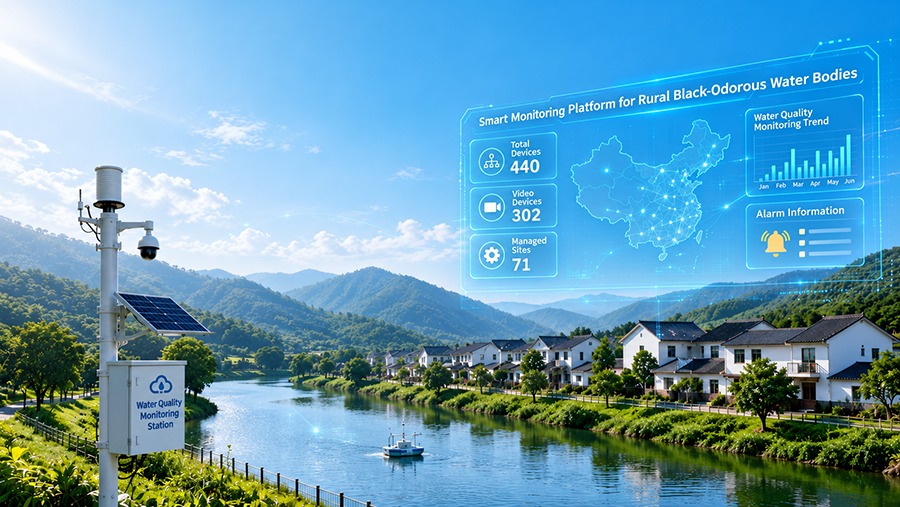
Rural environmental governance is fundamentally challenging due to a single word: "scattered."
Scattered monitoring points, high inspection costs: Monitoring stations, treatment facilities, and aeration machines are spread across dozens of townships, making manual inspections time-consuming and labor-intensive.
Diverse devices, data hard to integrate: Over five brands of flow meters, multiple analyzers and cameras with different protocols make data aggregation difficult.
High supervision requirements: Real-time tracking of water quality and facility status, with visualization and data traceability as essential needs.
Platform hard to scale: Expanding from one district to multiple regions becomes increasingly difficult with decentralized management.
The problem is clear — how to connect these scattered devices and manage them uniformly?
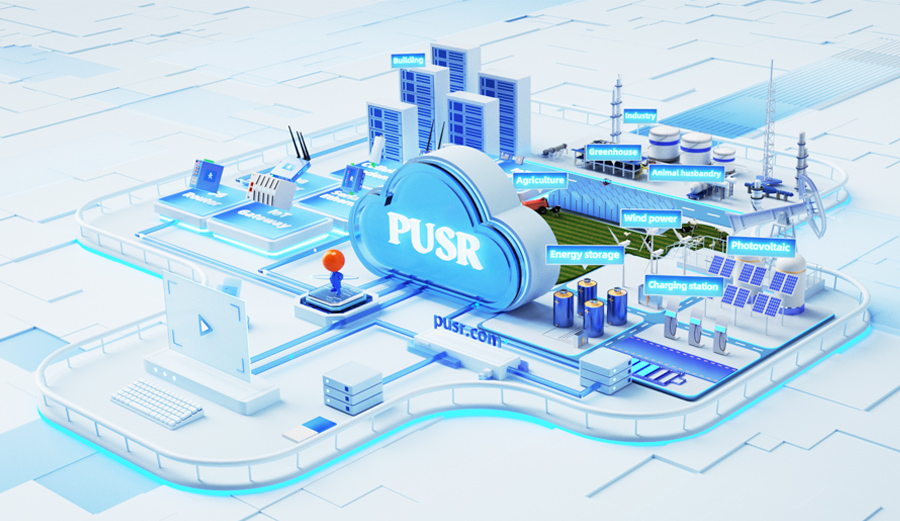
The company chose PUSR Cloud as the foundation, integrating devices, data, and business functions into a single supervision system.
Unified device access: PUSR M100 gateway combined with third-party DTUs for multi-brand, multi-protocol device compatibility. Different devices, one unified system.
Unified data management: Water quality, flow rates, liquid levels, and device status aggregated in the cloud, with 302 video channels providing real-time online access to on-site information.
Unified business applications: Real-time monitoring, anomaly alerts, remote control, automatic linkage, video inspections, data traceability, and visualization dashboards — from "connected" to "managed."
Device networking is only the first step. The real efficiency gains come from online and automated monitoring, inspection, alerting, and control.
Seventeen stations collect pH, dissolved oxygen, COD and other indicators in real time. Exceedances trigger automatic alerts pushed to responsible persons.
Over 90 devices managed centrally, with influent/effluent water quality, flow rates, and power consumption visible online.
Scheduled tasks start and stop aeration machines on time, enabling true unattended operation.
Rule engine achieves liquid-level cross-device linkage, with instant voltage anomaly alerts.
302 cameras connected, with mini-program access for real-time on-site viewing, transforming "on-site inspections" into "remote inspections."
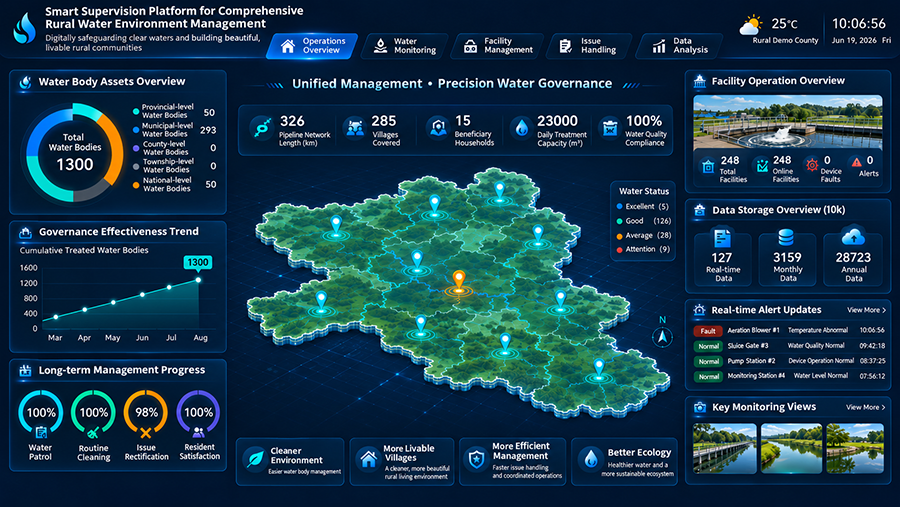
64 custom dashboards plus configuration capabilities, from regional overview to individual device details.
Scattered points across dozens of townships ultimately converge onto "one screen."
From pilot in June 2024 to coverage across three cities — the change is not in device numbers, but in management approach.
Dimensions: Inspection, Anomalies, Data, Control, Management, Expansion
Traditional management relies on personnel visits, manual detection, scattered records, manual operation, decentralized management, and repeat construction for new projects.
Digital supervision delivers: one-screen overview with remote video inspection, automatic alerts with multi-channel push notifications, cloud accumulation with traceable history, remote control with scheduled automatic execution, multi-brand device unified access, and copy from one district to multiple regions.
The data speaks for itself: 3 prefecture-level cities covered, 440 IoT devices connected, 302 video surveillance channels, 71 management scenarios, 470 communication gateways, 34 alert rules, approximately 15 million data records per day accumulated, 64 custom dashboards.
From "relying on people to run" to "online management"; from "discovering problems" to "proactive early warning"; from "single-point construction" to "cross-region replication."
The front end displays the customer's own brand, while the underlying capabilities come from PUSR Cloud.
Through PUSR Cloud enterprise exclusive configuration, the company built its own brand IoT platform: independent domain name, own logo, WeChat alert integration, own brand mini-program, and multi-level sub-user permissions, with regional, township, and personnel management organized by hierarchy, operating externally under its own brand.
From one district to three cities, from device networking to data accumulation, automatic early warning, and visualization supervision — this is not just a water treatment solution, but an IoT construction model that can scale with business growth.
PUSR Cloud, oriented to industrial IoT, provides full-link capabilities including device access, data acquisition, remote control, alarm linkage and visualization dashboards. It supports multi-protocol access, multi-brand compatibility, enterprise exclusive configuration and open APIs. The same capabilities can be extended to: township wastewater, agricultural non-point source pollution, river and lake supervision, irrigation area water saving, and breeding tail water treatment.
A case study: PUSR Cloud | Smart supervision practice for rural black and odorous water bodies
"With dozens of townships and hundreds of devices, it is impossible to cover them all manually."
This is one of the most realistic challenges in rural environmental governance. One environmental protection company, based on PUSR Cloud, transformed "running around exhausted" into "one-screen control" — 440 devices, 302 video channels, and 71 management scenarios integrated into a unified supervision system covering three prefecture-level cities.
Rural water treatment is shifting from "people finding problems" to "problems proactively finding people."