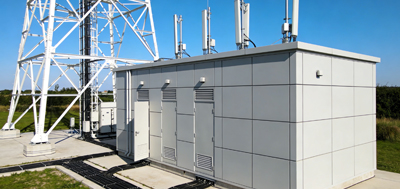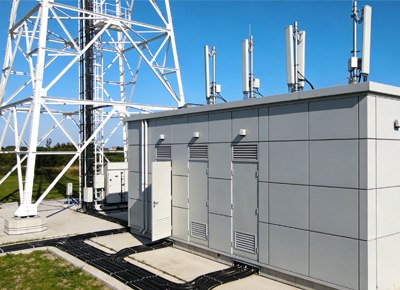
Fast and reliable telecommunications services are often taken for granted. However, the quality and continuity of these services depend fundamentally on the stability of the underlying physical infrastructure, particularly telecom base stations.
In practice, base station failures are most frequently caused by delayed or insufficient maintenance. Minor issues that could have been addressed early often escalate into major incidents, resulting in prolonged network outages. For telecom operators, such outages translate directly into revenue loss, service-level agreement (SLA) violations, and reputational damage.
As mobile networks evolve toward higher density and complexity—driven by large-scale 5G deployment—the operational pressure on base station infrastructure continues to increase. Traditional manual inspection and reactive maintenance models are no longer sufficient. A transition toward intelligent, predictive, and data-driven operation and maintenance (O&M) has become a strategic necessity.
Power-related failures remain one of the dominant causes of large-scale network outages. Industry statistics indicate that approximately 43% of major telecom network disruptions are directly associated with power system issues, with UPS failures representing the most common root cause.
Additional risk factors include:
If left unaddressed, these issues not only increase outage probability but also shorten equipment lifespan and raise total cost of ownership (TCO).
From an operational perspective, a telecom base station can be logically divided into three core subsystems:
● Communication Equipment
Radio units, baseband units, transmission devices, and related networking components.Sensors and Monitoring Devices
● Energy Management Equipment
Grid power interfaces, rectifiers, batteries (lithium-ion or lead-acid), renewable energy sources (solar, wind, hydrogen fuel cells), generators, power distribution units, and metering devices.
● Environmental and Status Sensors
Sensors for voltage, current, temperature, humidity, smoke, door access, vibration, and other environmental or security-related parameters.
Among these, the energy management subsystem plays a decisive role in ensuring service continuity and operational resilience.
Modern telecom energy systems are transitioning from passive monitoring to active prediction and adaptive optimization.
By deploying intelligent sensor networks and real-time data analytics, operators gain continuous visibility into:
Advanced algorithms can analyze historical and real-time data to identify abnormal patterns and predict potential failures. Typical predictive capabilities include:
In many cases, potential risks can be identified up to 72 hours in advance, enabling proactive maintenance actions before service impact occurs.
Remote monitoring is one of the most effective methods for improving base station maintenance efficiency.
Traditional O&M models rely heavily on field visits, which are costly, time-consuming, and often unnecessary. Many inspection, diagnostics, and configuration tasks can be performed remotely without any physical intervention.
A comprehensive remote monitoring solution enables:
This approach significantly enhances network availability while optimizing human and financial resources.
The USR-EG828 industrial edge computing platform is designed specifically to address the requirements of telecom base station energy and environmental monitoring.
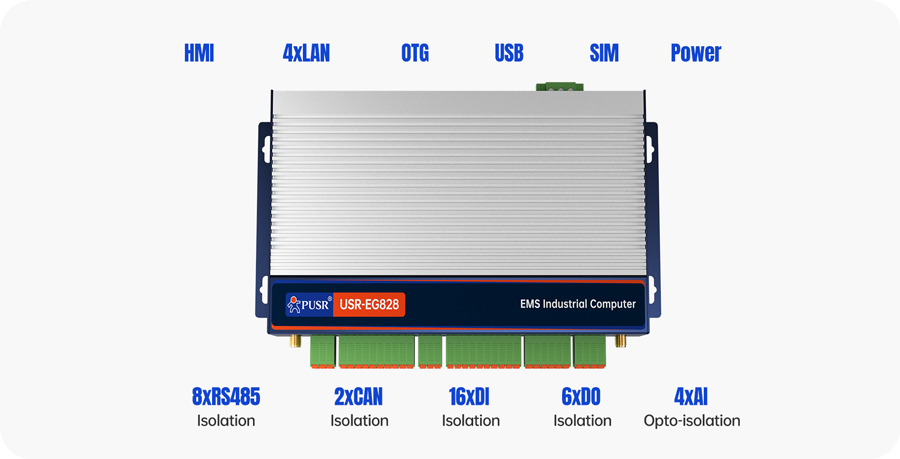
Key technical characteristics include:
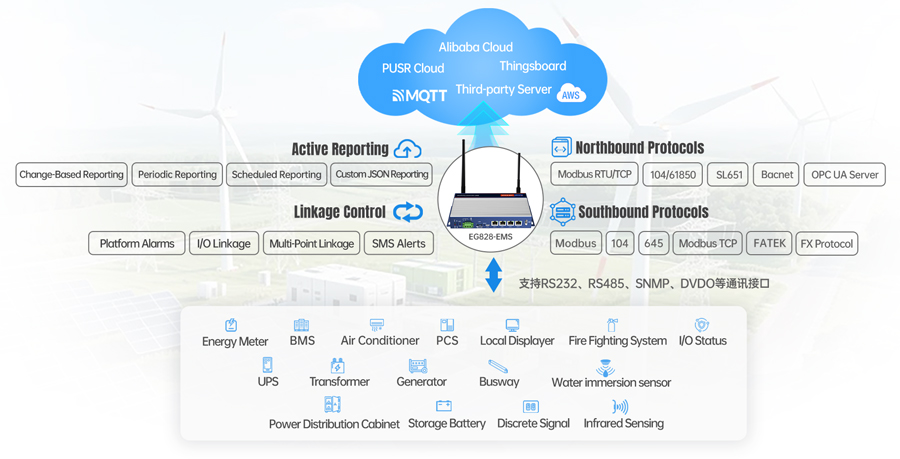
The platform provides unified data acquisition and local edge computing capabilities for critical energy subsystems, including:
With an extended operating temperature range of –20°C to +70°C, the platform is well suited for harsh outdoor base station environments. Localized deployment of predictive maintenance models enables millisecond-level alarm response, even in scenarios with limited backhaul connectivity.
The platform integrates a lightweight local SCADA/HMI system, providing:
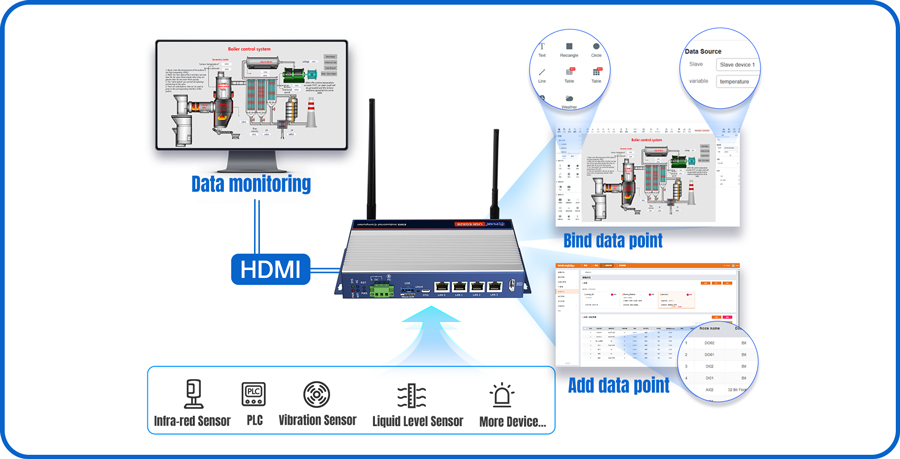
Efficient data configuration allows complete on-site data acquisition to be implemented in just three steps, while flexible visualization supports customized operational requirements.
The USR-EG828 platform has been deployed at scale in over 3,000 4G base stations in a national-level telecom network. The system has operated continuously for more than one year under real-world conditions, demonstrating high stability, reliability, and scalability.
These large-scale deployments validate the platform’s suitability for predictive maintenance, energy optimization, and long-term reliable operation in telecom base station environments.
With its powerful computing performance, rich industrial interfaces, open system architecture, and support for secondary development, the USR-EG828 serves as an ideal edge computing platform for modern telecom base station energy management systems.
By enabling predictive maintenance, intelligent energy optimization, and high-reliability operation, the platform helps telecom operators reduce operational risk, lower OPEX, and improve overall network resilience.