Upgrading a water plant's supply and drainage systems to a networked setup rarely starts with "should we do it" — it starts with "where do we begin." A few common situations, listed up front:
① Mixed field devices— PLCs, flow meters, pressure transmitters, and water quality instruments often come from different vendors with different protocols (Modbus, proprietary PLC protocols, serial interfaces, etc.), which makes direct integration with a cloud platform a considerable workload.
② Unstable network conditions— plants and pump stations are often located at urban-rural fringes or in remote areas, where wired access is unavailable and cellular signals fluctuate.
③ Data needs local pre-processing— uploading every second of raw data consumes bandwidth and is prone to packet loss; many metrics should be evaluated and alerted on locally first.
④ Rising regulatory requirements— data such as water quality, pressure, flow, and valve status increasingly needs to be traceable, auditable, and alarmable.
⑤ Retrofits must coexist with existing systems— replacing the existing PLC outright is not practical; more often the approach is to "add on" without overturning the current architecture.
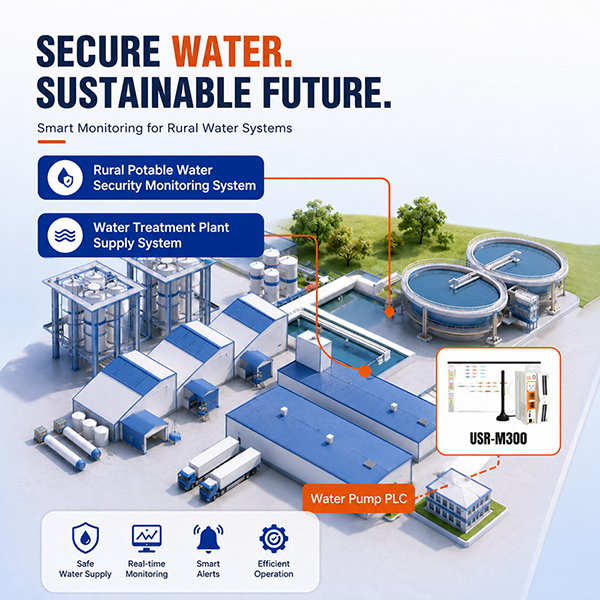
These two directions map exactly to the two most common scenarios in a water plant's supply and drainage system:rural potable water security monitoringandwater treatment plant supply systems. Here is how each one is typically deployed.
This kind of system is characterized by scattered sites, small data volume per site, and high safety requirements. The typical structure:
Three things usually matter at deployment:
① Protocol adaptation.The gateway should come with built-in protocol libraries for mainstream PLCs and instruments (Modbus RTU/TCP, Siemens, Mitsubishi, etc.); otherwise every site requires a separately developed driver, and the workload multiplies quickly.
② Store-and-forward on disconnection.Network stability at rural sites is poor, so the gateway needs local buffering and automatic retransmission once connectivity is restored — this directly determines data integrity.
③ Remote maintenance.Sites are too scattered for on-site visits to be economical. Gateways that support remote upgrades and remote site-status viewing cut travel significantly.
Compared with rural sites, a water treatment plant has far more equipment and data. The goal of networking is not just to "see" the system, but to "use" it — here, the USR-M300 connects directly to the pump house PLC (the Water Pump PLC in the scenario diagram) and collects key pump-house operating data.
The typical deployment structure:
Compared with rural water systems, this setup adds one more element:edge computing. That is, in addition to collecting and uploading, part of the decision-making and actuation happens at the gateway layer itself. There are two main reasons:
① Real-time response.Local decisions execute locally, without waiting for a round trip to the cloud, so pumps and valves respond faster.
② Reliability.The system can keep running at a basic level during network outages, then re-synchronize state after recovery.
The role the USR-M300 plays in this scenario maps to four values water plants generally care about:
For projects of this kind, industrial-grade certifications are less a differentiator than an entry ticket. The USR-M300 covers a fairly complete certification list (3C, CE, FCC, ROHS, WEEE, CTA, ANATEL, ECAS ROHS, MTC, NBTC, RCM, SRRC type approval, TDRA, cybersecurity, etc.), which satisfies the hard requirements of regulation and procurement for both treatment plants and remote sites.
Specs worth reviewing on the device itself:
① Industrial wide-temperature range (−40 °C to 75 °C) and a metal enclosure that suits humid plant environments and outdoor sun exposure.
② Multiple interfaces (RS485, RS232, CAN, DI/DO, relays, etc.), allowing it to connect to a variety of PLCs and instruments downstream.
③ Uplink options of 4G/WiFi/wired, with link redundancy available when needed.
④ Python/C support for secondary development, so custom edge logic can run directly on the device, avoiding the cost of an additional industrial PC.
⑤ Local closed-loop logic at the gateway side, such as pump protection, liquid-level interlocking, and on-site handling of abnormal flow.
⑥ A bundled device management platform for remote batch configuration, remote upgrades, and remote fault localization — scalable to hundreds or thousands of sites.
① Pilot on a small scale first.A plant-wide system usually involves multiple sites and device types; run a pilot at one pump house or one rural site to get the protocols, data formats, alarm thresholds, and network plan working, then replicate in batches.
② Tiered data reporting.Keep raw data archived locally, report key indicators on a schedule, and send alarms immediately — this satisfies both traceability and bandwidth savings.
③ Take timestamps seriously.Retransmitted data after network recovery will corrupt later trend analysis if its timestamps are not real. NTP time sync on the gateway and clock alignment on the PLC side should both be planned.
④ Decouple interfaces from platforms.The gateway wraps data in a unified format, so when connecting to a cloud platform, only the platform side changes, not the field side.
⑤ Account for cross-region compliance.Besides device certifications, water quality data also involves multiple local authorities (environmental, water resources, and health supervision); clarify the required reporting formats in advance.
Network retrofitting of a water plant's supply and drainage system is not fundamentally about "adding a gateway" — it is about stringing scattered devices, well-structured data, and traceable alarms into a usable, controllable, and expandable chain. An Industrial IoT Gateway like the USR-M300 sits between the field and the platform, handling data acquisition, protocol conversion, local logic, and uploads — and that is precisely the link that decides whether the project runs steadily.
As for what kind of enterprise should choose an Industrial IoT Gateway for supply and drainage networking, the answer is simple:
If more than half of the above apply, an Industrial IoT Gateway is no longer an "option" — it is the more straightforward choice.