Today, with the accelerated penetration of the industrial Internet, the core contradiction faced by enterprises in digital transformation is becoming increasingly prominent: On the one hand, there is a need to achieve cross-regional and cross-system device interconnection and data sharing; on the other hand, it is essential to address security threats such as cyberattacks and data breaches. The VPN private network technology equipped on industrial routers is emerging as a key infrastructure to solve this dilemma by constructing virtual secure channels. This article will provide an in-depth analysis of the core value of industrial vpn routers from three dimensions: technical principles, application scenarios, and user personas.
An industrial VPN router is a router built for cabinet or DIN-rail mounting that terminates VPN tunnels on the device itself, rather than on a server behind it. Three properties separate it from an office VPN router:
The tunnel is initiated outbound from the site, so a private or carrier-grade NAT address on the WAN side is not an obstacle, and no inbound port needs to be opened at the customer site.
Wide-voltage DC input with reverse polarity protection, a metal housing, a declared operating temperature range, and a hardware watchdog are part of the datasheet, not options.
Support for acting as a VPN client matters when the customer's IT department will only accept tunnels into their own concentrator; support for acting as a server matters when the equipment maker has to reach in on its own.
What it does not do: it does not decide what a connected device is allowed to reach. That is the job of firewall rules and access lists, and the two are configured in different places.

The technological evolution of industrial vpn routers has undergone three stages: starting with simple tunnel protocols based on PPTP/L2TP, gradually developing into a complete encryption system centered around IPSec/OpenVPN, and currently evolving towards intelligent networking that integrates SD-WAN with zero-trust architectures. Taking the USR-G816 industrial router as an example, its VPN functionality features three key technical characteristics:
Protocol-Level Security Protection: It supports a triple encryption protocol stack of PPTP/L2TP/IPSec, where the IPSec protocol employs a dual mechanism of AH authentication headers and ESP encapsulation security payloads to achieve data integrity verification and end-to-end encryption. In a case study of an automobile manufacturing enterprise, the deployment of USR-G816's IPSec tunnel reduced the transmission latency of PLC control instructions on the production line to under 5ms while decreasing the risk of man-in-the-middle attacks by 99.7%.
Dynamic Tunnel Management: The built-in intelligent routing algorithm can monitor network quality in real-time. When fluctuations occur in the primary 5G SA link, it automatically switches to the NSA backup link, ensuring continuous VPN tunnel connectivity. In the practice at a Qinghai photovoltaic power station, this dual-mode backup mechanism improved equipment inspection efficiency by eightfold and reduced single-station operation and maintenance costs by 65%.
Intelligent Traffic Isolation: Through deep integration of VLAN tags and QoS policies, it achieves logical isolation of different business traffic flows. For example, in a smart warehousing scenario, the USR-G816 can assign AGV scheduling data (priority P0) and video surveillance streams (priority P3) to different virtual channels, preventing critical business operations from being blocked by non-core traffic.
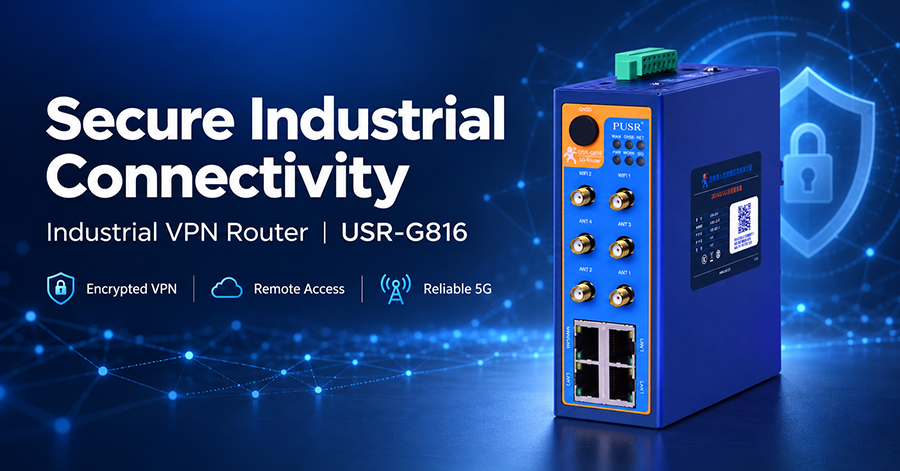
The value of industrial vpn routers is extending from single secure transmission to Network Functions Virtualization (NFV), forming a comprehensive solution that covers production, management, and service scenarios:
The Nerve Center for Remote Operation and Maintenance: In the global service networks of equipment manufacturers, the VPN functionality of the USR-G816 supports engineers in remotely accessing overseas customers' production lines through the USR Cloud platform. By employing two-factor authentication and dynamic token technology, the risk of unauthorized access is controlled at the 10^-9 level. A construction machinery giant utilized this solution to reduce overseas equipment fault response times from 72 hours to 4 hours.
The Connectivity Foundation for Flexible Manufacturing: Facing the demands of multi-variety, small-batch production, VPN private networks enable rapid reconfiguration of production line equipment. At a 3C electronics factory in Suzhou, the USR-G816, through its protocol conversion functionality supporting Modbus TCP/IP over VPN, achieved seamless integration of heterogeneous systems such as injection molding machines, robotic arms, and inspection equipment, reducing changeover times from 8 hours to 45 minutes.
The Secure Link for the Energy Internet: In the distribution automation scenarios of smart grids, VPN routers must meet the time synchronization requirements of the IEC 61850 standard. The USR-G816 ensures microsecond-level synchronization accuracy for circuit breaker opening and closing instructions through its built-in PTP precision clock protocol and 1588v2 time synchronization functionality, meeting the construction needs of the power industry's "three lines of defense."
Communication Guarantee for Vehicle-Road Coordination: In V2X applications, VPN private networks must simultaneously handle low-latency control instructions and high-bandwidth video streams. The 5G SA network slicing functionality of the USR-G816 can allocate dedicated virtual networks for autonomous vehicles. In real-world tests conducted in Pingshan District, Shenzhen, it stabilized the end-to-end latency of vehicle-road coordination data at under 8ms, meeting the requirements for L4 autonomous driving.
The question is better answered by looking at the site than at the industry. The table below lists the site conditions that come up most often; the last four rows are the cases where an industrial VPN router is usually the wrong purchase.
| Site condition | What it looks like on site | Verdict | What to confirm before buying |
| No routable address at the site | The WAN address is in the 10.x or 100.64.x range, or differs from the address an external lookup returns | Needed | The router must initiate the tunnel outbound; port forwarding and DMZ will not work behind carrier-grade NAT |
| Remote maintenance is part of the contract | Service engineers need to reach PLCs and HMIs without travelling | Needed | Protocol coverage (IPSec, OpenVPN and others), and whether the device can also act as a server |
| The network belongs to someone else | Machines ship into a customer plant where IT controls addressing and firewalling | Needed | Ability to join the customer's existing VPN as a client, with certificate-based rather than password-only authentication |
| Sites are unattended and dispersed | Pump stations, solar sites, roadside cabinets, vehicles | Needed | Link failover between wired, cellular and Wi-Fi, plus alarms for offline, weak signal and data overrun |
| Site already has a fixed public IP and a managed firewall | An appliance on site already terminates tunnels, and someone maintains it | Usually not | Whether that firewall can terminate the tunnel. A second endpoint adds a device to maintain without changing what is exposed |
| Requirement is internet access, not reachability | Kiosks, digital signage, shared terminals | Usually not | Whether outbound filtering and content rules cover the requirement. A tunnel adds nothing to it |
| No one is assigned to receive the alarms | | Remote access is enabled but alerts go to a shared inbox | Usually not | Who owns the alerts. Without an owner, the tunnel becomes an unmonitored doorway |
| Broadband site that cannot afford a disconnection | Wired primary with cellular standby | Depends | How quickly the router switches back, not how fast the cellular link is |
In one line: an industrial VPN router earns its place when the tunnel has to be initiated from a site that cannot be reached from outside, and it does not when something already on site can do the same job.

Faced with a wide array of industrial vpn routers on the market, enterprises need to focus on four core parameters:
Encryption Performance: Choose products that support the AES-256 encryption algorithm and hardware acceleration chips to ensure CPU utilization remains below 30% under 100Mbps bandwidth. The USR-G816, equipped with a Qualcomm QCM6490 chip, achieves wire-speed forwarding under full-traffic encryption.
Protocol Compatibility: Prioritize support for mainstream protocols such as IPSec/IKEv2/OpenVPN, while also ensuring compatibility with industrial protocols like Modbus TCP and Profinet. The USR-G816's protocol conversion engine enables transparent transmission between 16 industrial protocols and VPNs.
Environmental Adaptability: Industrial-grade products must pass the IEC 61000-4 series electromagnetic compatibility tests and operate within a temperature range of -40℃ to 85℃. The metal casing and triple-proof coating design of the USR-G816 ensure stable operation in extreme environments such as deserts and plateaus.
Management Convenience: Choose products that support remote management platforms like USR Cloud for one-click operations such as device status monitoring, firmware upgrades, and policy deployment. The zero-configuration setup functionality of the USR-G816 reduces new device deployment time from 2 hours to 15 minutes.

A tunnel that reports "connected" has not been verified. Five checks, in this order, take about an hour and produce the record that a customer's IT team will ask for:
① Baseline before the tunnel.
From the site LAN, ping the PLC or read one register and record the response. Without a baseline there is nothing to compare against later.
② Reach the device, not the gateway.
From inside the tunnel, ping the PLC address and go online once with the programming software. A ping to the router's own LAN address succeeds even when subnet routing on the tunnel is incomplete.
③ Prove it is invisible.
Run a port scan from the public side against the site address. The target ports should all be closed. Save the scan output — it is the evidence that nothing was exposed.
④ Time a link failure.
Unplug the primary uplink and time the recovery. Note whether collection continues locally and backfills, or stops for the duration. Recovery of the link and recovery of the tunnel are two different measurements; the tunnel is usually slower.
⑤ Archive the state.
Export the configuration, name the file with the site number and date, and record the firmware version. Reboot once after rule changes on models where rules only take effect after a restart. The same five checks scale to a fleet: export the configuration, import it into the next machine, and change only the addresses and ports.
With the integration of 5G-A and AI technologies, industrial vpn routers are evolving towards intelligence. Subsequent versions of the USR-G816 have integrated an AI traffic prediction module that can anticipate network congestion based on historical data and proactively adjust VPN tunnel parameters. In a pilot project at a steel enterprise, this functionality improved network utilization by 40% while reducing packet loss rates for sudden traffic surges to below 0.1%.
As manufacturing moves towards the era of "lights-out factories," industrial vpn routers will no longer be merely conduits for data transmission but will become the neural hub connecting the physical and digital worlds. From ensuring production safety to driving business innovation, this industrial network transformation sparked by encrypted tunnels is redefining the boundaries of smart manufacturing.
What is an industrial VPN router, in one sentence?
A router that terminates encrypted tunnels at the site itself, letting machines keep private addresses while remote engineers reach them without any inbound port being opened. The distinction from an office VPN router is that it is specified for a cabinet — wide-voltage DC input, a declared temperature range, DIN-rail mounting and a hardware watchdog — and that it can act as either the client or the server end of the tunnel.
When is an industrial VPN router actually necessary?
When the site has no routable public address, when remote maintenance is part of the service contract, or when machines ship into networks owned by someone else. In all three, the tunnel has to be initiated outbound from the site, which is exactly what these devices are built to do.
When is an ordinary VPN router enough?
When the site has a fixed public IP, an existing managed firewall and someone who maintains it. Adding a second tunnel endpoint in that case increases the number of devices to maintain without changing what is exposed.
IPSec or OpenVPN — which one should be used?
IPSec is the safer default when connecting to a customer's existing concentrator, because most enterprise firewalls already terminate it. OpenVPN is the practical choice when the equipment maker runs its own server and needs certificate files distributed across many machines. Support for both is worth more than performance differences between them.
Does the router work if the SIM only gets a private address?
Yes, provided the tunnel is initiated outbound from the site. Port forwarding and DMZ do not work in that situation, because there is no public address for an external host to reach. A remote management platform that opens the router's built-in web page without a public address is the alternative when no tunnel endpoint exists yet.
Does encryption slow down PLC traffic?
The overhead is a small header on each packet plus the cost of encryption, which matters far less than polling interval and tunnel stability. What usually degrades control traffic is a tunnel that silently drops and rebuilds, so configuring keepalive and monitoring reconnection events is more useful than measuring throughput.
How much cellular data does a VPN tunnel add?
A few percent on top of the payload for typical polling traffic, since encapsulation adds a header to each packet and keepalives run continuously. Where data plans are tight, the larger consumer is almost always video or cloud synchronisation rather than the tunnel itself; keeping recordings on a local NVR removes that load from the uplink.
How can the tunnel be checked without visiting the site?
Three remote signals cover most failures: whether the device is reported online by the management platform, whether the expected sessions appear in the real-time session list, and whether an offline or weak-signal alarm was raised. If all three look normal but the far end cannot reach the PLC, the cause is usually a missing subnet route rather than a broken link.