Why Can't a Regular Industrial Mini PC Handle AGV Predictive Maintenance?
Car Production Line AGV Down Again? An Industrial Mini PC That Can "Tell Fortunes" Lives Three Days Longer Than Yours
| Time | Line Status | Notes |
|---|---|---|
| Mon 07:15 | Normal | All 32 AGVs online |
| Mon 14:30 | AGV #7 Alarm | Drive board overheated, 40 min downtime |
| Tue 09:00 | Normal | Just replaced drive board |
| Tue 22:47 | AGV #15 Down | Main board burned out, 6 hours downtime |
| Wed 06:00 | Line Stopped | Waiting for spare parts, ~180k yuan loss |
This isn't one automaker's story. This is the daily reality for almost every AGV O&M team on China's car production lines in 2024.
You think AGV downtime happens "suddenly"? No. Every single downtime had its script written 72 hours in advance. Nobody just knew how to read it.
Where's the problem? It's not the AGV. It's that industrial mini PC responsible for collecting data, running algorithms, and making decisions — it can't hold up.
Anyone who's worked a car production line knows — AGVs don't just "break while running." They "die of illness" bit by bit.
Stage 1: Vibration Is Changing.
The AGV's drive wheels, differential, bearings — they run dozens of kilometers on the shop floor every day. In the early stage of bearing wear, the vibration spectrum shifts slightly — the shift might be only 0.02g. Human ears can't hear it. A regular industrial mini PC's sampling precision can't catch it either.
Stage 2: Temperature Is Rising.
The drive board's MOSFETs, the main board's FPGA — as load accumulates, junction temperature slowly climbs. From 70°C to 85°C might take two weeks. But a regular industrial mini PC's temperature sensor has an accuracy of only ±3°C. It can't tell the difference between "normal fluctuation" and "abnormal warning sign."
Stage 3: Current Is Jittering.
The current waveform at motor startup hides all the secrets of mechanical wear. A healthy AGV has a smooth startup current curve. A dying AGV has spikes on the curve. But to catch that spike, you need at least a 10kHz synchronous sampling rate — that's a hard spec for an industrial mini PC's data acquisition capability.
These three stages add up to a 3-to-7-day "warning window."
But what's the reality?
The reality is, the industrial mini PC most automakers use can't even sample vibration data stably. Sampling frequency isn't enough, temperature accuracy isn't good enough, data gets dropped when volume goes up, running an edge AI model maxes out the CPU at 100% and then crashes —
You don't lack data. Your data is all garbage.
Predictive maintenance requires that you can "predict" first. And the first step of prediction is that your industrial mini PC has to be alive, stable, and able to hold up.
Let me be blunt. 80% of industrial mini PCs on the market are designed for "just needs to run." But the AGV predictive maintenance scenario doesn't need "just runs." It needs "runs long, runs accurate, runs smart."
What's the environment in a car shop? Metal shavings, brake dust, oil mist aerosols — PM2.5 is chronically off the charts. A regular industrial mini PC uses a fan for cooling. In three months, the fan is clogged, CPU temp shoots to 95°C and starts throttling, data acquisition drops packets.
You say add a filter? The filter clogs even worse — cooling efficiency plummets. Vicious cycle.
Car welding shop, summer floor temp can hit 55°C. A regular industrial mini PC is rated 0–50°C, but in reality it starts getting unstable at 45°C. Your AGV is running fine out there, but the industrial mini PC monitoring it dies of heat first.
One AGV needs at minimum: vibration sensor, temperature sensor, current transformer, encoder, safety light curtain, LiDAR… A regular industrial mini PC has a few COM ports, a few USB ports. You need a bunch of external converter boxes, cables are a mess, any connector comes loose and data is gone.
The core of predictive maintenance is edge AI — you need to run vibration spectrum analysis, current waveform recognition, temperature trend prediction models locally on the industrial mini PC. A regular industrial mini PC uses a low-power CPU — TDP is low, but the performance architecture is old. Running one lightweight model maxes it out. No headroom for real-time inference.
Any one of these four wounds can turn your predictive maintenance into "Monday morning quarterbacking."
The answer is actually clear. You don't need an industrial mini PC that "works." You need one that "lives for this scenario."
Let me break it down with the USR-EG828 and see how it solves each of those four fatal wounds one by one.
First: Fanless Is What Truly Means Rugged
The USR-EG828 uses a fully passive cooling design — no fan, no vents. Heat is conducted directly from the chip to the chassis shell via precision-designed aluminum fins and heat pipes, then dissipated into the air.
What does that mean?
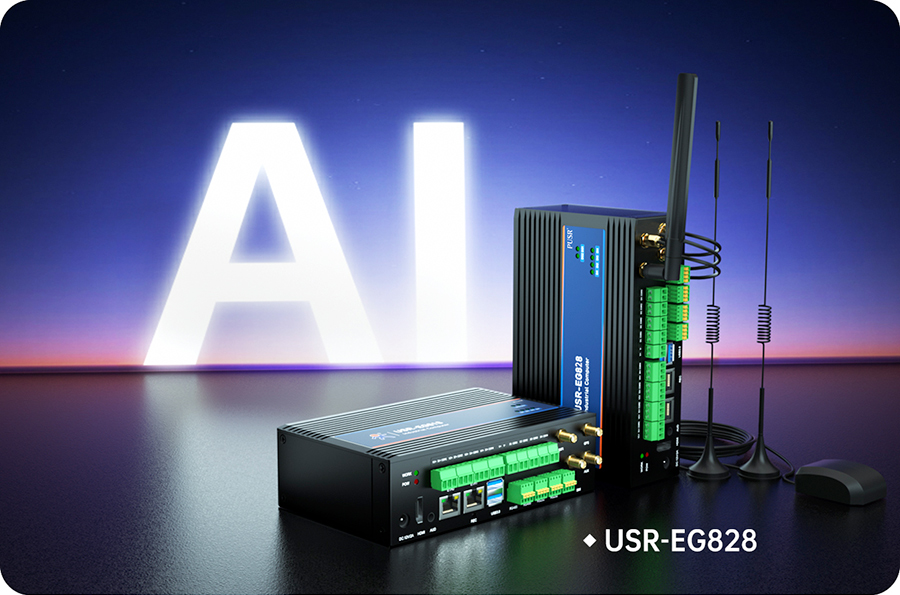
It means metal shavings, dust, oil mist — they simply can't get in. No fan means no air intake. No air intake means no dust buildup. In a welding shop where PM2.5 is off the charts, this machine can run continuously for five years without cleaning.
And fanless has a hidden bonus — zero noise. AGVs already have motor noise. If the monitoring industrial mini PC is buzzing too, the shop environment only gets worse. Fanless design makes the whole line quieter and cleaner.
Second: Wide Temperature Range, -40°C to 85°C — No Fear of Heat
The USR-EG828's operating temperature range covers -40°C to 85°C.
This isn't lab data — it's industrially verified real capability. What's 85°C mean? Your welding shop floor is 55°C in summer, cabinet interior can hit 65°C due to poor heat dissipation — this machine is still rock solid.
More critically, it supports wide-voltage input with overvoltage/undervoltage/short-circuit protection. Shop power fluctuates a lot, especially when high-power welders start up — voltage sags are common. A regular industrial mini PC reboots. The USR-EG828 holds up.
Third: I/O Maxed Out — Connect as Many Sensors as You Want
AGV predictive maintenance needs at minimum:
| Sensor Type | Qty | Interface Needed |
|---|---|---|
| 3-axis vibration accelerometer | 1 | Analog / RS485 |
| Temp sensor (PT100/NTC) | 4–8 | Analog |
| Current transformer | 2 | Analog |
| Encoder | 2 | Differential signal |
| Safety light curtain | 1 | Digital I/O |
| LiDAR | 1 | Ethernet / USB |
| AGV main controller comms | 1 | CAN Bus / EtherCAT |
Count them up — at least 10+ I/O channels, plus high-speed synchronous sampling.
The USR-EG828 provides rich expansion interfaces — multi-channel analog input, digital I/O, CAN Bus, RS485, Gigabit Ethernet, etc. — and supports modular expansion. Add what you need, don't take up space for what you don't.
No external converter boxes. No worrying about loose connectors breaking data. One machine, all done.
Fourth: Edge AI Compute — Let "Prediction" Actually Happen
This is the USR-EG828's most core differentiator.
It's equipped with Intel's new-gen low-power high-performance processor platform. TDP is only ~15W, but it uses a hybrid performance architecture — P-cores handle heavy AI inference, E-cores handle daily data acquisition and communication. They work together, guaranteeing compute power while controlling power consumption and heat.
More importantly, it supports NVIDIA Jetson SoM expansion (via a compatible modular design), allowing direct edge-side execution of:
Vibration spectrum analysis model: real-time FFT, catches 0.01g-level vibration anomalies.
Current waveform recognition model: 10kHz synchronous sampling, identifies spike features in motor startup current.
Temperature trend prediction model: LSTM network based on historical data, predicts junction temperature anomalies 72 hours in advance.
All inference is done locally, nothing uploaded to the cloud. Latency under 10ms.
What does that mean? It means the moment an AGV's bearing starts wearing, your industrial mini PC already knows — instead of waiting for the bearing to shatter, the AGV to go down, the line to stop, and then seeing "equipment failure" on the alarm light.
5. Let's Do the Math: How Much Can Predictive Maintenance Actually Save?
I know what you're thinking: "This machine costs more than a regular industrial mini PC. Is it worth it?"
Let's do the math. Take a car final assembly line with 30 AGVs:
| Metric | Reactive Maintenance (Current) | Predictive Maintenance (EG828) |
|---|---|---|
| Avg unplanned downtimes/year | 18–24 times | 3–5 times |
| Avg loss per downtime | 80–150k yuan | 10–20k yuan (planned) |
| Annual downtime loss | 1.44–3.6M yuan | 60–100k yuan |
| Spare parts inventory cost | High (large safety stock) | Low (on-demand) |
| AGV lifespan | 3–4 years | 5–6 years (fewer shock failures) |
One year's saved downtime loss is enough to buy 20 EG828s.
That's not even counting labor costs, line delivery delay penalties, or hidden losses from customer complaints.
You're not buying an industrial mini PC. You're buying the line's "insurance policy."
I've seen too many car production line project managers spend 80% of their selection energy on the AGV itself, leaving only 20% for the industrial mini PC.
"It's an industrial mini PC, as long as it runs. Good enough."
But have you ever thought about this — the AGV is your hands and feet. The industrial mini PC is your brain.
No matter how strong the hands and feet are — if the brain crashes, the whole person is paralyzed.
You spent millions on AGVs, hundreds of thousands on line modifications — and in the end, a few-thousand-yuan industrial mini PC holds you back. Is that worth it?
The USR-EG828 isn't the cheapest option. But it's the option least likely to have you getting a "the line is down" phone call at 3 AM.
No AGV downtime. No line stoppage. Then you can sleep soundly.
Pick the right machine, and the AGV can truly become "intelligent." And once it's intelligent, it goes from "fire brigade" to "prophet."


















