When selecting industrial routers for distributed industrial infrastructure, remote maintenance has become a standard requirement. Factories span multiple cities, equipment sits in unmanned sites, and engineers cannot always travel to the field for troubleshooting. The secure channel for remote access — the VPN — becomes part of the infrastructure itself.
WireGuard changed the game. It is significantly faster than OpenVPN, simpler to configure, and uses fewer system resources. More industrial routers now support it natively. But compatibility is not a universal key.
Three things need checking during selection.
WireGuard's core advantage comes from its design philosophy. The codebase is a fraction of traditional VPN protocols, kernel-level integration reduces data copying between user space and kernel space, connection establishment can be shortened to 0.3 seconds, and CPU usage drops by approximately 67%.
In industrial environments, these numbers are not abstract.
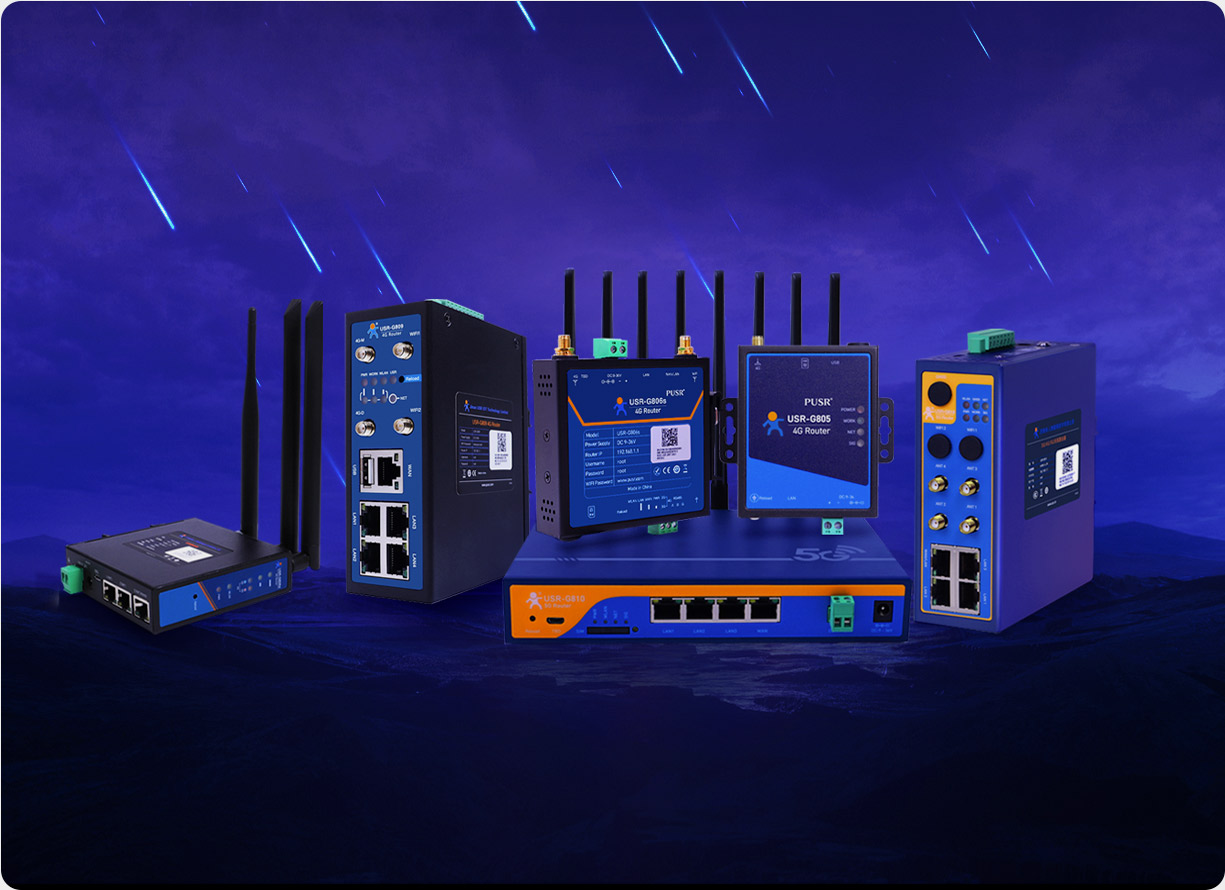
The Qualcomm quad-core processor with X62 5G modem in the 5G industrial router USR-G816 validated WireGuard's practical value in a pipeline monitoring project. The device supports zero-packet-loss seamless roaming during IP address switching in mobile scenarios, and maintained a 99.98% data transmission success rate in 3G network fluctuation environments (latency 200–1500ms).
The Gigabit Edge Router USR-G809s, as a flagship 5G router supporting edge computing and secondary development, pairs with gigabit Ethernet ports to fully leverage link capacity in low-latency scenarios requiring WireGuard for encrypted video backhaul.
Industrial router datasheets typically list multiple supported VPN protocols. The issue is not whether to pick a device that supports WireGuard, but whether to confirm its actual compatibility in real projects.
WireGuard requires both endpoints to support it for normal operation. If the VPN concentrator or existing firewall at the control center only supports IPsec, the field router's WireGuard capability cannot connect directly.
The first step in selection is to confirm what protocols the control center's VPN terminal supports, then decide whether the field router needs to be compatible with multiple protocols simultaneously.
Although WireGuard is lightweight, the encryption and decryption process still consumes CPU resources. Industrial routers without hardware encryption acceleration will show noticeably reduced VPN throughput in high-concurrency scenarios.
The USR-G806w 4G industrial router integrates a dedicated encryption chip that boosts AES-256 encryption throughput from 12Mbps to 85Mbps. In projects with large device counts, this directly determines whether the VPN tunnel becomes a network bottleneck.
Industrial routers are frequently deployed in mobile environments — logistics vehicles, engineering vehicles, mobile inspection units. SIM card switching or network switching causes public IP changes, and traditional VPN protocols take longer to reconnect.
WireGuard's advantage appears here. Its fast handshake and keepalive mechanism perform more stably in environments with frequent IP changes. Selection should confirm whether the router supports dual SIM redundancy and automatic switching, and the reconnection time of VPN tunnels after switching.
A suitable industrial router should simultaneously support WireGuard, IPsec, OpenVPN, and other protocols. Different scenarios use different VPN configurations: branch interconnection uses WireGuard for the data plane, remote access uses OpenVPN for user permission management, and secure interconnection between core business systems retains IPsec as a compatibility layer.
Industrial sites are not offices. Equipment needs to operate stably within a temperature range of -35°C to 75°C, pass industrial EMC protection, and include a hardware watchdog to prevent system lockups.
The USR-G816 adopts a metal enclosure and industrial-grade electronic components, operating stably in harsh environments from -35°C to 75°C, with a hardware watchdog ensuring 7×24 hour uninterrupted operation.
In large-scale deployments, configuring VPNs one by one is impractical. Selection should confirm whether the router supports cloud-based remote management, whether it can push VPN configuration templates in bulk, and whether it supports tunnel status monitoring and key rotation.
PUSR's remote management platform supports one-click VPN configuration push, reducing deployment time from 45 minutes to 3 minutes.
Industrial scenarios cannot tolerate single points of failure. Confirm that the router supports multiple WAN redundancy (wired broadband + 4G/5G cellular automatic switching), dual SIM card backup, and automatic VPN tunnel failover.
When the primary VPN tunnel is interrupted due to carrier failures, a quality router can automatically switch to the backup link within 0.5 seconds.
Industrial data security requirements grow increasingly strict. Confirm whether the router has passed relevant security certifications (such as EN 18031 cybersecurity certification), and whether it supports stateful packet inspection firewalls (SPI), access control lists (ACL), and DoS attack protection.
There is no best protocol, only the most matching one.
IPsec: Use when the control center already has firewalls and IPsec gateways. Enterprise networking equipment widely supports it with good compatibility. When deploying on cellular networks, NAT-T must be enabled to penetrate carrier CGNAT.
OpenVPN: Use when flexible remote access is needed. Engineers connecting temporarily to field devices for debugging, or network environments with strict firewall restrictions, OpenVPN's SSL/TLS encrypted channels penetrate more easily.
WireGuard: Use when pursuing maximum performance and simple configuration. Especially suitable for new projects, mobile scenarios, 5G links, and high-throughput requirements. If both endpoints support it, prioritize WireGuard.
Choosing a VPN solution for industrial routers is not about comparing which protocol is more advanced, but about what the team can maintain, what terminals support, and what the network environment allows. When chosen correctly, VPN is a transparent pipe. When chosen incorrectly, it becomes the scapegoat for every network problem.
WireGuard represents the future direction of industrial VPN, but compatibility determines when it can be used and how. Doing these checks during the selection phase reduces trouble significantly during deployment.
1. Is WireGuard support on an industrial router enough? Are other VPN protocols still needed?
It is recommended to support at least IPsec and OpenVPN simultaneously. VPN terminal devices in different project scenarios may only be compatible with specific protocols, and a single protocol cannot cover all situations.
2. How does WireGuard perform on 4G/5G cellular networks?
WireGuard is particularly well-suited for cellular networks. Mobile operator SIM cards are typically behind CGNAT. Since WireGuard is UDP-based, it reconnects quickly during IP switching and loses fewer data packets during reconnection.
3. How to select an industrial router that supports WireGuard? What key parameters should be checked?
Focus on: VPN protocol coverage range (whether it simultaneously supports WireGuard/IPsec/OpenVPN), hardware encryption acceleration capability, operating temperature range, whether dual SIM redundancy and cloud platform remote management are supported.
4. Is WireGuard's security sufficient for industrial use?
WireGuard uses modern cryptographic algorithms, with a small codebase that is easy to audit. The primary concerns in industrial environments are usually not security, but whether existing equipment and management platforms support it.
5. The old router does not support WireGuard. What should be done?
If existing equipment only supports OpenVPN or IPsec and cannot be replaced, it can continue to operate. However, during new deployments or equipment upgrades, prioritizing models that support WireGuard simultaneously is recommended to leave room for future upgrades.
6. Can an industrial router run multiple WireGuard tunnels simultaneously?
Yes. Mainstream industrial routers (such as USR-G816, USR-G809s, USR-G806w) can simultaneously establish multiple WireGuard tunnels, each connecting to different control centers or business systems.
7. Can WireGuard and IPsec be used simultaneously?
They can run concurrently. A common architecture is: branch interconnection uses WireGuard for the data plane, remote access uses OpenVPN for user permission management, and secure interconnection between core business systems retains IPsec as a compatibility layer.
8. Does deploying WireGuard VPN require additional license purchases or fees?
WireGuard itself is an open-source protocol with no additional licensing fees. However, industrial routers themselves must be purchased, and some vendors' cloud platform remote management services may involve annual fees. Taking PUSR USR-G809s as an example, there are no annual fees or licensing fees — purchase gives ownership, and firmware upgrades are free.