In the wave of digital transformation, traditional industries are facing unprecedented challenges and opportunities. Among them, Industrial Internet of Things (IIoT) has emerged as a crucial force in driving industry progress, serving as a bridge connecting the physical world with the digital world. Wireless bridges, as an essential component of IIoT, play a vital role in determining the overall system performance, particularly in terms of transmission distance and coverage area.
Wireless bridge, as its name suggests, is a bridging device for wireless networks. It establishes communication between two or more networks through wireless transmission. Compared to wired networks, wireless bridges offer greater flexibility and convenience, allowing for the easy跨越 of geographical obstacles and enabling remote communication.
In terms of transmission distance, wireless bridges excel. Theoretically, they can achieve transmission distances of tens of kilometers or even further. However, actual transmission distances are influenced by various factors, such as transmit power, antenna gain, receiver sensitivity, frequency, and obstacles. Therefore, when selecting a wireless bridge, it is crucial to consider the actual environment and usage requirements comprehensively.
It is noteworthy that with technological advancements, some high-performance wireless bridges are capable of achieving ultra-long-distance transmission. For instance, wireless bridges equipped with high-gain directional antennas and advanced modulation technologies can maintain stable communication quality over distances of tens of kilometers. This offers possibilities for applications in special scenarios, such as network coverage in remote areas and maritime communication.
Apart from transmission distance, the coverage area of wireless bridges is also a crucial indicator for evaluating their performance. The coverage area refers to the size of the region that wireless signals can cover, determining the availability and reliability of network services.
In practical applications, the coverage area of wireless bridges is influenced by various factors, such as topography, buildings, and weather conditions. To expand the coverage area, various technical means can be employed, including increasing transmit power, using high-gain antennas, and optimizing network layout. Additionally, techniques such as multi-band and multi-channel can enhance the network's anti-interference ability and stability.
In IIoT, the coverage area of wireless bridges is crucial for achieving interconnection between devices. Through reasonable network layout and selection design, it can ensure that network signals cover all devices requiring connectivity, enabling real-time data collection, transmission, and processing. This is significant for improving production efficiency, reducing operational costs, and optimizing product quality.
The nominal transmission distance of wireless bridges (e.g., 1-3 kilometers, 5-10 kilometers) requires a margin to be reserved based on the actual environment. Weather conditions such as rain, fog, and snow can cause signal attenuation. It is recommended to choose a model with a maximum transmission distance greater than the actual demand. For example, if a coverage of 3 kilometers is required, a bridge with a nominal range of over 5 kilometers should be selected.
Case Study: A monitoring project in a scenic area initially planned to use a 3-kilometer bridge but later switched to a 5-kilometer model due to signal attenuation during the rainy season, resulting in stable operation.
Theoretical speeds (e.g., 150Mbps, 300Mbps) need to be verified in conjunction with the transmission distance. For example, a model claiming 433Mbps may only achieve 200Mbps at a distance of 2 kilometers, so selection should be based on bandwidth requirements.
Recommendation: Prioritize models that support QoS (Quality of Service) to ensure priority transmission of real-time data such as video surveillance.
2.4GHz Band: Strong diffraction capability but susceptible to interference from WiFi, Bluetooth, and other devices; suitable for remote or low-interference environments.
5.8GHz Band: Clean channels, strong anti-interference, and long transmission distance but poor diffraction capability; suitable for urban areas, busy districts, or long-distance transmission.
Case Study: A school monitoring project improved signal stability by 70% after switching to a 5.8GHz bridge due to interference from surrounding routers.
Directional Antenna: Focuses signals in a specific direction, suitable for point-to-point or point-to-multipoint long-distance transmission (e.g., over 5 kilometers).
Omnidirectional Antenna: Provides wide coverage but short transmission distance, suitable for near-field coverage (e.g., within 500 meters).
Key Parameter: Higher antenna gain (e.g., 18dBi) increases transmission distance but may sacrifice penetration capability.
POE Power Supply: Powers devices via network cables, simplifying wiring and suitable for complex environments such as forests and ports. For example, PUSR bridges support 60-meter POE power supply, reducing the need for power cables.
DC Power Supply: Requires separate power cables, suitable for fixed locations with convenient power access.
Outdoor bridges must be waterproof, dustproof, heat-resistant, and anti-condensation. For example, an IP67 rating can withstand extreme weather such as heavy rain and high temperatures.
Case Study: An oil field monitoring project used IP67 bridges, which operated stably for 3 years in temperatures ranging from -30°C to 60°C.
Automatic Pairing: Automatically forms a network upon power-on, suitable for large-scale deployments (e.g., installing 50 units at once).
DIP Switch Pairing: Configured via physical switches, suitable for small-scale deployments or scenarios requiring manual adjustments.
PUSR Feature: Supports automatic pairing of two bridges out of the box, significantly reducing workload.
Must support encryption protocols such as WPA2 to prevent unauthorized access. For example, PUSR bridges enable encryption by default and support Access Control Lists (ACLs) to restrict connected devices.
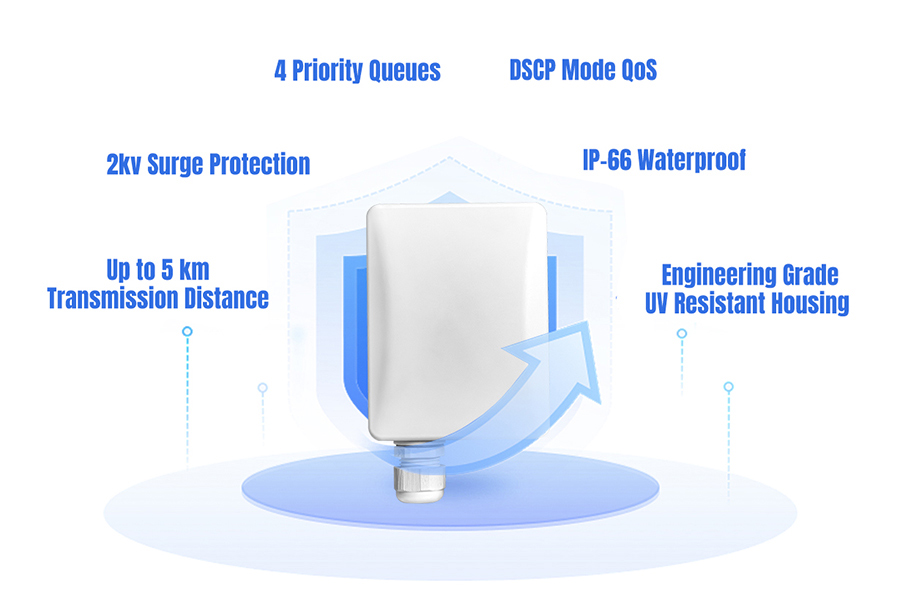
Supports point-to-point transmission up to 5 kilometers and wide point-to-multipoint coverage, suitable for scenarios such as cross-building and factory area networks.
Case Study: A manufacturing enterprise used PUSR bridges to enable file sharing across buildings 1 kilometer apart, reducing costs by 70% compared to fiber optics.
Theoretical bandwidth reaches 300Mbps, with actual bandwidth exceeding 200Mbps at a distance of 2 kilometers, meeting the demands of high-definition video surveillance.
Technology: Adopts 802.11n/ac protocols and supports MIMO (Multiple Input Multiple Output) technology to enhance data throughput.
IP65 protection rating, waterproof and dustproof, adaptable to environments ranging from -20°C to 55°C, suitable for harsh scenarios such as oil fields and mining areas.
Case Study: A mining area monitoring project used PUSR bridges, which operated fault-free for 2 years in dusty environments.
Supports automatic and DIP switch pairing, completing network formation within 2 minutes after power-on, reducing installation difficulty.
Tool Support: Includes signal strength indicators and software for convenient antenna angle and position adjustments.
Supports point-to-point and point-to-multipoint modes, connectable to cameras, sensors, and other devices, adaptable to scenarios such as smart cities and industrial IoT.
Case Study: A scenic area used PUSR bridges to cover a 5-kilometer range, connecting 20 monitoring points and saving tens of thousands of yuan in fiber optic costs.
Needs: Cross-building networking, file sharing, and printer sharing.
Case Study: An enterprise used PUSR bridges to achieve seamless interconnection between two buildings within 1 kilometer, reducing the construction period from 2 weeks to 2 days.
Needs: Video signal backhaul for scenarios such as highways, scenic areas, and factories.
Case Study: A highway project used PUSR bridges to transmit camera data within 10 kilometers, avoiding damage to fiber optics from vehicle crushing.
Needs: Data aggregation and low-latency analysis for distributed sensor networks.
Case Study: An industrial park used PUSR bridges to connect 50 sensors, monitoring equipment temperature and humidity in real time.
Needs: Rapid networking for scenarios such as exhibitions, music festivals, and emergency rescue.
Case Study: A large exhibition used PUSR bridges to connect the main venue with three sub-venues, ensuring seamless live signal transmission.
Needs: Extending village committee fiber optics to surrounding farmers to reduce wiring costs.
Case Study: A rural area used PUSR bridges to provide WiFi coverage to farmers within 500 meters, serving over 100 users.


















