From Stamping to Welding: How fanless industrial pc Let AGVs Survive High-Vibration Environments on Car Production Lines
"This is the third time this month. The AGV in the stamping workshop shut down mid-operation again. System error: vibration caused poor board contact. Two vehicles stopped right in the middle of the transfer line, shutting down the entire line for 47 minutes. Can your embedded computer actually handle our workshop environment?"
This was the email sent to us in March this year by Engineer Li, the equipment supervisor of the welding workshop at a top-tier automaker. 47 minutes of downtime—at their production capacity—meant a loss of roughly 600,000 to 800,000 RMB.
I didn't reply right away.
Because I knew this wasn't the first time Engineer Li had sent this kind of email. In the CC field, he listed five names: the workshop director, the production manager, the project director, the procurement manager, and their AGV supplier.
Five leaders receiving this email simultaneously meant this was no longer a technical issue. It was a trust crisis.
I later went to their factory and spent an entire day in the stamping workshop. I finally understood Engineer Li's anger.
Before going, I thought I knew what "harsh environment" meant.
I was wrong.
The operating environment for AGVs in a car stamping workshop is roughly like this: the floor isn't smooth concrete—it's a composite surface with stamping base protrusions, oil trench cover seams, and randomly scattered metal shavings. When the AGV passes over a stamping press base, the ground vibration acceleration peaks can reach 2.5G to 3.5G, at frequencies between 10 and 200Hz.
What's 3.5G? The moment you drop down a roller coaster—that's roughly 3G. And the AGV has to run continuously in this environment for 8 to 12 hours without stopping.
But that's not the worst part.
The worst part is the welding workshop.
The welding workshop has hundreds of welding robots operating simultaneously. Each robot's joint movements generate high-frequency vibrations, which superimpose to form an extremely complex wide-band vibration spectrum. An AGV running in this environment isn't just "shaking"—it's "being torn apart by multiple frequencies at once."
On-site, I watched an AGV run from Zone A to Zone B on the welding line—about 120 meters. The chassis was vibrating lightly but continuously at high frequency. The embedded computer's indicator lights were flashing, and the hard drive read/write light was jumping frantically.
The accompanying engineer, Xiao Chen, told me: "This is actually pretty good. Last month, one of them blue-screened halfway through. After rebooting, we found bad sectors on the hard drive—all data gone."
I asked him: "What embedded computer were you using before?"
He said: "A certain brand's embedded computer—the kind with a fan. They said it was industrial-grade, IP65 rated. But after eight months, the fan bearing started making noise, and then came all kinds of contact issues caused by vibration."
I had one thought at that moment: in this environment, a fan is a time bomb.
When AGV integrators choose an embedded computer, what do they usually look at?
Is the CPU fast enough? Is the memory big enough? Are there enough interfaces? Is there AI acceleration?
These are certainly important. But after spending a day on a car production line, my biggest takeaway was: everyone overlooks the most basic—but most lethal—question—can this embedded computer survive in a vibration environment?
Vibration damage to an embedded computer isn't just "a little shake now and then." It's systemic, cumulative, and chronic.
The first layer of damage: mechanical connections loosen.
Inside an embedded computer, there are a large number of connectors, slots, and screw-fixed points. In a continuous vibration environment, these connection points gradually loosen. PCIe slot gold finger contact degrades, SATA interface hard drive connections disconnect, memory module gold finger oxidation accelerates. These issues won't cause an immediate crash, but they manifest as random data errors, occasional communication interruptions, and inexplicable system reboots.
What Engineer Li called "poor board contact" is exactly this.
The second layer of damage: storage medium degradation.
This is the most insidious. Traditional hard disk drives (HDDs) in a vibration environment experience changes in the gap between the read/write head and the platter due to vibration, leading to read/write errors or even head crashes that scratch the platter. Solid-state drives (SSDs) are better, but their solder joints can develop micro-cracks under continuous vibration—this is the so-called "solder joint fatigue."
What Xiao Chen called "hard drive bad sectors" was most likely not a hard drive quality issue—it was solder joint fatigue caused by vibration.
The third layer of damage: cooling system failure.
For a fan-equipped embedded computer in a vibration environment, the fan bearing is the most vulnerable component. After the bearing wears out, the fan produces abnormal noise, unstable speed, or even seizes. Once the fan stops, the CPU temperature spikes—throttling, crash, board burnout, all in one go.
Even worse, the fan itself is a vibration source. Its rotation generates additional resonance inside the chassis, which superimposes with external vibration to form a more complex vibration spectrum.
So you see, in a stamping workshop and a welding workshop, a fan isn't a cooling tool—it's a failure catalyst.
After spending a day on the line, I talked with Engineer Li for a long time. One sentence he said stuck with me:
"We don't need the strongest computing power. We need a machine that won't break no matter what you throw at it."
That sentence actually captures the core logic of embedded computer selection for AGVs on car production lines.
It's not performance first—it's survival first.
So what does an embedded computer that can truly survive in a stamping and welding workshop actually need?
Many people think fanless just means removing the fan and relying on a heatsink for natural cooling. That works fine in an office environment, but in a stamping workshop, ambient temperatures frequently exceed 45°C—you can't control it with a heatsink alone.
True fanless design is a combination of passive cooling and intelligent thermal management. Through large-area aluminum heatsink fins, heat pipe conduction, and firmware strategies that dynamically adjust CPU frequency based on load, it keeps chip temperatures within safe limits without a fan.
And fanless means no rotating parts—no bearing wear, no additional vibration source. In a high-vibration environment, this isn't a "nice-to-have"—it's a matter of life and death.
What does vibration-resistant grade mean? It's not just about using screws to fix things.
True vibration-resistant design includes: PCIe slots with latch mechanisms to prevent vibration-induced slot ejection; memory modules using SO-DIMM with clip designs instead of exposed gold fingers; storage interfaces using M.2 brackets secured with screws instead of being plugged directly into the motherboard; all inter-board connections using connectors with locking mechanisms, such as M12 or threaded aviation plugs.
These details don't show up on the product spec sheet. But in a stamping workshop, they determine whether your embedded computer lasts eight months or eight years.
There are clear international test standards, such as IEC 60068-2-6 (sinusoidal vibration) and IEC 60068-2-27 (shock). Good fanless industrial pc are tested according to these standards and will tell you: I can withstand random vibration from 10 to 200Hz at 5G acceleration for 2 hours without failure.
Note: "random vibration," not "sinusoidal vibration." Sinusoidal vibration is the ideal lab condition; random vibration is the real production line environment. Many fanless industrial pc pass the sinusoidal vibration test but fail on the line—this is why.
In a stamping workshop, summer ground temperatures can reach 60°C; in winter, the unloading area of a northern factory can drop to minus 20°C. The nominal operating temperature of an embedded computer is typically minus 10°C to 60°C—but that's measured under static, no-vibration conditions.
Under the combined conditions of vibration plus high temperature, the actual reliable operating temperature range shrinks. So when selecting an embedded computer, you need to check whether its "operating temperature range" truly covers your most extreme conditions—not just the nominal value.
After that factory visit, I recommended a solution to Engineer Li.
I didn't recommend the most expensive one, nor the one with the strongest specs. I recommended a fanless, wide-temperature, random-vibration-tested embedded computer, paired with M12 locking connectors and a PoE power supply scheme.
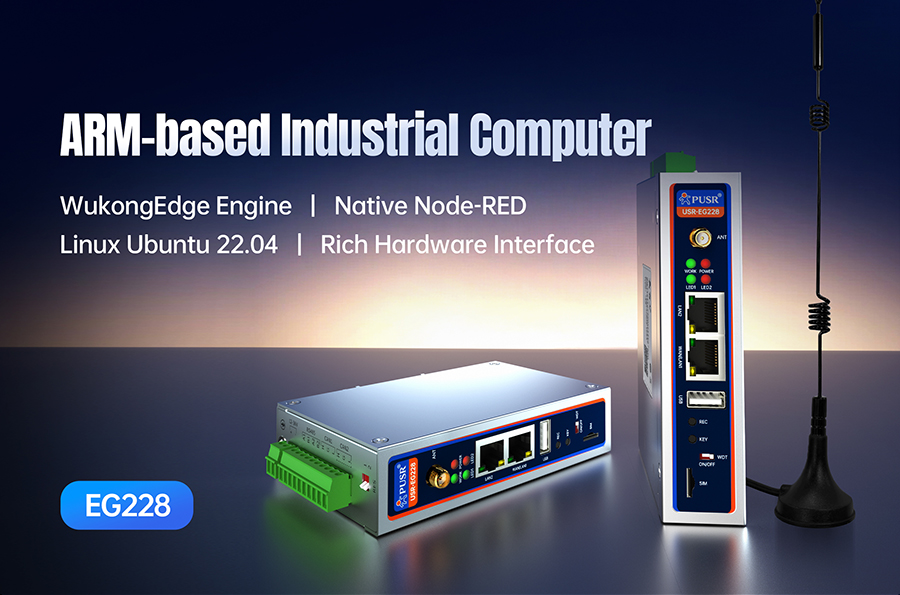
The USR-EG218 series is the product of exactly this thinking. Its design logic is simple: I won't compete with you on computing power—I'll guarantee survival in your environment first. The heterogeneous computing architecture ensures AI inference performance, but it puts "vibration resistance" and "thermal management" at a higher priority than "benchmark scores."
Engineer Li was half-convinced and took three units to the stamping workshop for a trial.
Three months later, he sent me an email with just one line:
"Three units, zero failures. Alternating between stamping and welding—never stopped."
Later, he rolled this solution out across the entire factory—all 127 AGVs were replaced. He told me that the biggest change now isn't how much production increased—it's:
"I can finally sleep at night."
I've met too many people who integrate AGVs for car production lines.
Their daily routine goes like this: chasing AGVs on the line during the day, analyzing logs at night, writing failure reports on weekends. What they fear most isn't technical challenges—it's the helplessness of "we did everything by the book, but the machine still broke."
The root of that helplessness often isn't that the algorithm isn't good enough, or the communication isn't fast enough—it's that the most fundamental hardware can't hold up in a vibration environment.
The multi-vehicle coordination algorithm you spent three months tuning might be undone overnight by a loose PCIe connector.
The countless path optimizations you made might lose all map data because of one bad sector on a hard drive.
Your AGV doesn't need the smartest brain.
It needs a heart that can still beat steadily in an environment of 3.5G vibration, 60°C heat, and metal shavings everywhere.
That heart is an embedded computer truly designed for the production line.
It's not enough that the spec sheet says "industrial-grade." It's that you throw it into a stamping workshop, run it for three months, and it's still alive—data intact, communication still working.
That's what industrial-grade really means.
That's what lets you sleep at night.


















