April 24, 2020
The TCP Client Function and TCP Server Function of Serial Device Server-USR-TCP232-410S
TCP Client Function
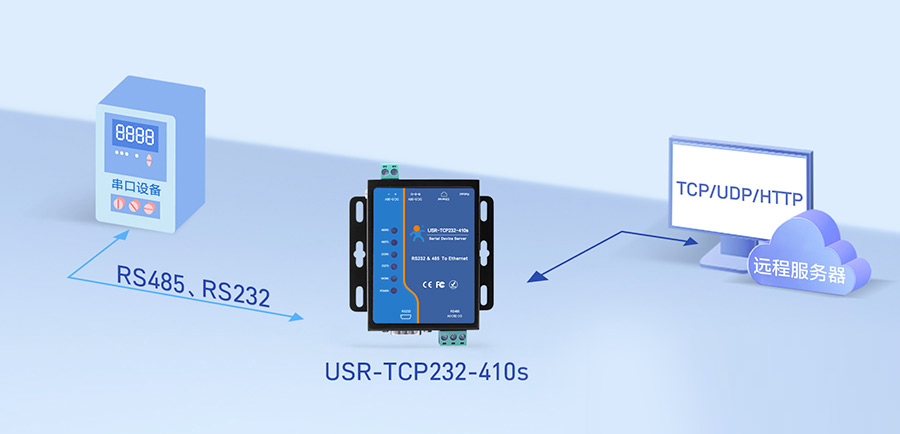
TCP Client provides Client connections for TCP network services. TCP Client device will connect to server to realize data transmission between the serial port device and server. According to the TCP protocol, TCP Client has connection/disconnection status differences to ensure reliable data transmission. TCP Client mode supports Keep-Alive function: After establishing connection, USR-TCP232-410S will send Keep-Alive package in every 15 second to check TCP connection and USR-TCP232-410S will disconnect and reconnect to server if any connection exception occurs. TCP Client mode also supports baud rate synchronization, USR Cloud and Modbus gateway. USR-TCP232-410S works in TCP Client mode needs connect to TCP Server and needs set the parameter: Remote IP/Port. USR-TCP232-410S works in TCP Client won’t accept other connection request except target server and will access server with random local port if configuring local port to 0.
TCP Server Function
USR-TCP232-410S works in TCP Server mode will listen network connections and build network connections, commonly be used for communication with TCP clients on a LAN. According to the TCP protocol, TCP Server has connection/disconnection status differences to ensure reliable data transmission. USR-TCP232-410S works in TCP Server mode will listen local port which user set and build connection after receiving connection request. Serial data will be sent to all TCP Client devices connected to 410s in TCP Server mode simultaneously. USR-TCP232-410S works in TCP Server mode supports 8 client connections at most. USR-TCP232-410S also supports Keep-Alive function, baud rate synchronization and Modbus gateway.
When utilizing the TCP Server or TCP Client functions of the 410S (assumed to be an industrial device or module supporting TCP communication, such as a 4G DTU or industrial router), customers may raise the following questions covering aspects such as functional configuration, communication stability, security, troubleshooting, and optimization:
1. Basic Function and Configuration Issues
TCP Server Mode
How to configure the 410S as a TCP Server?
What parameters need to be set (e.g., local port number, maximum number of connections, timeout duration)?
Does it support simultaneous connections from multiple clients? How is the connection queue managed?
How to bind to a specific IP address or interface?
If the device has multiple network interfaces (e.g., 4G, Wi-Fi, Ethernet), can the interface on which the TCP Server listens be specified? Stability in Dynamic IP Environments
If the IP address of the 410S changes dynamically (e.g., through 4G dial-up), how can clients maintain the connection? Does it support DDNS or heartbeat mechanisms? TCP Client Mode
How to configure the 410S to actively connect to a remote server?
Server IP, port, and reconnection strategy (e.g., retry interval after failure, maximum number of retries) need to be filled in.
How to handle situations where the server is unreachable?
Does it support automatic reconnection? Are unsent data retained during reconnection? Multi-Server Backup Support
Can primary and backup server addresses be configured? Automatically switch to the backup server when the primary server fails?
2. Communication Stability and Performance Issues
Data Transmission Reliability
How to recover after a TCP connection is disconnected?
Does it support automatic reconnection after disconnection? Is re-login or re-authentication required after reconnection? Data Loss or Out-of-Order Issues
How to ensure data integrity in weak network environments (e.g., 4G signal fluctuations)? Does it support checksum mechanisms (e.g., CRC, checksum)? Throughput and Latency
What is the maximum throughput of the 410S's TCP communication? Will there be latency or packet loss in high-concurrency scenarios? Network Adaptability Cross-Subnet or NAT Traversal Support
If the client and the 410S are located in different subnets (e.g., intranet and public network), is additional configuration required (e.g., port mapping, VPN)? Mobile Network (4G/5G) Optimization
Will the TCP connection be interrupted during mobile network switching (e.g., from 4G to Wi-Fi)? How to reduce switching time?
3. Security Issues
Data Encryption and Authentication
Does it support SSL/TLS encryption?
If encrypted communication is required, how to configure certificates (e.g., self-signed certificates or CA certificates)? Access Control and Permission Management
Does the TCP Server support IP whitelists/blacklists? Can client access permissions be restricted (e.g., read-only/read-write)? Identity Authentication Mechanism
Is username/password or token authentication required when the TCP Client connects to the server? Firewall and Protection Capabilities
How to defend against DDoS attacks?
Does the 410S have built-in firewall rules (e.g., limiting connection rates, filtering abnormal packets)? Data Privacy Protection
Can sensitive data (e.g., device status, user information) be stolen or tampered with during transmission?
4. Troubleshooting and Logging Issues
Connection Status Monitoring
How to view the current TCP connection status?
Does it support viewing active connection counts, client IPs, data traffic, etc., through a web interface, SNMP, or command line? Log Recording and Analysis
Does the 410S record TCP communication logs (e.g., connection establishment/disconnection times, error codes)? What are the log storage period and export methods? Common Error Handling
What are the possible causes of connection failures?
For example: port conflicts, firewall blocking, server non-response, excessive network latency.
How to debug data transmission issues?
Does it support packet capture tools (e.g., Wireshark) or built-in debug modes (e.g., printing raw packets)?
5. Advanced Functions and Extensibility
Protocol Compatibility
Can it work in conjunction with other protocols (e.g., UDP, MQTT, HTTP)?
For example: The TCP Server listens on multiple ports simultaneously to handle data from different protocols. Custom Protocol Support
If non-standard protocol data needs to be transmitted, does the 410S support data encapsulation or transparent transmission? Edge Computing and Data Processing
Can data be preprocessed on the 410S side?
For example: Filter invalid data, aggregate sensor readings, execute local rule engines, and then send via TCP.
What programming interfaces (APIs) are supported?
Does it provide an SDK or AT command set for secondary development?
6. Cost and Maintenance Issues
Resource Occupation and Performance Impact
How does TCP communication affect the device's CPU/memory usage?
Will it lead to performance degradation during long-term operation or in high-concurrency scenarios? Firmware Upgrade and Compatibility
How to upgrade the firmware of the 410S's TCP communication module?
Will existing connections be interrupted during the upgrade process? Is the new version compatible with old configurations? Example Scenario-Based Questions Scenario 1: Remote Monitoring System
The customer asks, "If the 410S acts as a TCP Server, can it simultaneously connect to 100 clients? Can the device operate stably if each client transmits data at a frequency of once per second?" Scenario 2: Unattended Equipment
The customer asks, "Can the reconnection strategy in TCP Client mode be customized? For example, enter sleep mode after three consecutive reconnection failures to avoid frequent attempts that consume traffic." Scenario 3: Financial Industry Applications
The customer asks, "Does the 410S's TCP communication support Chinese national cryptographic algorithms (e.g., SM2/SM4)? How to pass compliance certification?" By preparing answers to these questions in advance, customer concerns can be addressed more efficiently, enhancing the product usage experience.
Industrial loT Gateways Ranked First in China by Online Sales for Seven Consecutive Years **Data from China's Industrial IoT Gateways Market Research in 2023 by Frost & Sullivan
We use cookies to ensure that we give you the best
experience on our website. If you continue to use this site we will assume that you are happy with it.