In 2026, Wi-Fi 7 crossed a genuine inflection point. The Wi-Fi Alliance reports certified device shipments past 500 million units; IDC forecasts 120 million enterprise access points shipped by year-end, up 210% year over year, with AP pricing down roughly 38%.
The technology has left the lab. Walk a factory floor, though, and the picture is different: on Ookla's Speedtest data, Wi-Fi 7 accounts for just 1.8% of global samples in Q1 2026, against 26.7% for Wi-Fi 6. The gap between what vendors ship and what plants actually run is the real story — in industrial settings, Wi-Fi 7 is not about peak throughput. It is about stability.
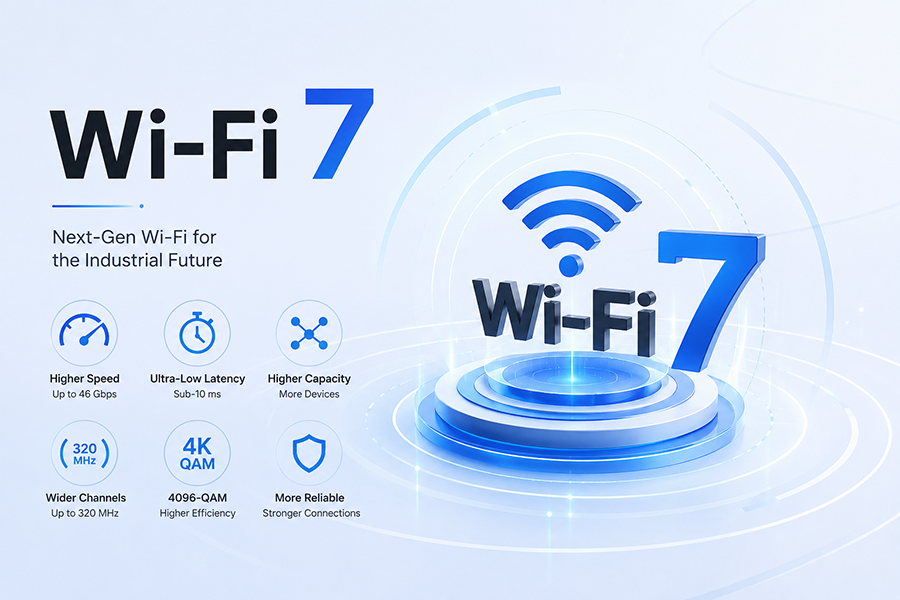
Of the four headline features Wi-Fi 7 adds over Wi-Fi 6 — 320 MHz channels, 4096-QAM, preamble puncturing, Multi-Link Operation — the one that matters industrially is MLO.
Machine shops are full of metal racks and RF reflections; AGVs and robots on a single band regularly see jitter and momentary drops. MLO lets a device hold two links at once, typically 2.4 GHz and 5 GHz; when one band hits interference, traffic shifts to the other and the connection holds. On a production line, "never drops" beats "faster."
One honest caveat: MLO comes in two forms. STR (simultaneous transmit and receive) is true aggregation, but most enterprise clients in 2026 support only NSTR (fast switching), which still helps latency and reliability. Among industrial IoT devices, fewer than 5% support MLO at all. The feature is real; the client base is not there yet.
Real projects show where the value lies now. Siemens has moved Wi-Fi 7 from pilots to full deployment across more than 40 smart-factory sites globally, per announcements in early 2026 — a rollout driven by dependable wireless for automated lines, not speed records.
In the U.S., a 700,000-square-foot logistics hub in Ohio stood up a Wi-Fi 7 network in 20 days while running 24/7: fiber backbone into four distribution frames, a dedicated 2.5GbE uplink per access point, and uninterrupted coverage for a fleet of barcode scanners that never stops moving. In the U.K., a manufacturing site in Birmingham deployed 11 Wi-Fi 7 APs across production and administrative zones with zero disruption to operations.
The common thread: each project treated Wi-Fi 7 as a reliability investment, not a throughput upgrade.
Going from "the technology works" to "we should buy now" requires answering three questions.
How much spectrum is open where the plant operates?320 MHz channels live in the 6 GHz band, and regulation splits the world. The U.S., Canada, Brazil and South Korea opened the full 1,200 MHz. The EU opened only the lower 500 MHz (5.925–6.425 GHz) — a single 320 MHz channel does not fit; 160 MHz is the ceiling. Japan is phasing in the full band; China assigned 6 GHz to mobile services; India is still reviewing. Where 6 GHz is unavailable, Wi-Fi 7's value concentrates in MLO and interference resilience — plan around 160 MHz and preamble puncturing, not the 320 MHz on the datasheet.
How many clients can actually use it?A Wi-Fi 7 AP serving Wi-Fi 6 clients delivers Wi-Fi 6 throughput. Ookla's Q1 2026 data: North America runs 13.8% of Wi-Fi traffic on 6 GHz, Europe just 1.6%; globally, Wi-Fi 7 is 1.8% of samples. On the floor, phones, scanners and older AGV controllers are mostly Wi-Fi 5/6. The pragmatic path: buy APs as Wi-Fi 7, tune them for the installed client base, and unlock MLO and 6 GHz as clients refresh.
Is the wired side ready?Wi-Fi 7 APs typically need 2.5G/5G uplinks and PoE++ power. Reviews of failed enterprise rollouts keep surfacing the same pattern: cabling and switching upgrades cost 5–10× the AP budget. With a 1 G uplink, the AP's speed advantage never shows up. Check switch PoE budgets and backhaul before ordering a single AP.
The client ecosystem sets the pace.
A pragmatic order: refresh infrastructure first (switches, backhaul, PoE), deploy pilot zones in high-impact areas, segment the network so Wi-Fi 7 capacity is reserved for demanding workloads, and let clients migrate naturally. Over a longer horizon, Wi-Fi 7, private 5G and wired TSN are complements, not substitutes: Wi-Fi 7 for high-bandwidth access inside the plant, cellular for mobile, outdoor and cross-site scenarios, and wired links for closed-loop control with strict latency budgets. The boundary of any choice is set by the application, not the marketing.
Upgrading to Wi-Fi 7 has nothing to do with "newer is better." Answer three questions first: how much spectrum is open, how many clients support it, whether the wired side is ready. Once those are clear, both the present and the near future of Wi-Fi 7 in industry become clear too.