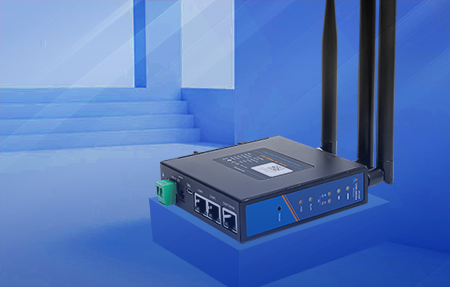
Modbus gateway is also called Ethernet communication gateway. It can realize the conversion between Modbus RTU/ASCII and Modbus TCP. Modbus protocols can classify into two types, one is RS485 based Modbus RTU(or ASCII), and the other is Ethernet-based Modbus TCP. Modbus gateway is a converter which can convert the data of Modbus RTU to the data of Modbus TCP. Due to the limitation of RS485 bus interface, Modbus TCP has the following advantages compared with RTU :(1) existing Ethernet network can be adopted, save the cost of wiring of RS485.(2) multiple hosts can be supported to access Modbus instruments simultaneously.
1. Functions of Modbus gateway
Modbus gateway is a network hub communication protocol conversion device of the industrial automation system. It connects with the intelligent instrument, collects the data of inferior instrument to Modbus gateway, connects with the superior computer network, and communicates with network computer according to Modbus TCP protocol. Modbus gateway has two types: storage type and ordinary type. Compared with ordinary Modbus, storage Modbus can store the contents of registers read in the gateway. In this way, the speed of Modbus TCP query can be greatly improved and the performance is superior when supporting multi-host access.
2. Modbus has the following characteristics
1. Standard, open, users can use Modbus protocol without paying the license fee or infringing intellectual property rights. At present, there are more than 400 manufacturers supporting Modbus and over 600 products supporting Modbus. 2. Modbus can support a variety of electrical interfaces, such as RS232, RS485, etc., and can be transmitted on various media, such as twisted pair, optical fiber, wireless, etc. 3. The frame format of Modbus is simple, compact and easy to understand.It is easy for users to use and easy for manufacturers to develop.
The core functions of a Modbus gateway are protocol conversion (Modbus RTU/ASCII ↔ Modbus TCP) and data transparent transmission. However, different scenarios have significantly varying requirements for performance, interfaces, and environmental adaptability. The selection of PUSR products should be carried out around the following dimensions:
Protocol Compatibility
Basic Requirements: Support bidirectional conversion between Modbus RTU/ASCII and TCP, and be compatible with multi-host polling (e.g., supported by USR-N520).
Advanced Requirements: If integration of non-Modbus devices (such as PLCs and sensors) is required, a gateway that supports multiple protocols (e.g., OPC UA, Profinet) should be selected (e.g., the WG series from Wutong Bolian). However, PUSR's product line mainly focuses on pure Modbus scenarios.
Interface Configuration
Serial Port Quantity: For single-device access scenarios, choose 1-2 serial ports (e.g., USR-N510). For parallel data collection from multiple devices, select 4-8 serial ports (e.g., Feichang Technology's 16-port solution).
Network Interfaces: For wired scenarios, choose Ethernet ports (USR-N520 supports dual-port backup). For wireless scenarios, 5G/4G/Wi-Fi are required (e.g., USR-W610).
Industrial Interfaces: When DI/DO point control is needed, choose a gateway with an integrated I/O module (e.g., some models from Hollysys).
Performance Requirements
CPU Processing Power: For lightweight data collection, a dual-core processor is sufficient (USR-N520 uses a Cortex-M7 400MHz processor). For edge computing scenarios, a quad-core or higher processor is required (e.g., Wutong Bolian's WG783).
Memory and Storage: Basic operation requires 1GB of RAM. Running Docker containers or AI models requires 4GB or more (PUSR's product line has not yet covered high-performance scenarios).
Environmental Adaptability
Temperature Range: For indoor scenarios, choose a range of 0-70℃. For industrial sites, -40~85℃ is required (USR-N520 meets this requirement).
Protection Level: For dust and water resistance, choose IP65 or higher. For vibration resistance, choose a metal casing (USR-N520 has an industrial-grade design).
EMC Protection: In strong electromagnetic environments, industrial-grade Level 3 EMC certification is required (USR-N520 has passed this certification).
6. Modbus Gateway USR-N520: Cost-Effectiveness and Scenario Coverage
USR-N520 is a dual-serial-port server from PUSR, focusing on industrial-grade reliability and protocol conversion efficiency. It is suitable for the following scenarios:
Core Advantages
High-Performance Protocol Conversion: With a Cortex-M7 400MHz main frequency and deeply optimized TCP/IP protocol stack, it offers low latency and fast transmission.
Dual Serial Ports Operating Independently: It supports simultaneous access of two RS485/RS232 ports, with each serial port capable of binding dual sockets (for backup or load balancing).
Industrial-Grade Design:
Operating temperature range of -40~85℃, suitable for extreme environments;
2KV electrostatic protection and lightning protection, with strong anti-interference capabilities;
Dual watchdog + hardware keep-alive mechanism for stable operation 24/7.
Protocol Support: Modbus TCP/RTU bidirectional conversion, multi-host polling, and ID bypass (to resolve device ID conflicts).
Typical Application Scenarios
Traditional Industrial Transformation: Connect old serial devices (such as PLCs and sensors) to Ethernet for remote monitoring.
Charging Pile Management: Connect charging piles to cloud platforms for real-time transmission of charging data and status (a PUSR case).
Centralized Management of Multiple Devices: Simultaneously access different subsystems (such as power and environmental monitoring) through dual serial ports.
Industrial loT Gateways Ranked First in China by Online Sales for Seven Consecutive Years **Data from China's Industrial IoT Gateways Market Research in 2023 by Frost & Sullivan
We use cookies to ensure that we give you the best
experience on our website. If you continue to use this site we will assume that you are happy with it.