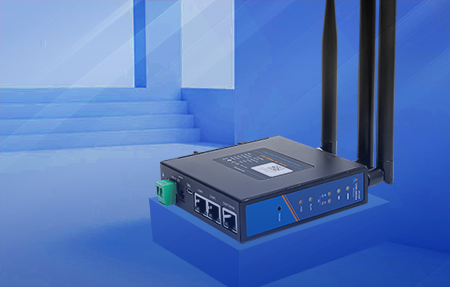
What is the transparent transmission? Transparent transmission refers to the data transmission mode that does not change the data in the process of data transmission through the wireless transmission, as if the transmission process is transparent, to ensure the quality of transmission. The transparent transmission has no associated with the media, modulation and demodulation mode, transmission mode and transmission protocol of the transmission network.
In the era of IoT, the wireless transparent transmission modules can realize the transparent transmission of smart devices. From the technology level, Bluetooth, WiFi, ZigBee and other wireless transmission technologies have become the main wireless transmission mode of IoT.
Transparent transmission transmits the data from the source address to the destination address without any change in communication. Transparent transmission usually used in reading the remote serial data. Transparent transmission is equivalent to a serial line. Which can be widely used in energy and power, automatic meter reading, smart city, industrial automation, vehicle-mounted traffic, environmental monitoring, equipment monitoring, modern agriculture, and many other industries.
PUSR's serial to Ethernet converters and industrial modems can realize bidirectional transparent transmission between RS232/RS485/RS422 and Ethernet.
The advantages of transparent transmission for the serial to Ethernet converters and industrial modems are as follows:
1. Real and effective. Transmit the data to the destination address without any process. Keep the data real and effective.
2.Simple and easy. Transparent transmission is not controlled by any protocol and can transmit the origin data.
Unlocking the Transparent Transmission Function of Cellular Modems: Solving Core Pain Points in Industrial IoT Data Transmission
In today's rapidly evolving Industrial Internet of Things (IIoT) landscape, enterprises face urgent demands for device data collection, remote monitoring, and real-time control. However, traditional data transmission methods often become bottlenecks restricting system efficiency due to issues such as complex protocols, high latency, and poor stability. The transparent transmission function of cellular modems (Data Transfer Units), characterized by "zero parsing, low latency, and high reliability," has emerged as a key technology to address these pain points. This article will provide an in-depth analysis of the core value of transparent transmission and offer practical guidance on selection and application for enterprises, tailored to industrial scenarios.
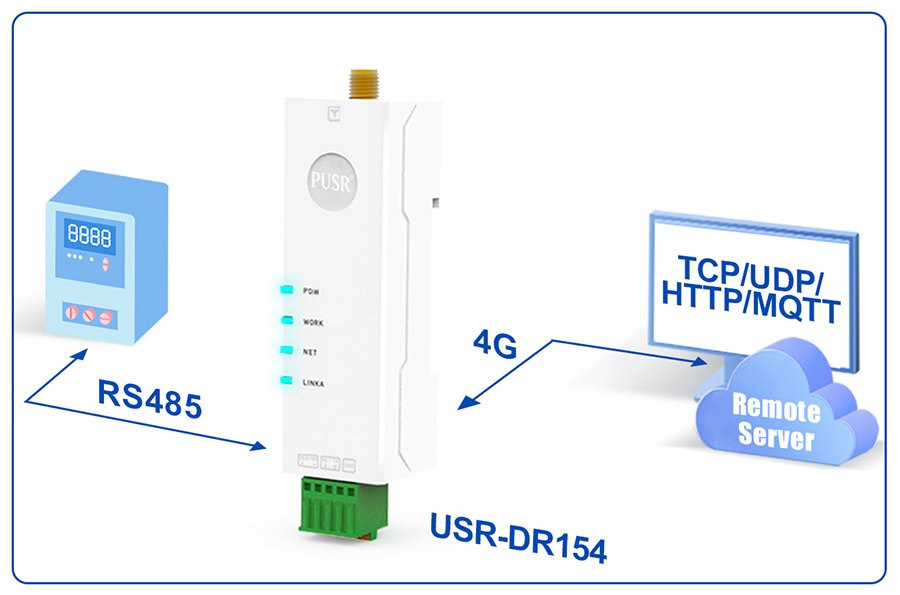
The essence of transparent transmission is to enable "direct passage" of data between devices and servers. The cellular modem acts solely as a physical channel, without parsing, modifying, or encapsulating the data content, ensuring the complete and lossless transmission of raw data (such as sensor readings and control commands). This "what you see is what you get" characteristic significantly simplifies system architecture and reduces development complexity.
Analogous Understanding: Transparent transmission is akin to a "data courier" responsible solely for delivering packages (data) from point A to point B without opening or altering the contents, ensuring that the recipient (server) receives information identical to that sent by the sender (device).
Many customers easily confuse transparent transmission with protocol conversion functions. The core difference between the two lies in:
Selection Advice: If the device and server protocols are compatible, prioritize transparent transmission to reduce costs and latency; if cross-protocol communication is required, a cellular modem supporting protocol conversion is necessary.
Scenario: In a smart factory, PLCs need to receive real-time instructions from upper-level computers to adjust production line parameters. Transmission delays exceeding 100ms may lead to product defects or equipment shutdowns.
Transparent Transmission Solution:
Case Study: After adopting a transparent transmission cellular modem, a automotive parts manufacturer reduced the transmission latency of production line adjustment instructions from 200ms to 15ms, improving product qualification rates by 3%.
Scenario: In remote environmental monitoring stations, 4G signal fluctuations are frequent, and traditional cellular modems are prone to data loss due to disconnections, requiring manual data entry, which is inefficient.
Transparent Transmission Solution:
Data Comparison: Traditional cellular modems can experience packet loss rates of 5%-10% in weak network environments, while those supporting transparent transmission and redundancy design can control packet loss rates below 0.1%.
Scenario: Enterprises need to connect hundreds of PLCs from different brands (e.g., Siemens, Mitsubishi) to a unified platform, but the significant differences in device protocols result in development and adaptation cycles lasting several months.
Transparent Transmission Solution:
Cost Estimation: After adopting a transparent transmission solution, system integration costs can be reduced by 40%, and development cycles shortened by 60%.
Scenario: In the energy industry, tampering with data from remote monitoring systems (e.g., power grid parameters) may trigger safety incidents.
Transparent Transmission Solution:
Communication Interface and Protocol Support:
Network Adaptability and Stability:
Security and Reliability:
Management and Maintenance Convenience:
Among numerous cellular modem products, the USR-DR154 has become a popular choice in industrial scenarios due to its high performance and ease of use:
Applicable Scenarios: Smart factories, energy monitoring, smart agriculture, transportation and logistics, and other fields with stringent real-time and reliability requirements.
If your project is facing challenges such as high data transmission latency, poor stability, and high integration costs, transparent transmission cellular modems are undoubtedly the key to breaking the deadlock. We offer:
How to Submit an Inquiry:
Transparent transmission is not only a technological innovation but also an "accelerator" for industrial digital transformation. By simplifying the data transmission link and improving system reliability, it helps enterprises focus on core businesses rather than being troubled by underlying communication issues. Choosing a high-performance transparent transmission cellular modem (such as the USR-DR154) will be a crucial step towards smart industry.