The oil and gas industry remains the cornerstone of global energy supply. Around the world, from national oil companies to independent exploration and production (E&P) operators, digital transformation is treated as a strategic priority. The maturing of a new generation of connectivity and computing technologies—5G, cloud, and AI—offers a practical path for upgrading aging oilfield infrastructure: digital retrofits can be completed quickly without trenching fiber across remote acreage.
The oilfield is a critical link in the petroleum production chain; its stable operation directly determines output and safety. Building a comprehensive monitoring system covering all well sites, with video surveillance at its core and visualized production management as the driver, is an important step toward higher work-safety standards.
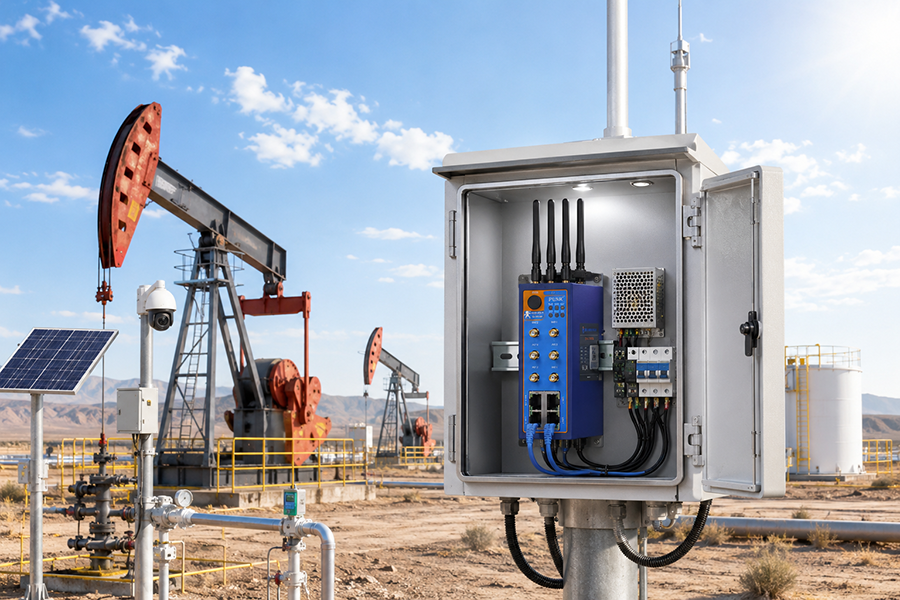
This solution combines automation control, information collection, transmission and processing technologies, remote monitoring and control, wireless information transmission, and big-data transmission and processing. It uses the5G networkas the core transmission channel, with the USR-G816 5G cellular router and the NR520X outdoor WiFi6 AP (with 5G NR) as key network terminal devices, to establish a modern, comprehensive monitoring system suited to safe oilfield production. The system consists mainly of wellhead monitoring terminals, 5G network access equipment, and a central management platform. Well-status data collected by the well RTU is sent via 5G to the operator's database servers, enabling production, engineering, and HSE departments to stay informed of well status in a timely manner—shortening fault resolution, raising uptime and output, and keeping personnel away from high-risk areas.
Most operators have already deployed network solutions such as optical fiber, 4G LTE, or private wireless bridges as part of oilfield digitalization efforts. Each of these approaches has delivered certain results, but as operations expand into more remote blocks with larger numbers of wells, their structural drawbacks have become increasingly apparent and their costs continue to rise.
Fiber — high deployment cost, long cycles:
Laying fiber to scattered wellheads means heavy civil-engineering costs, lengthy right-of-way negotiations, and construction safety risks. Many marginal and remote wells never gain remote monitoring at all.
4G — insufficient uplink bandwidth:
A 4G LTE site typically tops out at roughly 8 Mbps uplink; when multiple HD cameras share the link with telemetry, uplink bandwidth becomes the video bottleneck.
Bridges — fragile private links:
Unlicensed/private bridges offer short range, are prone to interference, may require spectrum fees, and degrade severely in bad weather—driving up on-site maintenance costs.
Diverse — no unified management:
Field teams run widely differing services—telemetry, RTU management, sensing, broadcast/lighting control, emergency response, local WiFi—with no unified management view.
Harsh — remote, hostile environments:
Oilfields span deserts, swamps, basins, and shallow waters; sites are far apart, field staff are scarce, and routine well-rounds are long and hazardous.
Costly — high labor, low efficiency:
Rounds, manual data entry, and mechanical start/stop consume large amounts of labor; cross-border "expert travel" is expensive and slow.
Silos — fragmented systems:
Legacy systems use incompatible data standards, so headquarters cannot achieve centralized management of regional assets.
Using 5G industrial routers, outdoor WiFi6 APs (with 5G NR), network cameras, and other monitoring terminals, the solution builds a modern, comprehensive monitoring system that delivers unified management of front-end operations, services, and equipment—meeting upper-level platform requirements for centralized management, tiered viewing, and hierarchical supervision, and enabling multi-level networking and cross-region monitoring. Specific objectives include:
Full-domain sensing: 5G's massive connectivity and low latency seamlessly connect sensors, video surveillance, and equipment monitoring points, breaking down information silos;
Visualized production management:video-centric HD backhaul and remote visual monitoring of well sites;
Remote control: low-latency, high-reliability remote start/stop of pumping units and fine-grained valve/pipeline control;
Proactive early warning: AI-driven fault warning and safety-risk identification—from passive response to proactive prevention;
Unified platform: a smart oil-and-gas-field data center platform integrating subsystems and interconnecting communications with business systems.
Built on the chain of "sensing — transmission — analysis — decision," the solution comprises three main parts:
wellhead monitoring terminals(sensor assemblies, power modules, RTU acquisition modules);
5G network access equipment(USR-G816 per-well access; NR520X area coverage + 5G NR backhaul);
acentral management platform(database servers, production monitoring center, big-data platform and AI engine, deployable on-premises or in the cloud per data-sovereignty requirements).
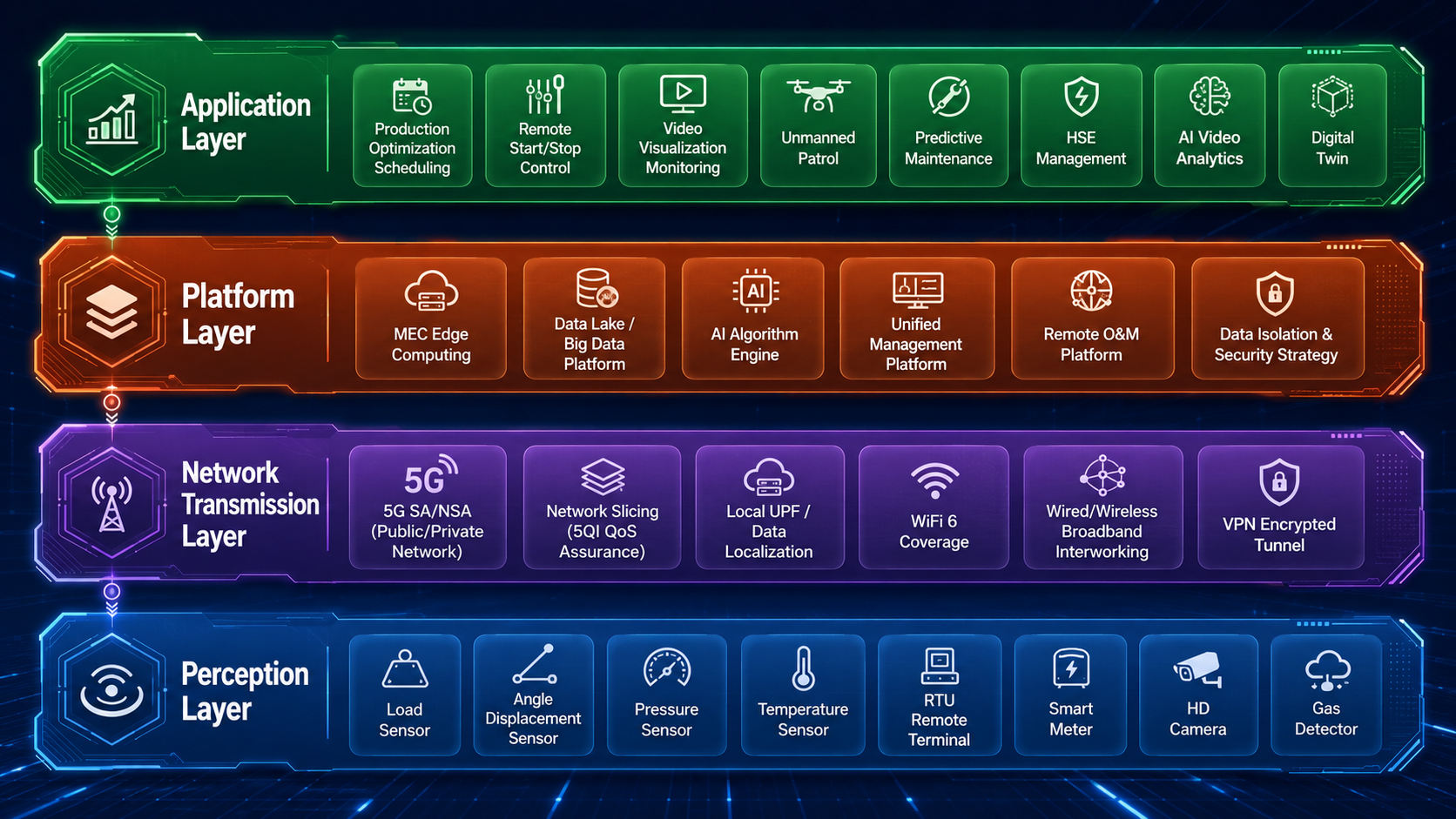
Data flow: load/pressure/temperature/angular-displacement sensors are aggregated by the RTU and connect to the USR-G816 via TCP/IP; HD cameras connect to the router's Gigabit ports. Data travels over 5G to an MEC edge node (isolated from public traffic) or directly to the operator's core network per the agreed connection model. In areas requiring regional coverage, the NR520X outdoor WiFi6 AP provides access, backhauling via its built-in 5G module—everything ultimately converging at the production monitoring center.
The system mainly collects parameters such as the three-phase voltage, current, active power, and power factor of the pumping unit, daily power consumption, cumulative power consumption, wellhead back pressure, wellhead temperature, polished rod load and dynamometer card, and shutdown status, and performs corresponding data processing and storage.
By connecting to various sensors, the system collects oil well production data in real time, including pressure, temperature, flow rate, polished rod load and dynamometer cards, as well as the oil pumping unit’s three-phase voltage and current, active power, power factor, daily power consumption, and other parameters. The collected data is transmitted to the monitoring center at high speed over a 5G network. The low-latency characteristics of 5G ensure real-time data transmission, enabling management personnel to stay informed of field conditions in a timely manner.
Leveraging the high bandwidth of 5G networks, the system supports real-time transmission of high-definition video surveillance signals, enabling visual monitoring of oil well sites. Unlike the upstream bandwidth limitations of 4G, which is typically below 8 Mbps, 5G can support stable transmission of HD video from multiple cameras, meeting the requirements of remote visual monitoring.
The system generates alarms for abnormal conditions such as oil pumping unit shutdowns, parameter limit violations, polished rod failures or disconnections, and polished rod sticking. When a person or vehicle enters a restricted area of the well site, an alarm is immediately triggered and forwarded to the responsible monitoring center. In the event of an emergency, the control center can view live footage of the site through a large display, enabling remote command, dispatch, and emergency response.
Taking advantage of the low latency and high reliability of 5G networks, management personnel can remotely control and adjust field equipment. Functions include remote shutdown of oil pumping units when load limits are exceeded, scheduled startup, adjustment of pumping unit operating parameters, and remote control of valve opening and closing. Parameters and alarm thresholds on monitoring terminals can also be configured remotely.
Based on the collected data, the system enables equipment fault detection, early warning, and predictive maintenance. Potential faults can be identified and warnings issued before failures occur, helping prevent production interruptions and equipment damage. Combined with AI-powered video analytics, the system can automatically detect events such as whether personnel are wearing safety helmets and required PPE, fires, oil leaks, and unauthorized access, enabling automated, unmanned alarms.
The system provides power-loss data protection, allowing configured parameters and historical data to be stored for extended periods. It automatically records the operating process of oil pumping units, including cumulative startup and shutdown times. Real-time and historical trend monitoring is available for dynamometer cards, current curves (or power curves), current, voltage, temperature, pressure, and other parameters, making it easier to quickly analyze long-term changes in operating conditions.
The system manages static information such as oil pumping unit models, motor configurations, oil well identification numbers, stroke length, line names, measurement ranges, upper and lower alarm limits, and oil well operating conditions. It also supports adding newly commissioned oil wells, removing wells that have ceased production, and modifying basic information for workover or maintenance wells.
Protection measures can be designed according to user requirements. For example, pressure gauge data from different transmission points can be cross-analyzed to effectively detect and prevent potential oil theft. All transmission links use VPN-encrypted tunnels to ensure secure data transmission.
This solution selects two PUSR products as the core network devices, which respectively serve as the well-site 5G access router and the regional WiFi 6 + 5G backhaul coverage node, covering various deployment scenarios in the oilfield.
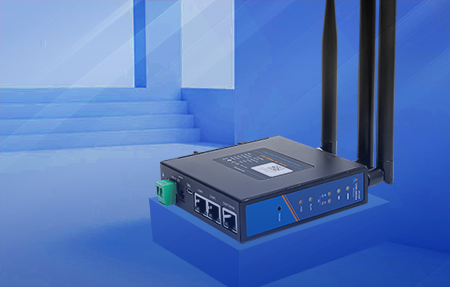
A multi-port industrial 5G cellular router with high speed, large bandwidth, and low latency. Industrial design with wide-temperature/wide-voltage power, level-4 EMC protection, and a hardware watchdog; Qualcomm quad-core processor and X62 5G modem supporting SA/NSA and all major global bands.
An 5G industrial wireless AP with built-in 5G NR (FWA). Qualcomm core, 27 dBm transmit power, up to 2975 Mbps WiFi, 5G Sub-6 GHz M.2 module (X62), SA/NSA, wired/cellular broadband mutual backup.
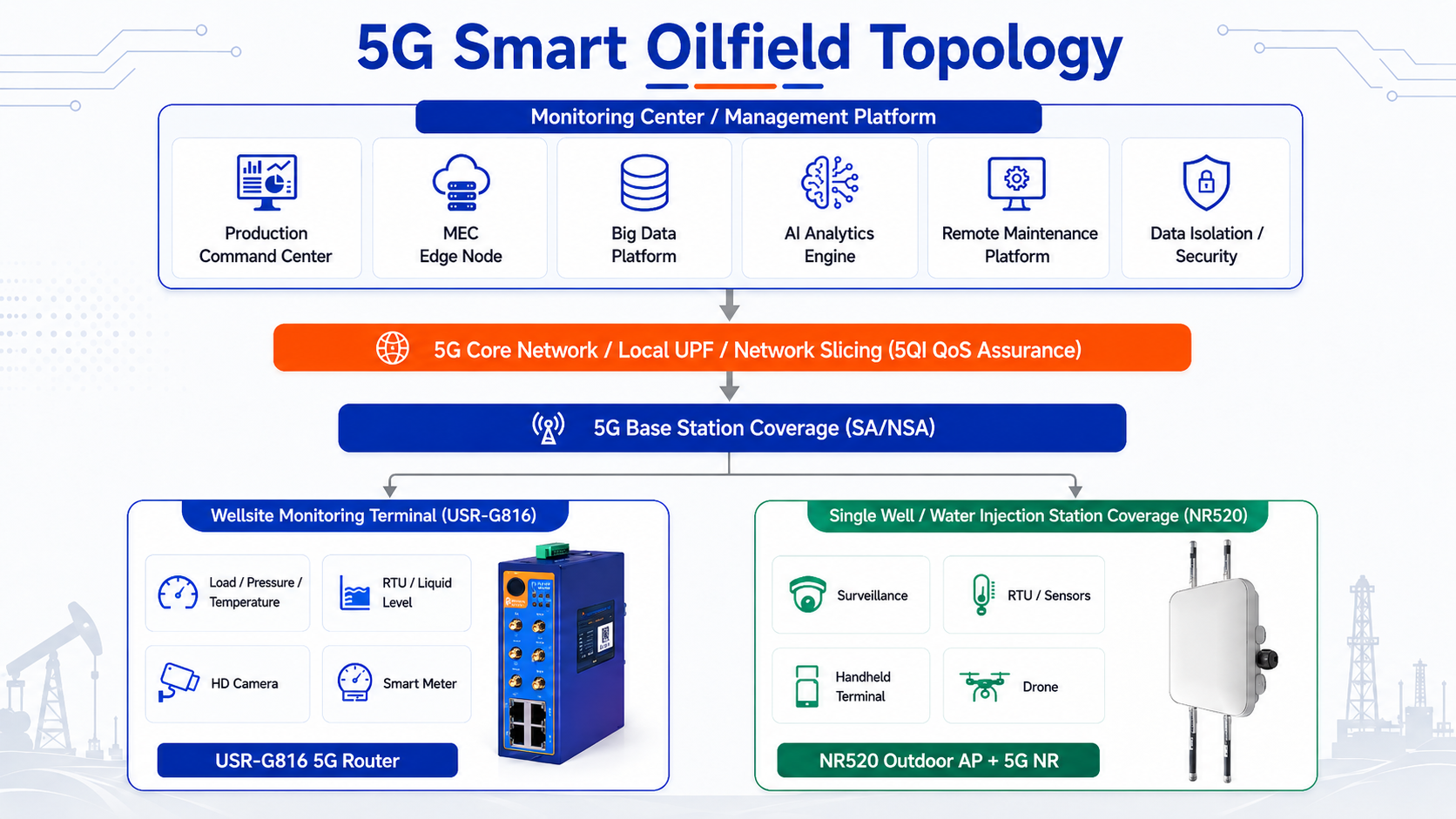
Sensors are aggregated by the RTU; the camera, RTU, and meter are installed on a monitoring pole roughly a dozen meters from the well, connecting to the USR-G816 over Ethernet. Video and sensor data enter the 5G network through the router. In areas requiring regional WiFi coverage, the NR520X provides access with its built-in 5G module backhauling to the core network—achieving full coverage of multi-well assets. Topology chain:monitoring center / management platform(production command center · MEC edge node · big-data platform · AI engine · remote O&M · data isolation) ←5G core network / local UPF / network slicing (5QI QoS)←5G base-station coverage (SA/NSA)←wellhead terminals (USR-G816with load/pressure/temperature, RTU/angular displacement, HD camera, smart meter)andsingle well/injection-station coverage (NR520Xwith camera, RTU/sensors, handheld terminals, drones).
SCENE 01 — Well-site data acquisition and remote monitoring.
Sensors aggregate via RTU into the USR-G816 over TCP/IP; HD cameras connect to Gigabit ports; data returns over 5G to the monitoring center for real-time acquisition, remote monitoring, automatic alarming, and online fluid metering. Serial ports with Modbus conversion enable retrofit without equipment replacement.Core equipment: USR-G816
SCENE 02 — Remote start/stop and precise control of pumping units.
Remote commands for load-over-limit shutdown, scheduled start, parameter adjustment, and valve switching. Intermittent production of low-yield wells saves electricity: in a publicly reported 26-well pilot, 16 wells achieved positive returns with average liquid-lifting daily energy consumption down 2.23 kWh/m³.Core equipment: USR-G816
SCENE 03 — HD video backhaul and AI analysis.
24-hour high-density video transmission over 5G to the MEC edge node; AI detects missing helmets, PPE violations, fire, leaks, and intrusions with unattended alarming and full event records.Core equipment: USR-G816 + NR520X
SCENE 04 — Work-area WiFi6 coverage and mobile office.
NR520X APs at large sites, central facilities, tank farms, and camps; staff connect phones, tablets, and AR glasses for mobile inspection and on-site work. OFDMA/MU-MIMO—up to 256 concurrent terminals per AP.Core equipment: NR520X
SCENE 05 — Unmanned inspection and robots.
Robots with thermal imaging and gas detection replace manual rounds in high-risk areas; AI flags abnormal equipment and intrusions. Reported results: inspection efficiency up 97%, incident rate down 75%. IP67 NR520X runs reliably in harsh outdoor conditions.Core equipment: NR520X + USR-G816
SCENE 06 — Drone pipeline inspection and emergency command.
"5G + drone" unmanned inspection of hundreds of kilometers of pipelines; AI detects ground subsidence and leaks and generates reports; live footage supports remote emergency command. 27 dBm transmit power provides stable access at drone take-off points.Core equipment: NR520X + USR-G816
High speed and low latency: Measured downloads up to ~700 Mbps; near-real-time remote control.
Industrial-grade reliability: Metal enclosure, -35°C–75°C, level-4 EMC, hardware watchdog; NR520X at IP67 with 2 kV surge protection.
Flexible networking: Network slicing and QoS; automatic WAN failover; "5G + WiFi6" integrated networking; fat/thin AP for any scale.
Strong access and expansion: Multi-Gigabit + RS232/485 with Modbus conversion; WiFi6 concurrency of 256 terminals per AP.
Security and data isolation: IPSec/L2TP/PPTP/OpenVPN/GRE tunnels, firewall/NAT/DMZ; user-plane isolation from public data; MEC/local UPF for data sovereignty.
Easy deployment and maintenance: PoE and quick mounting; remote config, firmware upgrade, and alarms (offline, weak signal, traffic over-limit) with email/SMS push.
HSE: Integrated production safety. Intrusion alarms forwarded instantly, traceable event records, live big-screen emergency command.
Integration: System consolidation. One data center platform interconnects communications and business systems, raising dispatching efficiency.
Lower cost: Replaces high-maintenance bridges, fiber, and 4G; cellularized routers are weather-resilient, cutting O&M and expert-travel costs.
More output: Higher uptime and crude output; finer start/stop and valve control; electricity savings from intermittent production.
More efficient: Inspection efficiency up 97%, incident rate down 75%; WiFi6 enables mobile inspection and AR collaboration.
Transformation: Big-data + AI foundation for digital twins and intelligent decision-making, driving sustainable oilfield development.