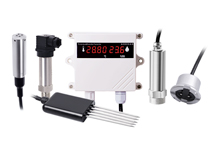
Building energy control cabinets are core nodes in building power distribution systems. They integrate incoming/outgoing circuits, intelligent meters, multi-function power meters, circuit breakers, compensation capacitor controllers, and distribution circuits for air conditioning, lighting, fans, and water pumps. Traditional building energy management generally operates in a rough state of "power supply without consumption management." Key pain points include:
From an industry trend perspective, under the "Dual Carbon" goals and the green building evaluation system, energy and carbon emission control requirements during the building operation phase are continuously rising. Public building energy management systems are evolving from "meter reading and statistics" to "online monitoring, sub-metering, and quota management." According to the statistical methodology of the China Architectural Energy Efficiency Association's annual "Research Report on Building Energy Consumption and Carbon Emissions in China," building operations account for approximately 20% of the nation's total carbon emissions, making them a key target for urban energy saving and carbon reduction. For existing buildings, accessing data collection and energy management without modifying the primary power distribution system is the lowest-cost, fastest-result path.
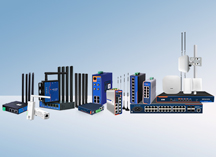
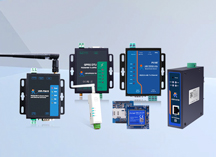
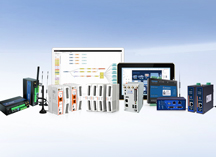
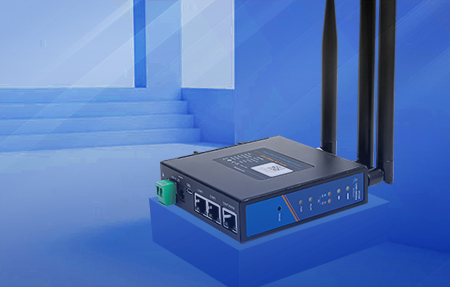
This solution centers on two PUSR industrial networking products to achieve data acquisition, protocol conversion, edge computing, and SCADA centralized monitoring of building energy control cabinets — enabling digital upgrade of traditional energy management — without replacing existing meters or distribution cabinets.
Based on the actual operation scenario of the building energy control cabinet, the following requirements are proposed for the system from the perspectives of function, performance and reliability:
| Dimension | Requirement Item | Description |
|---|---|---|
| Functional | Multi-protocol acquisition | Compatible with existing DL/T 645 meters, Modbus RTU multi-function meters, HVAC DDC controllers (BACnet / Modbus), air conditioning and lighting equipment, and mainstream PLCs in the cabinet — no meter replacement needed |
| Real-time monitoring | Centralized configuration display of key parameters such as voltage, current, power, energy, and switch status, with second-to-minute-level refresh | |
| Sub-metering | Automatic energy consumption statistics by floor, area, and four sub-categories (air conditioning, lighting, power, special electricity) | |
| Threshold alarms | Real-time alarm and recording of anomalies such as overvoltage, overcurrent, overload, demand exceedance, and communication interruption | |
| Performance | Acquisition capacity | Single gateway supports 2000-point-class real-time data points, meeting whole-building meter integration |
| Communication distance | Cabinet RS485 supports daisy-chain bus; cascade through network ports to expand to multiple distribution room aggregation | |
| Data integrity | Local caching during network interruption, automatic retransmission after recovery, no data loss | |
| Cloud capability | Supports standard interfaces such as MQTT(TLS)/OPC UA, connectable to group platforms and third-party systems | |
| Reliability | Electrical environment | Stable operation in high electromagnetic environments, isolated interfaces, wide-temperature and wide-voltage power supply |
| Continuous operation | Gateway runs unattended 7×24 hours, supports hardware watchdog and remote maintenance | |
| Retrofit-friendly | DIN-rail or desktop installation, retrofits can be completed without power shutdown or with brief interruption, no impact on power supply continuity |
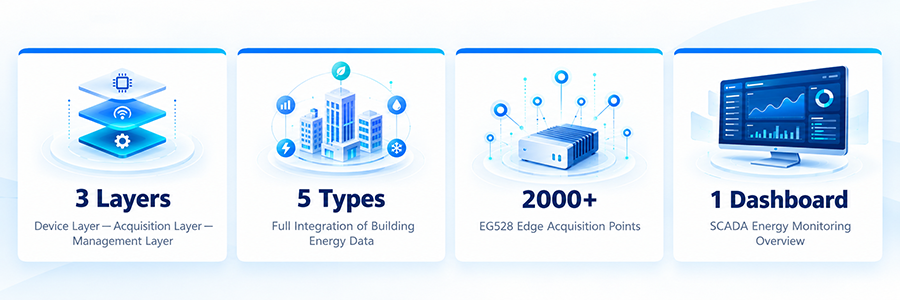
The system adopts a "Device Layer — Edge Acquisition Layer — Management Layer" three-layer architecture: Multiple RS485 meter buses in the main distribution room are centrally accessed by USR-N780/N716(8/16-channel isolated serial servers), and the core node of the energy control cabinet deploys USR-EG528 edge computing gateway, handling protocol conversion, edge computing, and local configuration SCADA. EG528 can cascade N780 via network ports, uniformly forwarding northbound data, and ultimately aggregating data to the SCADA server and energy management platform via building Ethernet/4G.
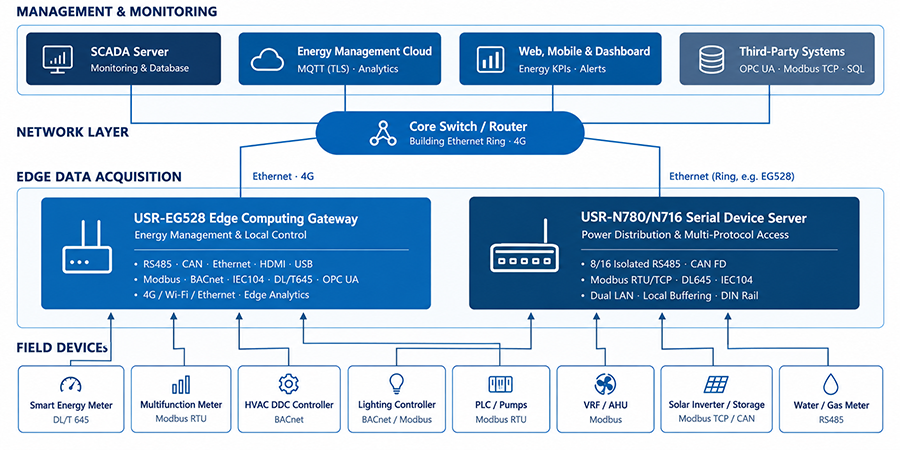
Deployment Notes: EG528 can directly cascade N780 (network port cascade), with EG528 centrally handling edge computing and northbound forwarding, forming a "one cabinet, one gateway, multiple cabinets aggregated" structure. N780 handles centralized access of multiple meter buses in the main distribution room, with its MicroSD local storage caching data during network outages and automatically retransmitting after recovery.
| Item | Specification / Description |
|---|---|
| Positioning | High-performance desktop Linux industrial computer / edge computing gateway, the "edge brain" of energy control cabinets |
| CPU / OS | Rockchip RK3562 Quad-core 64-bit Cortex-A53 @2.0GHz, Linux Ubuntu, open root access, supports C/C++, Docker |
| Edge Engine | Built-in WukongEdge engine, supports 2000+ real-point acquisition, edge computing, active reporting; pre-installed Node-RED drag-and-drop programming |
| Interfaces | 4×RS485 (COM3/4可switch RS232), 2×10/100M RJ45, 2×USB, HDMI (can connect local configuration display screen), dual-band WiFi / 4G |
| Acquisition Protocols | Modbus RTU/TCP, DL/T 645, IEC 104, IEC 61850, BACnet, DNP3.0, SL651, and mainstream PLC protocols (Siemens/Mitsubishi/Omron/Delta, etc.) |
| Northbound Conversion | Modbus, OPC UA, JSON, MQTT, connectable to SCADA, BA building automation, and cloud platforms |
| Local Configuration | Built-in local SCADA/HMI configuration, supports local data editing, display, and control, direct HDMI screen connection |
| Power / Environment | DC 9-36V wide voltage (reverse polarity protection), -25~75℃, aluminum alloy housing fanless cooling |
| Item | Specification / Description |
|---|---|
| Positioning | 8/16-channel fully isolated RS485 edge serial server, suitable for centralized online access of multiple meter buses in the main distribution room |
| Processor | Industrial-grade RK3506J (Triple-core Cortex-A7 + Cortex-A0, up to 1.2GHz), Linux system, built-in WukongEdge edge engine |
| Interfaces | 8/16×Fully Isolated RS485 (independent baud rate/check bits per channel, 2 Sockets per channel), 1×CANFD (compatible with CAN), 2×100M Network Ports (WAN/LAN + LAN), MicroSD Card Slot (local storage for offline caching and retransmission), RTC Battery Socket |
| Protocols | Modbus RTU/TCP, DL645, IEC104, HJ212, SL651 industry protocols interconversion; MQTT/TLS access to mainstream cloud platforms |
| Power / Environment | DC 12-48V, -25~75℃, metal housing, fully isolated anti-high electromagnetic interference, DIN-rail/wall mount |
| Maintenance | Built-in Web configuration interface + cloud remote management platform, supports remote configuration, monitoring, maintenance, and upgrades |
| Dimension | USR-EG528 | USR-N780/N716 |
|---|---|---|
| Role | Edge Computing Gateway / Local SCADA | Multi-channel Central Acquisition Serial Server |
| Serial Ports | 4×RS485 (可switch 232) | 8/16×Isolated RS485 + CANFD |
| Compute Power | ★★★ (2000-point edge computing + Node-RED) | ★★ (WukongEdge Edge Acquisition) |
| Local SCADA/HMI | Supported (HDMI external screen) | Not Supported |
| Deployment Location | Energy Control Cabinet / Monitoring Room | Main Distribution Room (cascadeable to EG528) |
| Cost Positioning | Flagship | Mid-to-High End |
After EG528 and N780 complete protocol access to energy meters southbound, the WukongEdge engine completes point normalization (uniformly converting to Modbus TCP / OPC UA / MQTT data models). Northbound interfaces standardly connect to SCADA configuration software. SCADA software handles real-time monitoring, energy consumption statistics, threshold alarms, and remote control. Its application architecture is shown below:
① Southbound Acquisition:EG528/N780 polls and acquires data per circuit meter communication protocol; 2000-point-class real-time data undergoes normalization and engineering unit conversion at the gateway;
② Edge Computing:Node-RED / WukongEdge completes demand sliding calculation, sub-category aggregation, threshold judgment, and linkage logic at the gateway side, reducing SCADA-side load;
③ Northbound Distribution:MQTT(TLS) to cloud, OPC UA/Modbus TCP for SCADA and BA system read/write, SQL/REST for report system data retrieval, multi-path concurrent without interference;
④ Offline Resume:N780 (MicroSD) and EG528 (local storage) cache locally during network outages, automatically retransmit after network recovery, ensuring energy data integrity.
| Screen | Content |
|---|---|
| Energy Monitoring Overview | Whole-building single-line diagram, real-time refresh of voltage/current/power/energy for each distribution cabinet, color change on threshold exceed |
| Sub-category Energy Analysis | Four sub-category pie charts and column trends (AC, lighting, power, special electricity), support floor drill-down |
| Alarm Management | Real-time/historical alarm lists, alarm confirmation, alarm linkage (e.g., automatic circuit cutout on overload) |
| Demand and Load Curves | 15-minute demand bar charts, prediction curves, peak-shaving strategy execution status |
| Report Center | Daily/monthly/yearly energy reports, electricity bill calculation, year-over-year comparison and energy efficiency KPIs (including carbon emissions) |
Based on building scale and meter count, two typical configurations are provided. Both solutions center on EG528, differing in whether N780 is introduced for multi-channel centralized expansion. Points can be smoothly upgraded based on point scale:
| Configuration Item | Solution A · Small / Single Cabinet | Solution B · Whole Building / Multiple Distribution Rooms |
|---|---|---|
| Edge Computing Gateway | USR-EG528 ×1 | USR-EG528 ×1 (Core) |
| Multi-channel Serial Server | — | USR-N780/N716 ×1 (可configure by bus count, network cascaded to EG528) |
| Acquisition Method | Direct acquisition via EG528's 4×RS485 branches, 4 buses, 30~60 meters per bus | N780's 8/16×RS485 centralized access to each bus in main distribution room, EG528 directly acquires nearby meters in cabinet |
| Acquisition Capacity | ≤ 500 points | 500 ~ 2000 points (EG528 maximum 2000+ points) |
| Local Display | Optional HDMI external display, local SCADA screen | HDMI external display, distribution room/monitoring room local attendance |
| Cloud Access Method | Building Ethernet primary, WiFi backup | Ethernet primary, 4G backup, MQTT(TLS) reporting |
| SCADA Deployment | Cloud platform / Remote configuration | Local SCADA server + Cloud platform dual deployment |
| Target Applications | Small single office buildings, standalone commercial buildings, server room distribution retrofit | Medium campuses, office towers, multi-circuit public buildings such as hospitals and schools |
Expansion Notes:For points exceeding 2000 or cross-building aggregation, additional EG528 can be deployed in zones with platform-side summarization. Meter buses use N780 multi-channel isolated serial independent networking, with independent baud rates and sockets per channel — expansion does not affect existing systems.
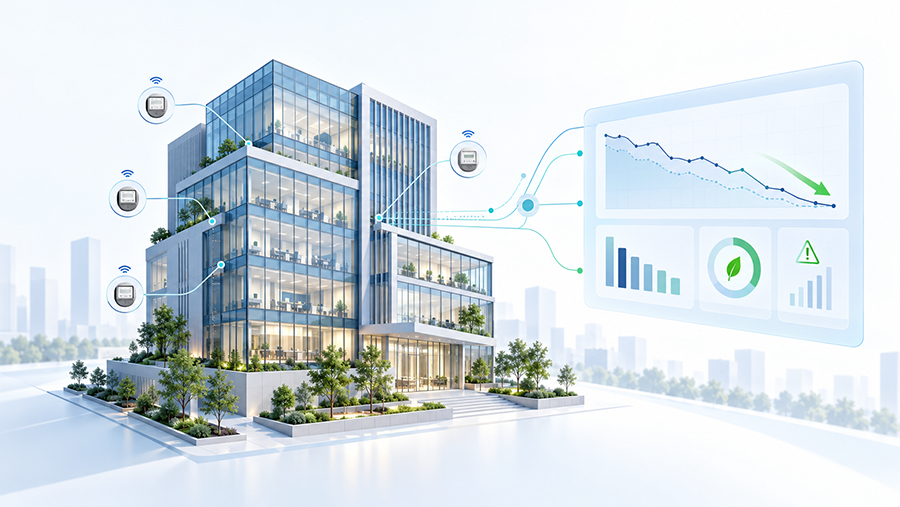
① Automated meter reading:Manual rounds transition to automated acquisition and auto-reports, eliminating missed/wrong readings, data continuously traceable;
② Early anomaly detection:Overload, demand exceed, and communication interruption shift from reactive repair to proactive alerting, shortening fault response time;
③ Quantifiable accountability:Sub-metering and area metering make each floor's/system's energy consumption assessable, supporting energy quota and internal assessment system implementation.
① Identify energy saving potential:Sub-category energy curves can intuitively expose waste points such as AC nighttime standby, lights left on, and inefficient equipment operation, providing accurate targets for energy-saving retrofits;
② Support energy-saving closed loop:After implementing measures such as AC start/stop optimization, time-based lighting control, and demand management based on data, platform year-over-year comparison data can continuously verify energy-saving effects, forming a "metering — analysis — optimization — verification" closed loop. In industry practice, existing public buildings typically have considerable energy-saving potential through systematic energy management operation (generally estimated at 5%~15% range, varying based on building's baseline management level);
③ Demand charge optimization:15-minute demand monitoring and peak-shaving strategies help reduce maximum demand, decreasing basic electricity charges.
① Data asset accumulation:Continuous energy time-series data is the foundation for carbon accounting, green building evaluation, and energy performance contract (EMC) cooperation;
② Smooth, scalable retrofit:No modification to distribution cabinets or existing meters, phased investment, on-demand expansion, single-point failures do not affect primary power system;
③ Open integration:Standard OPC UA / MQTT / SQL interfaces protect investment, enabling long-term synergy with building automation, property management systems, and group energy platforms.
Solution Summary:With USR-EG528 as the edge core and USR-N780/N716 as the centralized acquisition backbone, these two products work in coordination to rapidly build a building energy management system covering the full chain of "acquisition — conversion — computing — monitoring — analysis" without modifying existing distribution cabinets or meters.