A typical retail store's energy consumption falls into four categories: lighting accounts for 20%–30%, HVAC systems for 35%–45%, refrigerated display units for 20%–30%, with the remainder consisting of sockets, signage, and office equipment. In many stores, energy waste does not stem from aging equipment but from disconnected systems operating independently — lighting and climate control work in silos, HVAC runs at a fixed temperature regardless of occupancy, and open refrigerator doors go unnoticed for hours.
To address this systematically, the key lies not in replacing every device, but in connecting subsystems and orchestrating them through a unified platform. Below is a retail store energy saving solution centered on an industrial gateway, breaking down the architecture from data collection and strategy execution to centralized headquarters management.
The first step in energy saving is knowing where electricity goes. In many retail stores, electricity meters remain in electrical rooms "counting silently" — headquarters has no access to sub-metered data, and store managers cannot identify which areas consume abnormally.
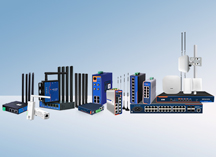
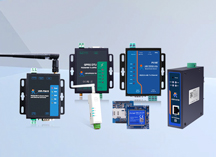
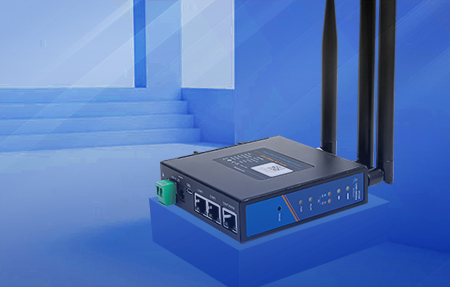
In this solution, RS485 remote transmission electric meters are deployed at the main distribution panel and branch circuits, aggregating sub-metered data for lighting, HVAC, refrigeration, and sockets into the USR-M300 industrial gateway. The gateway uploads data to the cloud via 4G or Ethernet, enabling headquarters to monitor energy consumption trends for individual stores or the entire chain on a unified platform.
The practical value of this approach becomes clear when data can be analyzed by zone and equipment type. Headquarters can quickly locate stores with abnormal consumption patterns. Industry practice shows that a data management platform powered by real-time monitoring can identify and eliminate 4.5%–10% of lighting-related energy waste during daily operations.
Lighting represents a significant portion of store energy consumption, yet it is also one of the most easily overconsumed systems. During daytime, areas near windows receive ample natural light; after closing hours, no one remains in the sales floor — yet lights often stay at full brightness in both scenarios.
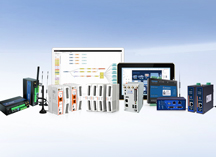
The USR-M300 connects to power distribution controllers, which support drag-and-drop graphical programming for grouped lighting circuit control. Specific approaches include:
Industry data shows that intelligent lighting systems can achieve approximately 30% energy savings. This approach requires no changes to existing light fixture hardware; the core value lies in connecting lighting circuits to control strategies through the gateway.
HVAC systems typically represent the largest single energy consumer in a store and offer the greatest savings potential.
The USR-M300 collects HVAC operation data through protocol conversion, combining information on customer density, ambient temperature, and time-of-day to generate energy-saving strategies automatically:
Refrigerated display units are another major energy drain in retail stores. Doors left open or with degraded seals force compressors to run continuously at high load — wasting energy and risking product spoilage.
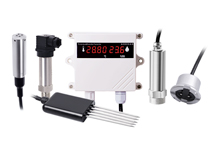
The USR-M300 connects to door magnetic sensors for real-time monitoring of refrigerator door status. When a display door remains open longer than a set threshold, the system automatically alerts the store manager or remote maintenance team. This seemingly simple monitoring approach has been proven in industry practice to effectively reduce refrigeration-related energy consumption while lowering product loss rates.
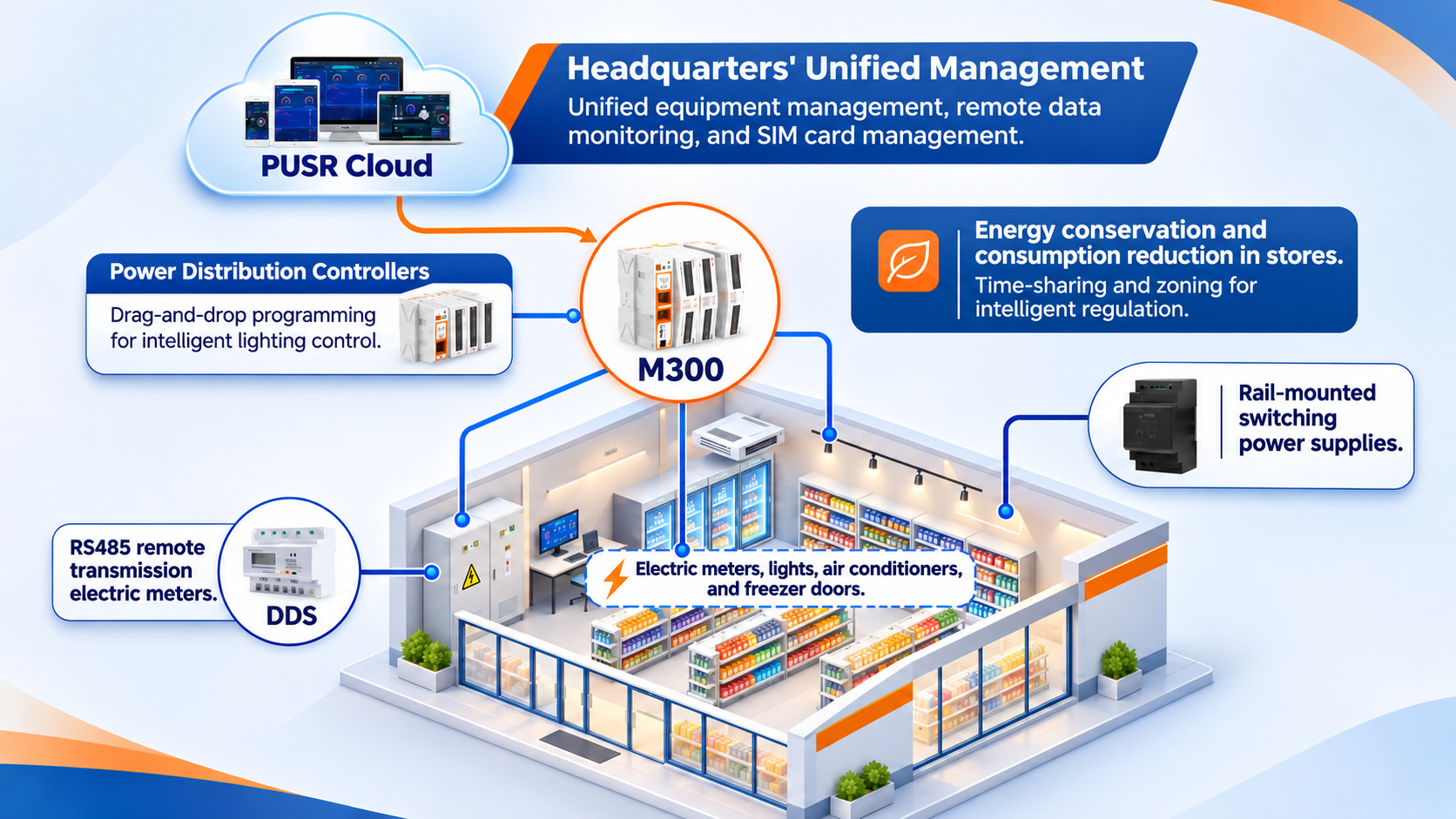
After implementing energy savings at individual stores, chain brands face a new challenge: how to uniformly manage energy data, device status, and SIM card utilization across dozens, hundreds, or even thousands of locations?
The USR-M300 supports rapid integration with cloud platforms such as PUSR Cloud. The headquarters management dashboard enables:
A retail store energy-saving retrofit follows a simple principle: "see clearly first, then manage well."
The advantage of this solution is that it does not depend on large-scale equipment replacement. A single industrial gateway can incorporate existing devices into a unified orchestration framework. For chain brands, once energy-saving results are proven at a pilot store, replicating the solution across nationwide locations requires significantly lower cost and engineering effort.