From AGV Scheduling to Robotic Arm Collaboration: All-in-One Computer Touch Screen Breaks the Impasse in Heterogeneous Robot Communication Management
Introduction: The "Communication Maze" in Factory Intelligence Transformation
In the intelligent workshop of an automotive component manufacturer, AGV trolleys shuttle along preset trajectories to transport materials, six-axis robotic arms precisely grasp parts for assembly, and visual inspection systems scan product defects in real-time... This was supposed to be a picture of efficient collaborative intelligent manufacturing, but the production supervisor, Mr. Zhang, is plagued by the differing communication protocols of robots from different brands: "The German KUKA robotic arms use PROFINET, the domestic AGVs use Modbus-TCP, and the Japanese visual inspection system uses EtherCAT. The protocol conversion equipment alone fills an entire cabinet, and troubleshooting is like solving a puzzle!"
Mr. Zhang's predicament is not unique. With the penetration rate of industrial robots exceeding 35% (data from China Industrial Control Network in 2023), it has become commonplace for factories to operate more than 10 heterogeneous robots simultaneously. These devices from different manufacturers are like "workers" speaking different dialects. How to enable them to collaborate efficiently under the same "workshop language" has become a key bottleneck restricting the implementation of intelligent manufacturing. As the "intelligent brain" on the industrial site, the all-in-one computer touch screen is providing a solution to this challenge through its ability to manage unified communication protocols.
The current industrial robot market is fragmented, with ABB, KUKA, and Fanuc occupying the high-end market, domestic manufacturers like SIASUN and Estun rapidly rising in the mid-to-low-end segments, and emerging categories such as AGVs and collaborative robots. This results in more than a dozen communication protocols, including PROFINET, EtherCAT, Modbus-TCP, and OPC UA, coexisting in factories. A survey of an electronics manufacturing enterprise revealed that protocol incompatibility accounted for 22% of equipment downtime on its production lines, resulting in annual losses exceeding 10 million yuan.
After engaging with over 300 manufacturing enterprises, we found that customer awareness of heterogeneous robot communication management evolves through three stages:
Initial optimism: "Devices from different brands each have their advantages, and combining them yields better results."
Mid-stage confusion: "The cost of protocol conversion equipment exceeds expectations, and the debugging cycle is extended by three times."
Late-stage anxiety: "Fault localization requires coordinating with five suppliers, and the MTTR (Mean Time to Repair) is as long as eight hours."
The sentiment of a CIO from a home appliance enterprise is quite representative: "We spent 2 million yuan on equipment procurement but had to spend another 1 million yuan on protocol conversion gateways. It's like buying a luxury car but needing an extra interpreter."
Data silos: Different protocols prevent production data from being interconnected, leaving MES systems with access to only 60% of real-time data.
Maintenance nightmares: Each additional protocol requires the maintenance team to learn new tools, increasing personnel training costs by 40%.
Upgrade obstacles: During equipment software upgrades, protocol compatibility issues often paralyze entire production lines.
Security risks: Multi-protocol conversion increases the attack surface, with one automotive plant experiencing a production data breach due to a protocol vulnerability.
Traditional solutions employ a combination of "protocol conversion gateways + upper computers," akin to using multiple interpreters to relay information sequentially. In contrast, the all-in-one computer touch screen achieves "one-time access, global interoperability" through its built-in multi-protocol driver engine. Take the USR-SH800 as an example: it supports simultaneous parsing of 12 mainstream industrial protocols, including PROFINET, EtherCAT, and Modbus-TCP, and allows custom expansion of private protocols, keeping protocol conversion delays under 5ms.
Physical layer: Provides RJ45/fiber optic/5G multi-interfaces to accommodate different equipment communication needs.
Protocol layer: Employs a dynamic parsing engine to automatically identify equipment protocol types.
Application layer: Uses OPC UA to unify data models, enabling cross-system data interaction.
A practice in a 3C manufacturing enterprise showed that after deploying the USR-SH800, the collaborative efficiency between AGVs and robotic arms increased by 35%, and production line changeover time was reduced from two hours to 20 minutes.
Modern all-in-one computer touch screens have transcended simple protocol conversion functions, leveraging edge computing capabilities to achieve:
Real-time diagnostics: Monitor protocol communication quality to preemptively warn of potential faults.
Traffic scheduling: Dynamically allocate bandwidth based on business priorities.
Security reinforcement: Built-in industrial firewalls block unauthorized protocol access.
In an application at a chemical enterprise, the USR-SH800 successfully identified abnormal motor control in an AGV by analyzing protocol communication patterns, averting a major production accident.
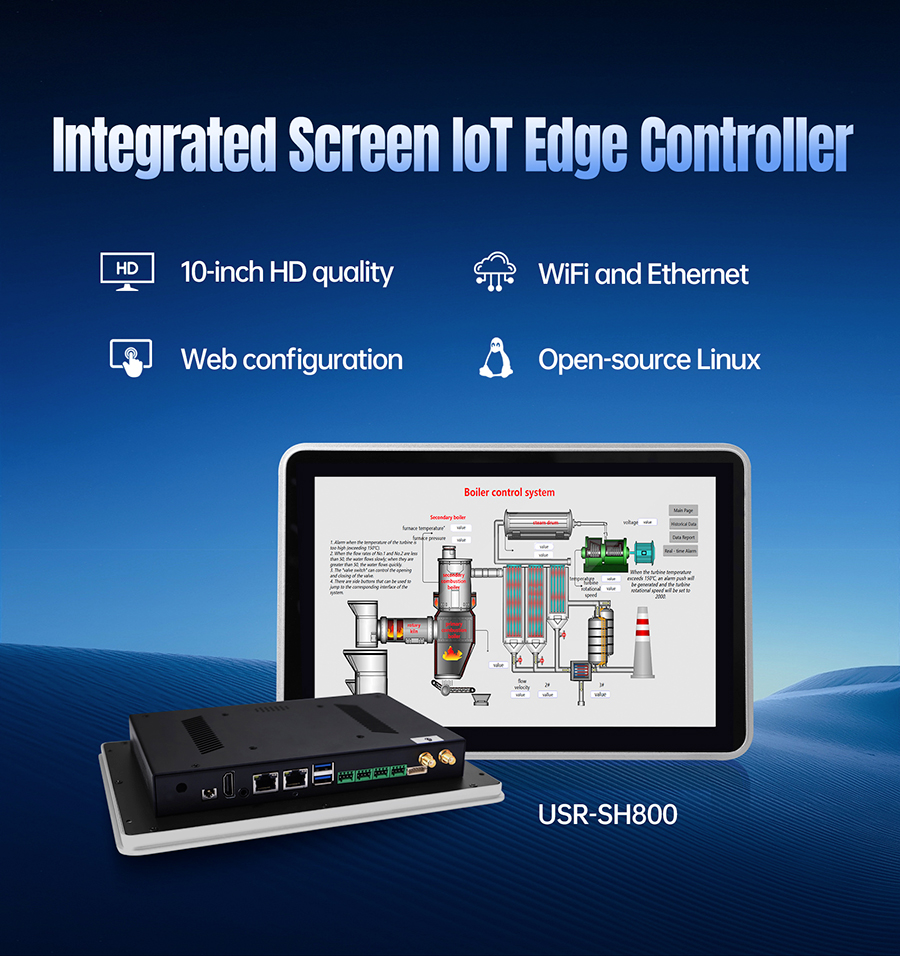
Protocol compatibility: Covers mainstream industrial protocols and supports custom private protocol development.
Real-time performance: Protocol processing delay <10ms to meet motion control requirements.
Reliability: Industrial-grade design (-40°C to 70°C wide temperature operation), MTBF >50,000 hours.
Ease of use: Provides visual configuration tools to lower debugging thresholds.
Simple deployment: Completes protocol (docking) in 20 minutes through a drag-and-drop configuration interface.
Elastic scalability: Supports PCIe slot expansion for connecting peripherals such as AI acceleration cards.
Open ecosystem: Seamlessly integrates with mainstream MES/SCADA systems and provides a secondary development SDK.
A case from an equipment manufacturing enterprise is highly persuasive: Its production line simultaneously operates Fanuc robotic arms, KUKA AGVs, and Siemens PLCs. Through unified protocol management with the USR-SH800, the Overall Equipment Effectiveness (OEE) increased from 68% to 82%, saving over 1.5 million yuan in annual operation and maintenance costs.
With the in-depth development of 5G + Industrial Internet, factory communication architectures are evolving from "island connections" to "full connectivity." Gartner predicts that by 2025, 70% of manufacturing enterprises will adopt unified communication platforms to manage heterogeneous equipment. As the core carrier of this transformation, the all-in-one computer touch screen is evolving from a "protocol converter" into an "operating system for the industrial site."
For enterprises undergoing intelligence transformation, choosing an all-in-one computer touch screen with unified protocol management capabilities is not just a temporary solution to current communication challenges but a strategic investment in building a future-ready intelligent factory. As the CTO of an automotive group put it: "True intelligent manufacturing only begins when all devices can speak the same language."
In the intelligent workshop of a precision manufacturing enterprise in Shenzhen, the USR-SH800 all-in-one computer touch screen is quietly coordinating 23 robots from different brands: AGVs automatically adjust their delivery paths based on the processing rhythm of robotic arms, and visual inspection systems provide real-time feedback of inspection data to PLCs. All devices collaborate efficiently under a unified "language," like a well-coordinated team. This may be the most beautiful vision of intelligent manufacturing—free from protocol barriers, characterized by the smooth flow of data and continuous improvement of production efficiency.
When enterprises are no longer troubled by communication protocols, and when engineers' energy shifts from "firefighting" to innovation, the true value of intelligent manufacturing will finally be realized through these "subtle yet profound" transformations.


















