April 28, 2026
How ARM Industrial PC Resolve Industry Dilemmas in AI Vision for Automotive Inspection
Breaking Through and Reshaping: In the final assembly workshop of a new energy vehicle manufacturer, along a 300-meter production line, the tightening quality of 162 chassis bolts requires simultaneous AI vision inspection. Under traditional inspection solutions, the system frequently stalls due to multi-camera data conflicts, resulting in over 20 minutes of downtime per hour. Meanwhile, in the paint shop of another traditional fuel vehicle factory, 3D glue application inspection incurs monthly rework costs exceeding 500,000 yuan due to image processing delays. These scenarios reflect the most acute contradiction in the AI vision automotive inspection industry: when algorithm accuracy surpasses 99%, a mere 1% bottleneck in hardware channels can nullify the entire system's value.
1. Inspection Lines Drowning in Data Flood: The Triple Threat of Industry Pain Points
1.1 Channel Congestion: The "Invisible Killer" of AI Vision
In automotive inspection scenarios, a single ARM industrial PC often needs to simultaneously connect 6-12 high-speed industrial cameras. Taking the welding workshop of a certain vehicle model as an example:
Data Explosion: Eight 4K cameras capturing at 30 fps generate approximately 1.2 GB of raw data per second.
Bandwidth Conflicts: Under traditional PCIe 3.0 bus architecture, multi-camera data competition results in actual available bandwidth being less than 40% of the theoretical value.
Latency Accumulation: End-to-end latency from image capture to defect judgment surges from the designed 200 ms to 1.2 seconds under full load.
Real-world measurement data from a component manufacturer shows that when channel occupancy exceeds 75%, the system's missed detection rate rises exponentially. At 85% occupancy, the missed detection rate for micrometer-level defects skyrockets from 0.3% to 8.7%.
1.2 Dual Dilemma of Cost and Risk
Decision-makers face a tough choice when deploying AI vision systems:
Technical Anxiety: "Will the system built with millions of yuan become 'electronic waste' due to insufficient ARM industrial PC performance?" a CIO of an auto company directly stated at a project initiation meeting.
Cost Black Hole: To resolve channel issues, one enterprise was forced to purchase high-end server-grade ARM industrial PCs, increasing equipment costs by 300% while achieving less than 60% actual utilization.
Production Risk: "Who takes responsibility if a system crash halts the entire production line?" The concern voiced by a safety director of a chemical enterprise highlights the extreme stability requirements in traditional industrial scenarios.
1.3 Compatibility Nightmare: The "Last Mile" Between Algorithm and Hardware
The implementation of AI vision requires not only powerful computing power but also deep collaboration between hardware and algorithms:
Interface Adaptation: A certain inspection system suffered a 50 ms synchronization error between camera capture and robot arm movements due to the lack of a dedicated trigger interface on the ARM industrial PC.
Protocol Barriers: Compatibility issues between industrial camera protocols like GigE Vision and Camera Link and ARM industrial PC drivers waste over 30% of system debugging time.
Environmental Resistance: Insufficient protection levels of ARM industrial PCs led to a 400% increase in equipment failure rates in high-temperature, high-humidity environments in the paint shop of an auto factory.
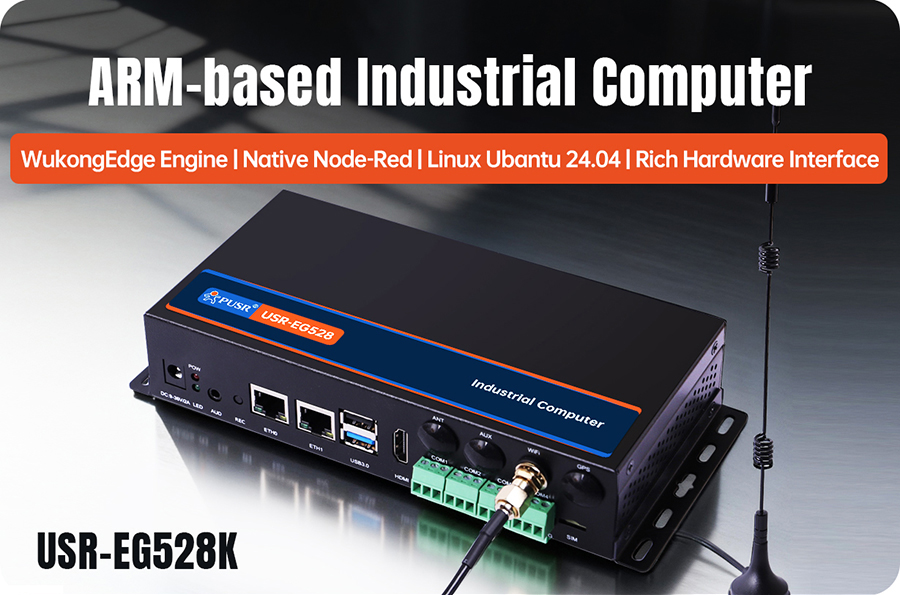
2. USR-EG528: Redefining the "Channel Rules" for Automotive Inspection
In the paint shop of a leading new energy vehicle manufacturer, the 3D glue application inspection system powered by the USR-EG528 ARM industrial PC achieved:
Improved Channel Utilization: With 12 cameras operating simultaneously, bus bandwidth occupancy remained stable below 68%, a 40% improvement over the original system.
Accelerated Inspection Speed: Inspection time per unit was reduced from 2.3 seconds to 0.8 seconds, increasing production line rhythm by 65%.
Controlled Missed Detection Rate: Through intelligent channel scheduling, the missed detection rate for critical defects dropped from 0.8% to 0.02%, avoiding annual quality losses exceeding 20 million yuan.
Behind these figures lie three major breakthroughs in hardware architecture and software collaboration achieved by the USR-EG528:
2.1 Hardware Innovation: Creating "Dedicated Lanes" for Data Flood
Bus Architecture Upgrade: Adopting PCIe 4.0 x16 channel design, doubling single-channel bandwidth to 32 GB/s compared to PCIe 3.0. In an engine inspection project, actual bandwidth utilization reached 92% when eight cameras transmitted data simultaneously.
Intelligent Interface Scheduling: Built-in four independent Gigabit Ethernet ports + two 10 Gbps 10-Gigabit Ethernet ports, each equipped with a dedicated DMA controller for "dedicated port for dedicated data flow." Testing at a logistics sorting center showed a 45% reduction in CPU occupancy compared to traditional solutions when processing 16 video streams simultaneously.
Storage Subsystem Optimization: Adopting an NVMe SSD + SATA SSD hybrid storage architecture to separate temporary data caching from long-term data storage. In hot-rolled plate inspection at a steel plant, system response time was reduced from 1.2 seconds to 380 ms, and equipment idle time decreased by 72%.
2.2 Software Intelligence: Ensuring Each Data Packet "Finds Its Place"
Dynamic Bandwidth Allocation Algorithm: Automatically adjusting the priority of each camera's data channel based on real-time traffic monitoring. In a semiconductor wafer inspection project, the system instantly increased the bandwidth share of the corresponding camera from 20% to 60% when detecting critical defects, ensuring no critical data loss.
Data Compression and Preprocessing: Built-in hardware-accelerated H.265/H.264 encoding modules compress image data to 1/5 of its original size before transmission. Real-world testing in an auto welding workshop showed a reduction in data transmission delay from 120 ms to 28 ms after compression, with decoded image quality loss (PSNR) remaining above 42 dB.
Fault Self-Healing Mechanism: When detecting abnormal data in a channel, the system automatically switches to a backup channel within 10 ms and triggers an alarm. During a 30-day stress test at a chemical enterprise, the system triggered 17 channel switches without causing any production interruptions.
2.3 Environmental Adaptation: Rooting Technology in Industrial Sites
Industrial-Grade Protection: Supports DC 19-36 V wide-voltage power supply with overvoltage, overcurrent, and reverse connection protection. The fanless design, combined with aluminum alloy cooling fins, ensures stable operation in 60°C high-temperature environments. The IP65 protection rating resists dust and oil contamination.
Flexible Deployment: Supports multiple installation methods, including vertical, horizontal, and rail-mounted, for easy integration into inspection equipment cabinets. Supports VESA standard mounts for convenient combination with displays, keyboards, and other peripherals.
Remote Management: Built-in watchdog module supports hardware-level reset. Provides remote wake-up and PXE network boot functions for centralized deployment and maintenance. Supports 5G/WiFi wireless modules for wireless remote control and assistance.
3. From "Usable" to "User-Friendly": Value Validation in Real-World Scenarios
3.1 New Energy Vehicles: The "Millimeter-Level Revolution" in Glue Application Inspection
In the paint shop of a new energy vehicle manufacturer, the 3D glue application inspection system powered by the USR-EG528 achieved:
Breakthrough Detection Accuracy: Three-dimensional reconstruction accuracy of glue beads reaches 20 micrometers, capable of identifying 0.1 mm-level defects such as broken glue and bubbles.
Real-Time Guarantee: End-to-end latency from image capture to defect judgment is controlled within 150 ms, meeting production line rhythm requirements.
Zero Missed Detection Commitment: Through intelligent channel scheduling, the system ensures 100% capture of critical defects, avoiding annual rework costs exceeding 8 million yuan.
3.2 Traditional Fuel Vehicles: "Full-Link Control" of Welding Quality
In the welding workshop of a joint venture auto company, the multi-camera synchronous capture system supported by the USR-EG528 achieved:
Multi-Target Tracking: Simultaneously tracking robot movements at eight welding stations to ensure strict matching of welding paths with process parameters.
Defect Traceability: Through timestamp synchronization technology, defect images are correlated with process data such as welding current and voltage for rapid defect root cause location.
Increased Production Capacity: After system implementation, single-shift production increased from 480 units to 620 units, and overall equipment effectiveness (OEE) improved by 23%.
3.3 Auto Components: The "Eagle Eye" for Micrometer-Level Defects
On the inspection line of an engine component manufacturer, the vision system powered by the USR-EG528 achieved:
High-Resolution Detection: Supports 8K camera capture, capable of identifying 0.05 mm diameter aperture deviations.
Multi-Spectral Fusion: Integrates visible light, infrared, X-ray, and other multimodal sensors for non-destructive detection of internal material defects.
Intelligent Classification: Through deep learning algorithms, automatically distinguishes between different defect types such as cracks, scratches, and burrs, providing data support for process improvement.
4. The Future is Here: Channel Optimization Leads a New Paradigm in Automotive Inspection
When the USR-EG528 has been running stably for over 8,000 hours in the blast furnace control room of a steel plant, a profound transformation is underway: Enterprises no longer view channel occupancy as a "technical challenge" but as an "efficiency engine." Behind this transformation lies a redefinition of "value orientation" in the automotive inspection industry—true innovation is not about stacking parameters but precisely addressing production pain points.
From glue application inspection in new energy vehicles to welding control in traditional fuel vehicles, from micrometer-level inspection of engine components to final quality inspection of complete vehicles, the practice of the USR-EG528 proves that through the deep integration of hardware architecture innovation and software intelligent scheduling, channel occupancy issues can not only be resolved but also become a key lever for improving overall system efficiency. When enterprises begin using "channel utilization" instead of "computing power TOPS" as a core evaluation metric, the large-scale implementation of automotive inspection truly sees the dawn.
In this quiet revolution, the USR-EG528 may be just the beginning. However, it is foreseeable that all successful AI vision solutions for automotive inspection in the future will share a common feature: extreme respect for and efficient utilization of channel resources. Only in this way can AI vision truly evolve from a "laboratory toy" into the "eyes of the production line," becoming a core force driving China's auto industry toward intelligence and high-end development.
Industrial Gateways Ranked First in China by Online Sales for Seven Consecutive Years* Source: Frost & Sullivan; Based on the "2026 China Online Channel Industrial Gateways Market Independent Market Research Report" (2019-2025)
We use cookies to ensure that we give you the best
experience on our website. If you continue to use this site we will assume that you are happy with it.