Green Building AGV's "Energy-Saving Solution": How ARM Industrial PC's Low-Power Design Cuts Costs and Boosts Efficiency?
Honestly, I've seen too many scenes like this:
The workshop supervisor stares at the monitoring screen — AGV #3 is down again. Not because it hit a wall, but because it mysteriously rebooted. The maintenance guy squats under the chassis wiping dust, replacing fans, checking wiring, restarting the system — go through the whole routine, and half a day is gone. You stand there, saying nothing, but in your head you're already calculating: how many times a day does this thing stop? How much capacity is lost each time? Over a year, just from maintenance and downtime, you could buy half a new unit.
What makes it even more stressful is the battery. The AGV starts "gasping" mid-run — fully charged, but it hits the alarm in under two hours. You know you should switch to LiFePO4 batteries, but when you run the numbers — full vehicle retrofit, incompatible interfaces, system re-tuning, the timeline can't be stretched. So you make do, you make do, you make do — and watch your capacity get eaten away bit by bit.
You don't not want to upgrade. You're afraid the cost of upgrading is higher than the cost of not upgrading.
This "stuck between a rock and a hard place" pain — that's the real pain point. And what I want to tell you today is: the root of the problem might not be the AGV itself at all. It's that unassuming ARM industrial PC sitting in its gut.
Let's break down a seriously underestimated fact.
In an AGV's cost structure, the battery system accounts for about 10%~17%, the chassis and navigation system each take a big chunk. But what truly determines whether this vehicle "runs stably and saves energy" is its control brain — the ARM industrial PC.
The performance of traditional ARM industrial PCs in AGVs is nothing short of a disaster:
First, fan dust buildup → cooling failure → system crash.What's the AGV operating environment? Dust, vibration, high temperature. The fan on an ordinary ARM industrial PC is basically a "vacuum cleaner." In less than three months, the heatsink fins are clogged, CPU temperature spikes, and the system crashes right in front of you. You think it's the AGV's poor quality? No — it's the brain that burned out first.
Second, not enough interfaces → external expansion → double the failures.LiDAR needs to connect, industrial cameras need to connect, PLCs need to communicate, motor controllers need to be managed… Traditional ARM industrial PCs are strapped for I/O, so you have to add external converter boxes. Every extra adapter point is an extra failure source. You think the system getting more and more complex is a "feature upgrade"? No — you're planting landmines for yourself.
Third, voltage fluctuations → repeated reboots.AGVs run on battery power. The voltage isn't a straight line — it's a sawtooth wave. Ordinary ARM industrial PCs have extremely low tolerance for voltage swings. One momentary power dip, the system reboots, the task is interrupted, and the entire production line waits for it.
What's the result when all these problems stack up? Unstable equipment → frequent downtime → capacity loss → skyrocketing maintenance costs → the boss's heart is bleeding.
And the real breakthrough point isn't changing the battery. It isn't changing the AGV. It's —swapping in a "low-power brain."
When we say "ARM industrial PC low-power design," we're absolutely not just crudely turning down the CPU frequency. True dynamic power management is a sophisticated intelligent scheduling system that does three things:
Take an ARM industrial PC powered by the Rockchip RK3568 processor as an example. Under light load, the main frequency can drop to 0.8GHz, cutting power consumption by 40% straight away. What does this mean in an AGV scenario? When the AGV is cruising slowly through the warehouse, the ARM industrial PC automatically enters low-power mode. The moment it receives a transport command, it instantly maxes out its computing power — path planning, obstacle avoidance calculations, all done in one go.
It's not about saving power all the time. It's about saving when you should save, and going full throttle when you should go full throttle.That's what intelligence means.
Going further, task offloading mechanisms can migrate non-critical tasks — like weather data analysis, inventory counting — to a low-power co-processor, letting the main CPU go straight to sleep. In solar monitoring scenarios, the main CPU's sleep time ratio reaches as high as 60%. Same logic for AGVs: visual recognition can be handed off to a dedicated NPU, the main controller only handles scheduling and decision-making, and power consumption drops off a cliff naturally.
This is the "killer-level" feature for AGV scenarios.
A fully enclosed fanless design, relying on the aluminum chassis itself for heat dissipation — completely saying goodbye to dust-induced crashes. It runs stably even in dusty, vibrating environments, pushing equipment failure rates below 0.1%.
Wide voltage input supports DC 12V~28V, perfectly matching the voltage fluctuations of AGV batteries. No more reboots from a momentary power dip. No more "going crazy" from unstable voltage.
You know what this means? It means your AGV can actually"run continuously"instead of "run-stop-run-stop."
There's data to back this up: in a 3,000-meter altitude energy storage project in Qinghai, ARM industrial PC saved 30% energy through thermal control algorithms with dynamic heat dissipation, compared to fixed-speed fan modes. AGVs don't go to high plateaus, but the principle is the same — instead of relying on "brute force" cooling, let the system learn to "self-adapt."
What does an AGV need to connect? LiDAR (RS485), industrial cameras (USB), PLCs (serial port), dispatch system (Ethernet), 4G/5G communication modules… The traditional approach relies on external expansion — the more interfaces, the more failure points.
A low-power ARM industrial PC designed specifically for AGVs crams 3 Gigabit Ethernet ports, multiple COM ports, and USB 3.0 into a palm-sized chassis. One port for dispatch, one port for in-vehicle communication, one port for redundancy expansion. No converter boxes needed, no extra cabling, clean system architecture.
One less adapter point means one less reason for someone to call you at midnight to fix equipment.
I know what you care about most is the numbers. Let's calculate, line by line:
| Cost Item | Traditional Solution | Low-Power ARM Industrial PC Solution | Savings |
|---|---|---|---|
| Equipment Failure Rate | Frequent crashes, 2~3 times/month | <0.1%, no issues for half a year | Maintenance cost ↓ 60%+ |
| Cooling Energy Consumption | Fans running constantly, high cooling overhead | Fanless/smart thermal control, cooling energy ↓ 60% | Saves thousands of kWh/year |
| Battery Life | High power draw, short range, frequent charging | Dynamic power management, range ↑ 30%+ | Longer battery life, lower replacement cost |
| System Integration | Lots of external expansion, long deployment cycle | Rich I/O, plug-and-play | Faster delivery, shorter timeline |
| Capacity Loss | Downtime = production halt, uncontrollable losses | Stable operation, 7×24 online | Huge hidden gains |
A garment company introduced 20+ AGVs and saved massive labor costs, becoming a smart manufacturing demonstration factory. A Huaneng solar power station used domestically produced ARM industrial PCs for real-time data analysis, reducing daily ineffective power generation by 15%. In an energy storage project, dynamic charge-discharge strategies pushed system conversion efficiency from 85% to 91%.
The logic behind all these numbers is the same: when the control core is stable enough and power-efficient enough, the energy efficiency of the entire chain gets pulled up.
Now look at the battery side. LiFePO4 batteries have 2,000~4,000 charge cycles — 4~8× that of lead-acid (~500 cycles). Energy density is 110Wh/kg, more than double lead-acid's 50Wh/kg. Charge time is 1~2 hours vs. 7~8 hours for lead-acid. When the ARM industrial PC pushes its own power consumption to the absolute minimum, the battery's advantages can truly be unleashed.Otherwise, no matter how good the battery you swap in, it can't feed a "greedy" main controller.
Starting January 1, 2026, theGeneral Code for Energy Efficiency and Renewable Energy Application in BuildingsGB55015-2025 will be fully enforced. Carbon emission intensity becomes a prerequisite for construction permits. Green smart warehouses and green factories are no longer a "bonus" — they're amandatory requirement.
In this grand game, AGVs are the core carriers of smart logistics, and the ARM industrial PC is the AGV's core brain. If the brain isn't energy-efficient, the whole body is wasted.
The future trend is already crystal clear: digital twin prediction, carbon neutrality data platforms, 5G + edge computing… All of these require a stable, low-power, intelligent control core. ARM industrial PCs linked with carbon emission monitoring devices automatically generate energy efficiency reports and participate in carbon trading — one photovoltaic power station increased its annual carbon credit revenue by 1.2 million RMB. This isn't the future. This is happening right now.
Every kilowatt-hour you save on the ARM industrial PC today, every downtime you avoid — that's real money in tomorrow's carbon trading market.
After all that, you're probably wondering: is there a product that can pack everything I just described into one box?
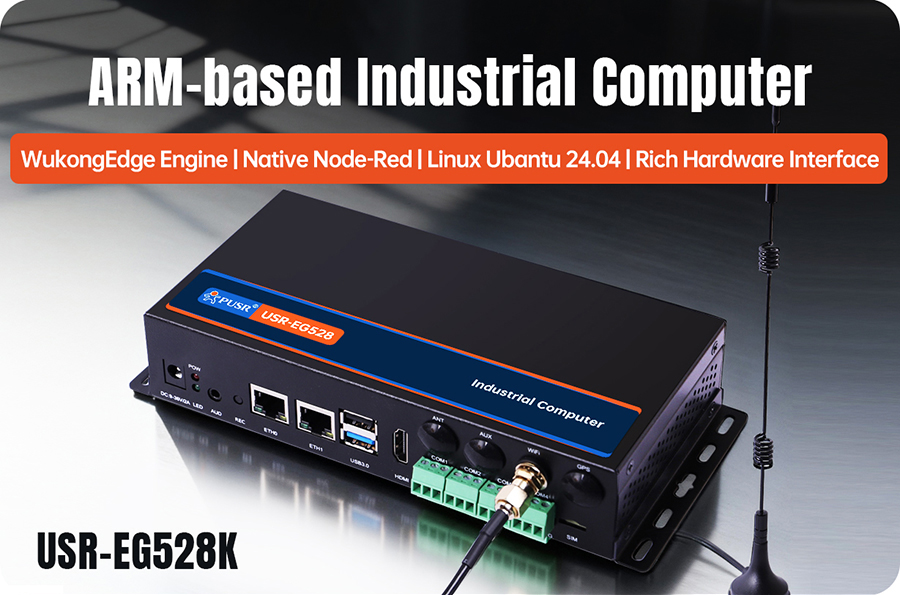
Honestly, there aren't many ARM industrial PCs on the market that can simultaneously deliver "fanless + wide voltage + multi-GigE + low power + compact size + industrial-grade shock resistance." If you're in the selection process, take a look at theUSR-EG528— its performance in AGV scenarios is seriously impressive. Low-power processor paired with rich I/O, wide voltage input perfectly suited for on-vehicle environments, compact enough to fit directly into the AGV chassis. No hype, no fluff — it's the kind of "install it and forget about it" solid choice.
Of course, selection is just the first step. What matters more is that you think clearly about what you really want: you don't want an AGV that "can run." You want an AGV that"keeps running."And the secret to making it "keep running" is hidden in that low-power brain.
The future of green buildings doesn't start with the solar panels on the roof. It starts with that quiet, low-power ARM industrial PC sitting in the AGV's gut. Whoever figures this out first gets the ticket to the "dual carbon" era.


















