How Can IoV Break the "Data Silos" Dilemma in the Auto Industry? This Automaker's Practice Provides Answers
In the wave of digital transformation in the auto industry, data silos are like stubborn reefs, hindering enterprises from sailing towards intelligence and efficiency. From R&D and manufacturing to supply chain management and marketing, each link accumulates massive data. However, due to system fragmentation and inconsistent standards, data circulation is difficult, leading to delayed decision-making, rising quality risks, and frequent compliance issues. One leading automaker's practice offers a way out for the industry: using IoV technology to build a "highway" for data circulation, making data truly a core asset driving enterprise development.
In auto R&D, structured data generated by design departments using tools like CATIA and NX often cannot communicate with unstructured data from simulation departments (e.g., fluid dynamics simulation results, crash test data). This "language barrier" extends R&D cycles by 15%-20%. One automaker even saw a 12% mismatch rate of parts due to BOM and production system asynchrony, resulting in annual losses exceeding 50 million yuan.
The auto supply chain involves thousands of suppliers, with data scattered across multiple systems. Among 6,800 suppliers of one leading automaker, only 40% achieve real-time data synchronization, and material inventory turnover is 30% lower than industry benchmarks. More critically, when a part has quality issues, the lack of full-chain traceability can lead to recall costs of hundreds of millions of yuan.
In marketing, customer information from 4S stores, online platform leads, and in-vehicle network user behavior data are scattered across more than 20 systems, with user profiling accuracy below 60%. One new energy brand once had private traffic scattered across seven platforms, resulting in cross-channel marketing ROI at only 50% of the industry average, with single promotion event GMV struggling to break the 100 million yuan mark.
Automaker management often faces a dilemma regarding data silos: while they recognize the importance of data circulation, they worry about high system integration costs, long cycles, and difficulty in quantifying returns. One commercial vehicle group saw supply chain costs increase by 18% and new product R&D cycles extend by 25% due to inconsistent data standards, yet decision-makers hesitated due to "invisible immediate benefits."
Technical teams face a conflict between "technical debt" and innovation. Data silos formed by legacy systems due to historical reasons act as heavy burdens, limiting the application of new technologies (e.g., AI, blockchain). One joint venture brand attempted to reduce cross-system collaboration costs through master data governance but still saw a 12% BOM error rate due to a lack of unified coding rules, trapping the technical team in a cycle of "patchwork fixes."
Business departments feel the pain of data silos most acutely. Production departments face downtime due to delayed material delivery, marketing departments miss opportunities due to inaccurate user profiling, and after-sales departments struggle to quickly locate issues due to scattered repair data. One new energy automaker saw after-sales claim data accuracy below 80%, leading to declining user satisfaction and damaged brand reputation.
The leading automaker's path to breaking the deadlock began with top-level strategic design. They established a data governance committee directly led by the CTO, clarified data owner responsibilities, and formulated 17 types of systems, including the "Master Data Coding Rules" and "Data Security Classification Standards," covering the entire data lifecycle. Simultaneously, they built a unified data mid-platform, integrating over 100 data sources and supporting petabyte-scale data processing, laying the technical foundation for data circulation.
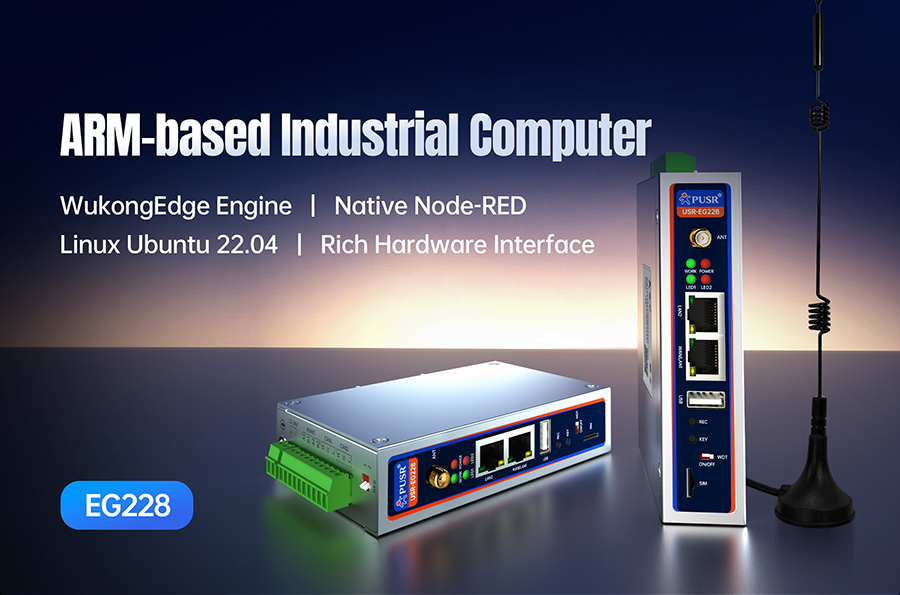
Technologically, the automaker built a data circulation network covering the entire "R&D-production-supply-marketing-service" chain using IoV technology. Take production as an example: they embedded IoV RFID chips on intelligent assembly lines to collect real-time data on equipment parameters, process parameters, and key materials. Local processing was carried out via edge computing nodes (e.g., USR-EG228 fanless industrial PC), with cleaned data uploaded to the cloud. The USR-EG228, with its industrial-grade RK3506J triple-core processor, 4G/Wi-Fi/Ethernet multi-mode communication capabilities, and built-in WukongEdge edge computing engine, enabled real-time data collection, computation, and reporting, providing second-level response support for production decisions.
The automaker's practice did not adopt a "one-size-fits-all" approach but started with core scenarios and gradually expanded to the whole. For example:
Supply Chain Collaboration: By building an inbound logistics intelligent platform, they achieved transportation route optimization (loading rate increased by 8%) and real-time visual tracking (on-time delivery rate improved to 99.3%), cumulatively saving over 200 million yuan.
User Data Integration: They built a CDP platform integrating over 20 million user data points, constructed a 200+ user tag system, achieved a 9-fold increase in cross-channel marketing ROI, and broke the 500 million yuan mark in single promotion event GMV.
Quality Traceability: They applied blockchain technology to make battery traceability data tamper-proof, reducing recall costs by 60% and meeting compliance requirements of the "Automobile Data Security Management Regulations."
The key to breaking the deadlock lies in organizational transformation. The automaker upgraded data circulation from a "technical requirement" to an "enterprise consensus" by establishing a data governance office, setting up cross-departmental data collaboration mechanisms, and conducting data culture training. For example, they required all new systems to pass data interface standard certification before going live; otherwise, approval would be denied. Meanwhile, they incorporated data quality into departmental KPI assessments, forming a virtuous cycle of "data-driven decision-making."
Automakers need to focus on three core requirements when selecting IoV solutions:
Real-time Performance: Production data requires second-level responses to support dynamic scheduling and quality control. The USR-EG228 compressed vehicle network data quality inspection time from 8 hours to 30 minutes via its distributed computing engine, with abnormal data detection rates improving to 99.97%.
Scalability: It must be compatible with emerging technology stacks like Hadoop and IoT to adapt to future business changes. One automaker supported 10-layer BOM structure editing and achieved minute-level data synchronization through unified coding rules.
Security: It must meet over 20 certifications, including ISO 27001 and GDPR, to prevent data leaks. The USR-EG228 implemented fine-grained permission management for over 2,000 data fields based on the RBAC model and built a robust security protection system through VPN, firewall, and other functions.
Solution Type | Applicable Scenarios | Strengths | Limitations
Traditional ETL | Batch synchronization of a few systems | Simple implementation, low cost | Poor real-time performance, weak scalability
Data Mid-platform | Integration of multi-source heterogeneous data | High scalability, supports real-time stream processing | High initial investment
Master Data Management | Standardization of core business objects | Resolves coding confusion, improves consistency | Requires supporting organizational and process changes
IoV + Edge Computing | Real-time processing of production site data | Reduces cloud load, improves response speed | Requires professional equipment support
Among IoV solutions, the USR-EG228 fanless industrial PC stands out with its "hardware-software integration" advantages. In addition to powerful hardware performance (e.g., industrial-grade processor, multi-mode communication capabilities), it offers out-of-the-box functions like drag-and-drop programming, protocol conversion, and linkage control through its built-in WukongEdge edge computing engine. For example, one automaker achieved active sensor data collection via the USR-EG228 and completed complex logic processing through a graphical interface without secondary development, significantly shortening project launch cycles.
In the future, IoV will deeply integrate with AI, blockchain, and other technologies. For example, large models can automatically generate data quality inspection rules (a pilot project improved efficiency by 70%), or blockchain storage can make battery traceability data tamper-proof (already applied in a battery swap alliance). These technologies will further reduce data circulation costs and increase data value density.
As the "White Paper on the Circulation of New Energy Vehicle Data Products" predicts, the vehicle network data trading scale will exceed 120 billion yuan by 2025, with battery health assessments and user driving behavior analyses becoming high-value data products. Automakers need to shift from "data silos" to a "data ecosystem," sharing data value with suppliers, dealers, and tech companies through open APIs and joint data platforms to jointly drive industry intelligence upgrades.
Breaking the data silos is not just a technical challenge but also a process of organizational transformation and cultural reshaping. The leading automaker's practice proves that building a data circulation network through IoV technology can not only improve product ion efficiency and reduce operating costs but also cultivate data assets and seize future competitive high grounds for enterprises. For automakers, data circulation has become the "new infrastructure" for digital transformation, and choosing the right IoV solution (e.g., USR-EG228) is a crucial step in this transformation.


















