6-Axis Robot Welding's "Fiery Eyes": How Does an Industrial Panel PC Achieve Real-Time Weld Pool Monitoring Through Infrared Sensing?
Welding engineer Old Zhang stares at the data for weld seam #1387 on his screen, his brow twisted into a knot. Last week, a client sent back a batch of parts claiming false welding. He spent three days investigating — process parameters were fine, welding wire was fine, the machine never threw an alarm — but the welds were still garbage.
Old Zhang said something to me that I still remember:
"What I fear most isn't that problems happen. It's that when they do, you can't find the cause."
That sentence nails a pain point the welding industry has long ignored: your robot has "steady hands," but it's"blind"to what's actually happening inside the weld pool.
Let's start with a number.
According to industry statistics, over 60% of welding defects come from abnormal fluctuations in weld pool status — temperature too high, insufficient penetration, shielding gas disturbance… These problems occur before the weld bead even forms, but traditional robot welding systems are completely oblivious to them.
Why?
Because the control logic of most 6-axis welding robots goes like this:
Set current → Set voltage → Set speed → Start welding → Done
The whole process is"groping in the dark."
It doesn't know what temperature the weld pool is at right now. It doesn't know if there's spatter. It doesn't know if the weld seam has already drifted. It only knows "I finished the program."
Finishing the program doesn't mean the weld is good.
There's a sentence in Corvalent's industrial PC fundamentals article that fits the welding scenario perfectly:
"These specialized machines are designed to operate in demanding environments, where factors like temperature, humidity, and shock can affect their performance."
Temperature, spatter, electromagnetic interference on the welding floor — which one isn't "demanding"? But what's truly deadly isn't the harsh environment — it's that your system haszero perceptionof what's actually happening inside that environment.
So how do you break through?
The answer:infrared sensing + real-time monitoring.
The principle isn't complicated: the weld pool emits infrared radiation at specific wavelengths during welding. The higher the temperature, the greater the radiation intensity, and the more concentrated the wavelength distribution. By collecting these signals in real-time via an infrared sensor, the industrial panel PC can deduce the weld pool's real-time temperature, area, and morphological changes in milliseconds.
In plain language:
| Traditional Approach | Infrared Monitoring Approach |
|---|---|
| Measure with calipers after welding | Know if the weld is good while it's happening |
| Discover scrap after it's made | Adjust parameters the moment temperature drifts |
| Judge by experience | Judge by data |
| Hindsight is 20/20 | Real-time prophecy |
Nalarobot's selection guide mentions:
"A study from the Industrial Computing Alliance indicated that inadequate cooling increases failure rates by up to 40%."
The infrared sensor on a welding floor works in a high-temperature zone itself. If the industrial panel PC's cooling can't keep up, the monitoring data will drift, drop frames, and trigger false alarms — you think you're monitoring the weld pool, but you're actually looking at a pile of noise.
So the core challenge of infrared sensing isn't the sensor itself — it's whether the industrial panel PC processing the data behind it is up to the task.
I've talked to many people who do welding integration. During selection, everyone says "I want real-time monitoring," but when it actually lands, they hit these problems every single time:
Infrared sensor sampling rates can reach kHz levels. The 6-axis robot is simultaneously running motion control. Two data streams pour in at the same time — a standard industrial PC's CPU gets maxed out instantly.
Result? Monitoring latency jumps from milliseconds to hundreds of milliseconds. By the time you detect a weld pool anomaly, the seam is already scrap.
Eurocoin's article puts it plainly:
"The required processing power depends heavily on your application."
Welding + infrared monitoring is exactly that "heavily" application. You don't need a "good enough" CPU — you need a multi-core architecture with ample headroom that can handle both motion control and image processing simultaneously.
The center of a welding arc can exceed 6,000°C. Even if the infrared sensor isn't pointed directly at the arc, ambient temperatures regularly sit between 40–55°C. Add spatter, fume, and electromagnetic interference —
If your industrial panel PC uses fan cooling, the fan gets clogged with welding dust within three months, then overheats and throttles, then data is lost, then monitoring fails.
The fan is the #1 killer of industrial PCs on the welding floor.
Nalarobot said:
"Look for features like fanless designs and sealed enclosures to protect from debris."
In a welding scenario, this isn't advice. It's a lifeline.
A welding workstation has more than just an infrared sensor. You also have:
That's at least 4–6 independent inputs + 2–3 communication interfaces minimum.
Many industrial panel PCs look like they have plenty of ports, but the channels are shared — sensor data and communication data ride the same bus, and they collide and drop packets.
Eurocoin's article specifically mentions this:
"For complex setups, selecting an industrial PC for system integration with flexible I/O options is essential."
Welding + infrared monitoring is the definition of "complex setups."
Infrared weld pool monitoring isn't as simple as "sample data, display temperature." Useful monitoring requires running real-time algorithms:
These algorithms demand extremely high real-time response from both memory and CPU. 8GB of RAM is fine for a teach pendant program, but for real-time monitoring algorithms? It's barely enough.
Corvalent's article says:
"Adequate RAM ensures smooth operation during demanding applications. Aim for at least 8GB or more, depending on your specific needs."
In a welding monitoring scenario, that "or more" — start directly from 16GB.
Welding equipment exported to Europe and America requires CE and FCC. If your industrial panel PC doesn't have these, the entire line's compliance gets stuck right there.
Eurocoin mentions:
"Ensuring your industrial PC systems meet all regulatory standards helps avoid delays, legal issues, and additional costs."
Welding industry projects already have tight delivery schedules. A certification issue can hold things up for months.
There's a sentence in Nalarobot's article that I think is the most valuable line in the whole piece:
"Be mindful of over-specifying, which can lead to unnecessary costs."
Welding infrared monitoring doesn't need an i9. It doesn't need 32GB of RAM. It doesn't need a discrete GPU.
But what you do need is:
| Capability Dimension | Minimum Requirement | Why |
|---|---|---|
| CPU | Multi-core, supports hard real-time scheduling | Motion control + infrared processing run simultaneously — cannot compete for resources |
| Cooling | Fanless, passive cooling | A fan on a welding floor is a time bomb |
| Memory | 16GB minimum | Real-time algorithms + communication buffers + system overhead |
| Storage | SSD | Monitoring logs write continuously — HDDs can't handle it |
| I/O | ≥4 independent inputs + ≥2 serial ports + ≥2 LAN ports | Sensors, power supply, robot, PLC — all need to connect |
| Operating Temp | -10°C~60°C | The welding shop doesn't negotiate temperature with you |
| Certification | CE / FCC | Hard threshold for export projects |
| Lifecycle | ≥5 years supply | Production line equipment can't be replaced every two years |
Miss any one of these eight, and the project site will teach you a lesson.
By now, you might be thinking:"I understand all the specs, but industrial panel PCs on the market are either too big to fit in a welding station, don't have enough I/O to go around, or their cooling solution won't last three months on a welding floor."
That's the real dilemma for welding integrators — the requirements are crystal clear, but products that meet all of them simultaneously can be counted on one hand.
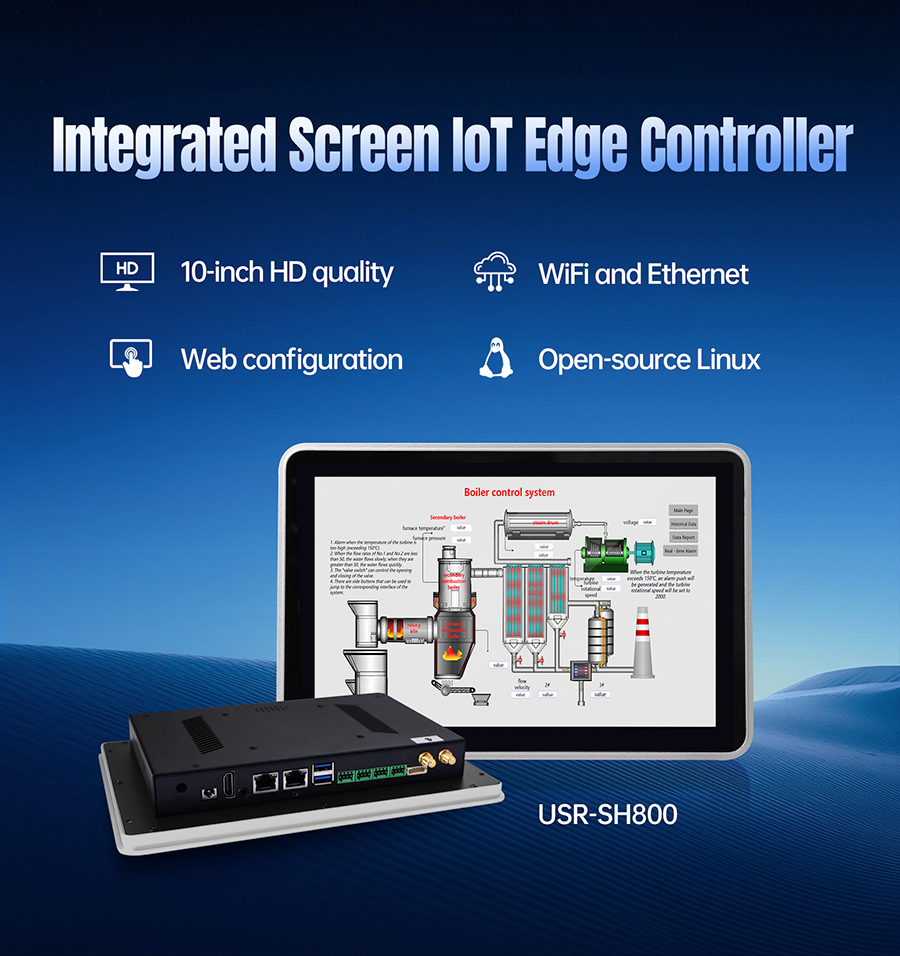
If you're comparing solutions, I recommend seriously putting theUSR-SH800on your evaluation list.
It's not designed specifically for welding, but its capability model happens to hit every core requirement for welding infrared monitoring:
| Welding Monitoring Core Need | USR-SH800's Corresponding Capability |
|---|---|
| Multi-core parallel: motion control + infrared algorithms | Multi-core processor, hard real-time scheduling — two task streams don't compete |
| Fanless, high-temp resistant | Fully passive cooling, fanless structure — stable operation at 55°C ambient |
| Multiple independent I/O for all sensors | Rich I/O interfaces — infrared sensor, welding power supply, PLC each get dedicated channels |
| 16GB+ large memory for real-time algorithms | Large-capacity memory — supports weld pool temp prediction, spatter detection, and other algorithms in real time |
| SSD for monitoring logs | Solid-state drive — 7×24 continuous writing without speed drop |
| Compact form factor fits welding station | Integrated design, compact size — easily embedded into welding workstations |
| CE/FCC certification | Meets export compliance requirements — no project delivery blockers |
| Long lifecycle supply | Industrial-grade components, 5+ years stable supply |
It's not a "can do everything" machine. It's a machine"born for the high heat, high interference, multi-sensor, real-time monitoring reality of the welding floor."
That's fundamentally different from those "great spec sheet, terrible on the floor" products.
Let's go back to Old Zhang's opening line:
"What I fear most isn't that problems happen. It's that when they do, you can't find the cause."
Infrared weld pool monitoring solves exactly that problem.
It transforms your 6-axis robot from "groping in the dark" to"fiery eyes"— it knows if the weld is good while it's happening, adjusts the moment it drifts, and stops the moment it goes bad.
And the industrial panel PC that carries these "eyes" must withstand the high heat, withstand the interference, withstand the compute pressure of real-time algorithms, and withstand the lifecycle demand of five years without discontinuation.
You don't have to pick the most expensive. You don't have to pick the one with the most exaggerated specs.
But the machine you pickmustbe able to operate in a 55°C welding shop, with kHz-level infrared data pouring in, 6-axis robot moving in sync, and electromagnetic interference at maximum —
And still output stably. Not a single frame lost.
That is the true requirement of real-time infrared weld pool monitoring for an industrial panel PC.
Put the USR-SH800 on your comparison list, or use the eight-dimension table above to measure any machine.
But please remember:
On a welding line, a robot that canseethe weld pool is the only robot you can truly count on. And an industrial PC that cansurvivethe floor is the only one worthy of those eyes.


















