Modular Design + Rapid Changeover: How an Industrial Touch Screen Computer Helps Production Lines Adapt to "Hundreds of SKUs Daily" E-Commerce Orders
Lao Zhang has been managing production at an e-commerce supply chain company for eight years. What he fears most isn't too few orders — it's orders that aretoo alive.
Yesterday's white storage box is now emerald green, and the client wants it shipped by this afternoon. The vision inspection parameters he spent all morning tuning? Gone. By afternoon, he needs a completely different set of dimensional checks. And the industrial PC on the line — that ordinary embedded box he's used for three years — starts acting up again: not enough ports, so he needs adapters; swap the inspection algorithm and the whole system blue-screens and reboots; worst of all, the machine's lifecycle is almost over, the supplier has discontinued it, and he can't even find spare parts.
Lao Zhang is not alone.
In e-commerce models where lines run "hundreds of SKUs daily" — or even "ten SKUs per hour" — changeover is no longer an occasional exception. It's a daily reality. The old mindset of "one machine, set it and forget it" is becoming the single biggest bottleneck in the entire flexible manufacturing chain.
The real problem isn't that the line isn't fast enough. It's that the "brain" on the line can't keep up.
Most people think the pain point of e-commerce warehouses is "volume." But volume is actually the easiest problem to solve — just add more people, run more shifts. The real challenge is "too many SKUs, too fast changes, too fragmented batches."
Let's break down a typical scenario:
| Scenario | Traditional Line Response | Actual Cost |
|---|---|---|
| Produce SKU A in the morning, switch to SKU B in the afternoon | 2-hour downtime, rewire, reinstall software | Daily output drops 30% |
| Add a new vision inspection station | Find adapters, buy extra capture cards | Half a day of debugging, still unstable |
| Client suddenly adds a barcode scanning station | Original IPC doesn't have enough ports, add USB hub | USB ports loosen under vibration, packet loss spikes |
| Seasonal launch, line needs to support a new protocol | Entire IPC solution needs to be scrapped and rebuilt | Procurement cycle: 6-8 weeks. Can't wait. |
See the pattern? Every single changeover, the traditional industrial PC solves a "local adjustment" problem with a "whole-machine replacement" approach. It's like changing a light bulb by tearing down your entire house and rebuilding it — of course it's slow.
There's a consensus in the industrial PC world that's been validated over and over: an industrial PC shouldn't be a "black box." It should be a set of "LEGO bricks."
Referencing the product philosophies of industry leaders AAEON and OnLogic, a truly future-proof industrial PC must have these core characteristics:
Fanless design: In dust- and fiber-filled warehouse and sorting environments, the fan is the #1 failure point. Fanless design uses precision thermal structures for passive heat dissipation, eliminating dust intake. This is the foundation of 24/7 uptime.
Wide temperature range (-40°C ~ 85°C): E-commerce warehouses are stifling in summer, freezing in winter, and cold chain warehouses go sub-zero. The IPC must run stably in extreme temperatures — no "throttle when it gets hot."
Long lifecycle (5+ years): The worst nightmare for production line equipment is supplier discontinuation. Modular design adds another layer of value — the motherboard platform can be upgraded across generations without scrapping the whole machine.
Rich I/O and expandable interfaces: This is the heart of modularity — need vision inspection? Plug in an AI accelerator card. Need multiple barcode scans? Add a serial port expansion module. Need 5G? Mount a communication module. Don't replace the whole machine. Just swap the module.
This logic is tailor-made for "hundreds of SKUs daily."
If we're recommending a product that actually delivers on this logic, theUSR-SH800 industrial touch screen computer deserves a serious look.
It's not one of those "does everything but nothing well" general-purpose machines. It's specifically designed for production line scenarios that demand frequent changeovers and rapid deployment. Let's break it down across several key dimensions:
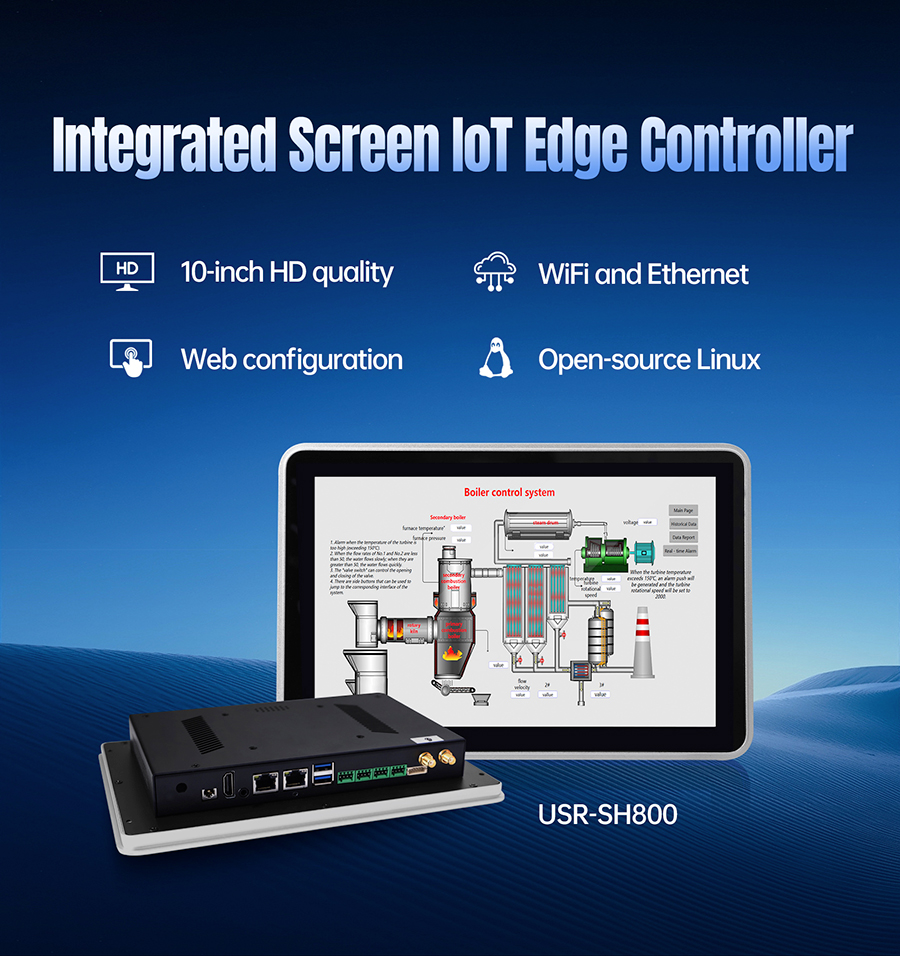
USR-SH800 uses a modular design where the core compute module, I/O expansion module, and communication module can be independently plugged and unplugged. What does that mean in practice?
Morning: producing SKU A with a vision inspection module. Afternoon: switching to SKU B, need multi-channel barcode scanning — pull out the vision module, plug in the multi-serial expansion module, reboot, and you're back online in 5 minutes.
No rewiring. No driver reinstalls. No waiting for the original manufacturer's engineer. Line workers can do it themselves after a quick training session.That'sreal "rapid changeover."
How harsh is an e-commerce warehouse environment? Cardboard dust, packaging debris, un-air-conditioned summer heat, cold chain winter chill… A regular industrial PC's fan clogs in three months.
USR-SH800's fanless thermal design, combined with a -20°C~60°C wide operating range, runs stably for years without shutdown in these conditions. For e-commerce production lines that "can't stop," this isn't a bonus feature — it's a lifeline.
The devices on an e-commerce production line are all over the place: PLCs, barcode scanners, scales, vision cameras, AGV dispatch systems, MES terminals… Traditional IPCs never have enough ports, so the line is covered in USB hubs and adapter cables — ugly, headache-inducing, and all potential failure points.
USR-SH800 integrates a rich set of native I/O — multi-channel COM ports, USB 3.0, GPIO, Ethernet, and more — with modular expansion on top. Need CAN Bus? Add a module. Need PoE power for a camera? There's a port for that. Eliminate adapters from the production line entirely.
The thing e-commerce companies fear most: you just finalized your production line solution, and the supplier says it's discontinued. Now you spend 2-3 months re-selecting, re-validating, re-deploying.
USR-SH800 is built on a mature chip platform with a lifecycle of 5+ years. And because of its modular design, even if you need to upgrade compute performance in the future, you only swap the core compute module — the peripheral I/O and chassis stay the same. One deployment, years of peace of mind.
We ran the numbers for Lao Zhang (simulated scenario, but based on real project data):
| Comparison Item | Traditional (Whole-Machine Replacement) | USR-SH800 Modular |
|---|---|---|
| Changeover downtime | 2-4 hours per change | 5-15 minutes per change |
| Annual changeovers | ~200 times (100 SKUs/day level) | ~200 times |
| Annual cumulative downtime | 400-800 hours | 17-50 hours |
| Annual capacity lost to downtime | ~30% | <3% |
| Procurement cycle (new protocol / new function) | 6-8 weeks (new whole machine) | 1-3 days (add a module) |
| 5-year TCO | High (frequent replacements + downtime losses) | Low (one deployment + modules on demand) |
The capacity you save in a single year might be worth ten times the cost of the machine itself.
That's the real value of modular design — it doesn't make your industrial PC "look more premium." It makes your production linecome alive.
Let's go back to Lao Zhang's story.
After he switched to the modular IPC solution, he no longer panics when the afternoon change order comes in. Workers spend ten minutes swapping a module, adjusting parameters, and the line keeps running. He said something that really stuck with me:
"I used to dread change orders. Now, the more change orders I get, the more I feel like I bought the right system."
E-commerce-era production lines don't compete on who has the "hardest" machine. They compete on who has the "most agile" system. Modular design + rapid changeover isn't a future trend — it's a capability youmust have todayin a "hundreds of SKUs daily" world.
If your production line is being tortured by "slow changeovers, not enough ports, too much downtime," the USR-SH800 might be the turning point that takes you from "reacting to orders" to "chasing orders."
Want to learn more about the USR-SH800's detailed specs and configuration options? Reach out — we can help you put together the optimal module combination based on your actual production line scenario.