From Teach Pendant to Industrial Panel PC: A Real-World Case of a 3C Factory Saving 40% Robot Programming Time Through Upgrade
Zhang Lei was the automation supervisor at a 3C OEM factory in Shenzhen.
At 3 a.m., he received an email from the production line manager with a subject line of just four characters: "Line Stopped."
The reason was simple: a six-axis robot on a mobile phone mid-frame polishing line had jammed during a changeover.
Changeover—in the 3C industry, these two words mean everything. One second you're polishing an iPhone aluminum mid-frame; the next, the customer order switches to a Huawei titanium bracket. Every product has different polishing trajectories, force profiles, and angles. The traditional changeover method: an engineer takes the teach pendant, squats beside the robot, and drags coordinates, tweaks parameters, and runs tests point by point.
Six axes, dozens of key points per trajectory—minimum four hours per robot for a changeover.
How much does a twenty-four-hour line stop cost? Zhang Lei didn't calculate it. He only knew that last month, changeover downtime alone consumed three production lines and over one million RMB in capacity.
His hands shook when he replied to the email—not from sleepiness, but from anger.
He wasn't angry at the robots. He was angry at the teach pendant programming process that had been in use for ten years.
Zhang Lei's factory wasn't small. Twelve production lines, over forty robots—mostly six-axis polishing and dispensing units.
The 3C industry has a characteristic outsiders struggle to understand: product lifecycles are extremely short, and changeover frequency is extremely high.
A phone mid-frame, from mold opening to next-generation replacement, averages only six to eight months. Within those eight months, the customer might revise the design three times—chamfer from 0.3mm to 0.5mm, hole position offset by 0.2mm, surface treatment switched from anodizing to PVD coating. Every change means the robot has to be reprogrammed.
What's the traditional method?
Step one: the engineer generates trajectories in offline software. The software might still be a five-year-old version, with an interface like Windows 98, and importing new models crashes frequently.
Step two: export the program to the teach pendant. What is a teach pendant? Essentially a handheld remote with a small screen—computing power roughly equal to a smartphone from ten years ago, memory so small it can only load one trajectory at a time.
Step three: the engineer squats beside the line, fine-tuning point by point. The robot runs; he watches from the side. It bumps—he backs it up. It bumps again. Polishing dust flies everywhere; his protective suit is covered in aluminum powder.
Step four: after finishing one robot, copy to the next. But each robot has slight differences in mounting position—copy over, and fine-tune again.
Four steps done, four hours gone. The engineer's knees are nearly gone too.
Zhang Lei once told me something I remember vividly:
"I'm not afraid of expensive robots—I'm afraid of engineers on their knees. A senior robot engineer earns 25,000 RMB a month, kneeling eight hours a day just to make the robot move those tenths of a millimeter correctly. This isn't automation—this is a handcraft workshop."
And the problems don't stop there.
Teach pendant programming carries a hidden cost: every changeover is a risk.
Parameters manually tuned by engineers—everyone's feel is different. Zhang Lei had three engineers; changing the same product, the resulting trajectory accuracy could differ by 0.1mm. What does 0.1mm mean on a phone mid-frame? It means yield fluctuation—and the customer's not-so-happy face during inspection.
He wasn't without ideas. But the moment he asked about pricing: an offline programming workstation cost over 100,000 RMB; the robot vendor's intelligent programming module required an additional license fee—a single line changeover ran close to 200,000 RMB. Factory margins were already thin; the boss shook his head.
So they endured. For ten years.
I later had a deep conversation with Zhang Lei and discovered his real pain point wasn't "slow programming."
His pain point was: programming and production live in two different worlds.
Think about it: product design lives in CAD, process planning in CAM, production scheduling in MES—but when it comes to robot programming, everything suddenly jumps to a teach pendant's tiny screen. All digital achievements break apart.
Engineers read drawings from CAD, judge polishing paths by experience, manually input on the teach pendant, then judge results by eye. The entire process has no data loop, no version control, no traceability.
Premio mentioned a concept in their AGV/AMR case—called "sensor fusion"—integrating multi-source data through heterogeneous computing to make decisions.
What Zhang Lei's line was missing was exactly this.
His robots had force control sensors, vision cameras, encoder feedback—but all that data was scattered across individual controllers. There was no unified compute node to "fuse" it all into an editable, replicable, optimizable digital trajectory.
The teach pendant isn't a tool—it's a bottleneck.
Its computing power can't support fusion. Its screen can't hold the data. Its offline capability is zero. Its only reason for existing is that twenty years ago, there was no better choice—it gave engineers something that could "move."
But twenty years have passed.
Last August, Zhang Lei saw something at an automation exhibition.
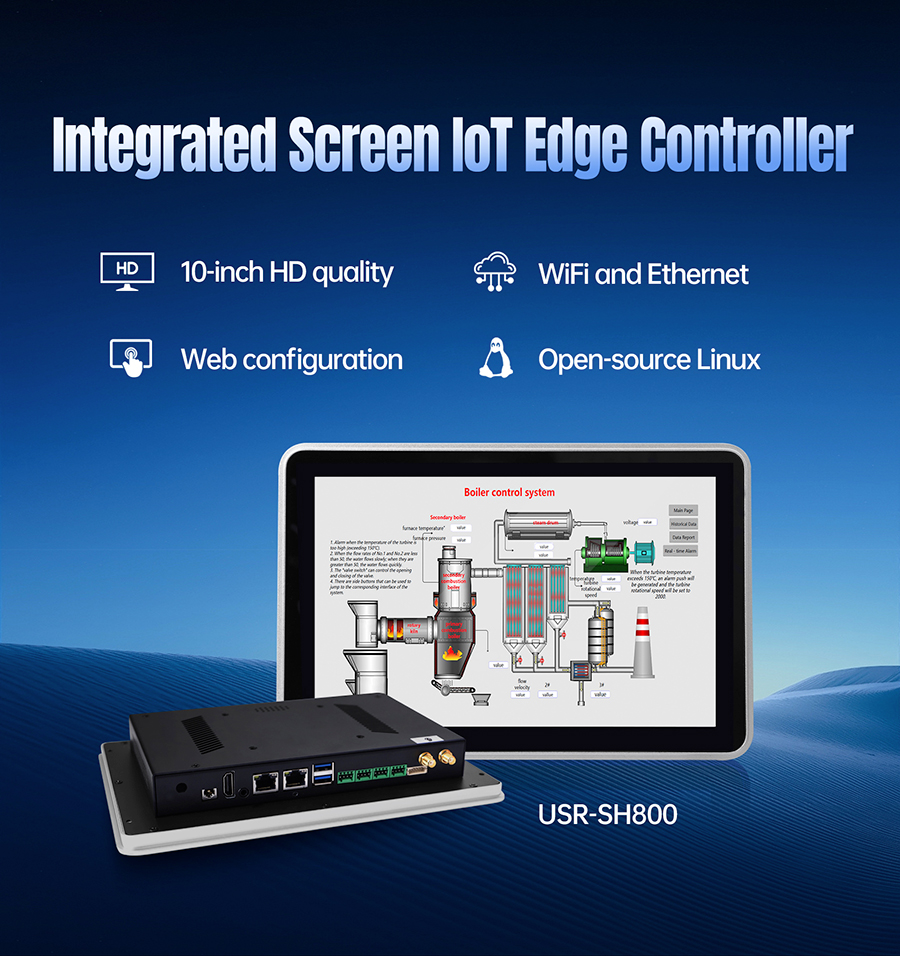
An industrial panel PC—no keyboard, no mouse, just a 15-inch touchscreen embedded in an aluminum enclosure. On the back: CAN ports, RS485, Ethernet, USB—bolted directly onto the robot control cabinet's DIN rail.
The person at the booth told him: it's called USR-SH800. It can be mounted right next to the robot, run offline programming software, simultaneously read the robot's encoder data and force control feedback, optimize trajectories locally, then push with one click.
Zhang Lei's first reaction: "Isn't this just an industrial PC with a screen?"
The person at the booth smiled and demonstrated on the spot: import a new mid-frame 3D model, the software auto-generates the polishing trajectory, drag and adjust two key points on the screen, click push—the robot next to it starts running immediately.
From import to first part: eleven minutes.
Zhang Lei said nothing—but he put the business card in his pocket.
Back at the factory, he did one thing first: trial on one line.
He installed the USR-SH800 inside the polishing robot's control cabinet, connected it directly to the robot controller via Ethernet port, loaded the offline programming software, and linked it to the line's MES system—when MES pushed a new product work order, the industrial panel PC automatically retrieved the corresponding 3D model and process parameters.
First changeover: the engineer sat in the office drinking coffee, clicked three times on the industrial panel PC, and the new trajectory was running.
No squatting beside the line. No aluminum dust. No kneeling.
What surprised him even more was the accuracy. The auto-generated trajectory, combined with real-time force control sensor feedback, produced a polishing surface consistency 0.05mm better than manual tuning. Yield improved from 96.3% to 97.8%.
After two months on one line, he converted all twelve lines.
After the conversion, Zhang Lei ran the numbers for me:
Programming time: Previously 4 hours per robot for changeover; now averaging 1 hour 20 minutes, plus automatic system push and verification—total compressed to under 2 hours. Six robots: from 24 hours down to under 12 hours. The 40% saving isn't conservative—it actually reached 50%.
Engineer man-hours: Previously two engineers per line for changeover; now one person in the control room manages three lines. Three senior engineers freed up for process optimization and new line commissioning.
Yield: The consistency improvement brought a monthly yield gain worth roughly 80,000 RMB in good parts.
Downtime loss: Changeover downtime halved—two fewer line stoppages per month. Calculated by hourly capacity value, the savings could buy twenty industrial panel PCs.
But Zhang Lei said the biggest gain wasn't money.
"Before, my engineers dreaded changeover notifications—they knew they'd be squatting all day. Now they come to me proactively: 'Mr. Zhang, three new models next month—I'll prepare the offline programs in advance.' You know what that means? It means they don't see themselves as operators anymore. They see themselves as engineers."
That sentence reminded me of a line from the Sphinx France article: an industrial computer isn't just hardware—it's "the brain of AGVs and AMRs."
Applied to a 3C factory, the industrial panel PC isn't just a screen. It's the thread that reconnects the digital world to the physical one.
I've seen too many factories like this.
Robots bought. Lines built. MES deployed. But at the last meter—robot programming—everything falls back to a handcraft workshop. Engineers squat on the floor, teach pendant in hand, dragging points one by one through the dust.
You call this automation?
This is a two-million-yuan robot paired with a twenty-thousand-yuan teach pendant, and a twenty-five-thousand-yuan-a-month engineer kneeling on the ground to serve it.
The problem isn't that people aren't working hard enough—it's that the tool is wrong.
An industrial panel PC like the USR-SH800 does something fundamentally simple: it moves programming from "human hands" to "beside the line," connects offline and online, and turns fragmented data into a closed loop.
It doesn't require you to stop production. It doesn't require new robots. It doesn't require you to overhaul your MES or process flow. It just mounts in the control cabinet—clip the DIN rail, plug in the Ethernet cable, talk to your robot controller—and your engineers can stand up off the floor.
Zhang Lei later told me his favorite image: on changeover day, the engineer sat in the control room, and on the big screen, six robots' trajectories ran simultaneously—all green, not a single error.
He said in that moment, he finally felt the line looked like a modern factory.
The 3C industry, as competitive as it is today, no longer competes on who has more robots or faster lines.
It competes on changeover response speed, yield stability, and whether engineers spend their time creating value—or kneeling to tune parameters.
From teach pendant to industrial panel PC, the 40% you save isn't time—it's your competitiveness.
If there's someone on your line still squatting at 3 a.m. tuning trajectories, maybe it's time to let them stand up.