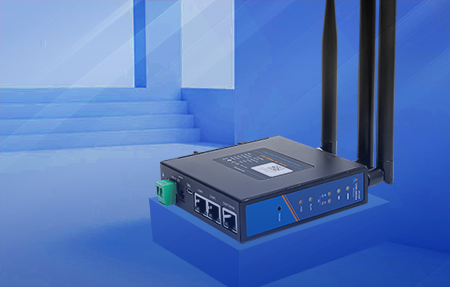
The differences between Industrial router and Commercial cellular router mainly include the following eight points, which are comprehensively described from the aspects of router appearance, design materials, network coverage, communication interface, data security transmission, WIFI coverage, configuration method and stability.
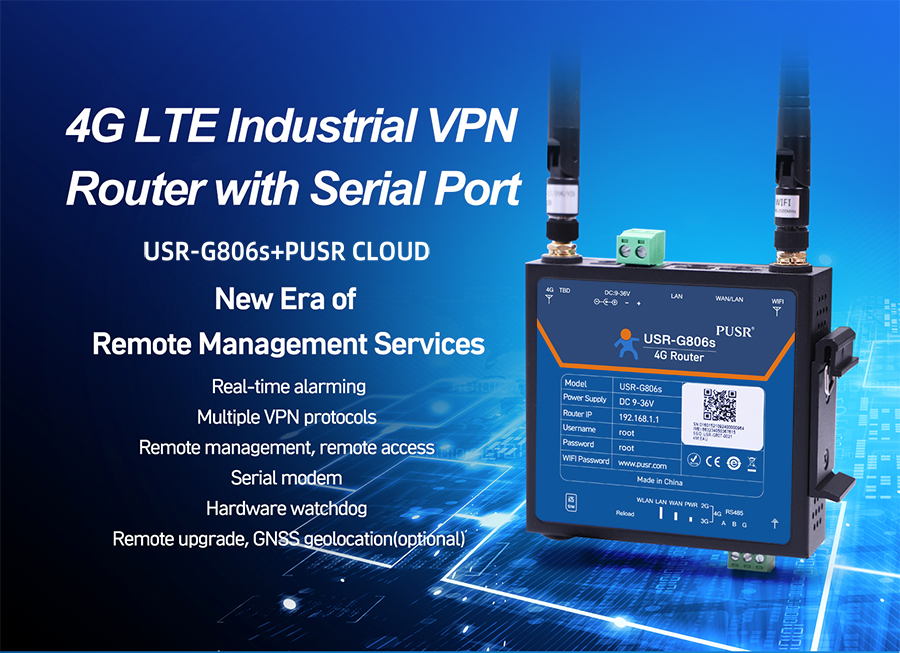
Home cellular router or Commercial cellular router is generally used for indoor applications, so in order to be more beautiful in appearance, a plastic shell with high beauty and low price is used. The industrial router is mainly used for outdoor unattended applications, which requires high protection level, is not easy to damage, and can adapt to various harsh application environments, so the metal shell is thickened and durable. The shell is safely isolated from the system, and the safety advantage of industrial control occasions is obvious.
Industrial router uses industrial-grade wireless communication modules, all devices are selected according to industrial-grade standards, and it works closely with famous brands such as Free scale and NXP. High and low temperature resistance (-35 ℃ to 75 ℃), wide voltage range (5V-35 V), designed for stable operation in harsh environments. Commercial cellular router has low requirements for device stability, high and low temperature resistance, and wide voltage range.
The industrial router can not only realize the whole network communication of LTE, but also be downward compatible with EVDO, WCDMA, TD-SCDMA, CDMA1X, GRPS/EDGE, etc. The maximum uplink rate can reach 50Mbps and the downlink rate can reach 100Mbps. Transmit power < 23 dBm, receive sensitivity < -93.3dBm, that is to say, it can connect to the operator's network even when the signal value is extremely weak. Home cellular router or Commercial cellular router generally do not have the whole network communication equipment due to cost considerations. Most of them are based on a separate frequency band of an operator, and cannot be normally connected to the operator's network in places with poor signal values.
The industrial router has rich interface resources. Take the industrial router as an example:
● 4 groups of LAN ports, 1 group of WAN ports and 1 group of USB interfaces are standard;
● Two groups of DI digital quantity input, which is convenient to connect the field intelligent equipment and monitor the equipment status;
● Two sets of relay output, easy to control the front-end equipment;
● Support RS485 and RS232 data transmission in the form of terminals, facilitate wiring, and meet the networking needs of various types of port equipment on site;
● As required by the data project, the Wan port can be customized as a LAN port, so that the BMR500 can be easily expanded to 5 LAN ports, and the project networking application is more flexible;
● The Home cellular router or Commercial cellular router generally does not need to be equipped with so many communication interfaces.
There is also a big difference between the industrial router and the Commercial cellular router in terms of data security functions: the industrial router supports IPSec, L2TP, PPTP, OPEN, GRE, etc., and can be used as a server and a client to establish multiple data security channels. It is widely used in industries with high data security requirements such as tax control and finance. Home cellular router only has L2TP and PPTP functions, and can only be used as a client.
Industrial router not only supports traditional WPA, WPA2, WEP and other encryption functions, but also adds Radius authentication. It can not only be used as a WIFI access device, but also as a client and other functions through wireless networking with other routers, which can be used in many places where network cables can not reach, greatly saving the cost of network investment. Home cellular router can only be used as WIFI access, and does not have other functions. The encryption method is relatively single, and only supports traditional encryption. The security performance of wireless access is relatively poor.
Industrial router is equipped with online maintenance mechanism (to ensure long-term stable online), with software watchdog and hardware watchdog technology. The equipment automatically monitors the working status. When the M2m equipment is occasionally abnormal, it intelligently wakes up the software or restarts the hardware after power failure, and resets the whole equipment to ensure the real-time normal operation of the equipment.It supports multi-level link detection mechanisms such as PPP layer heartbeat, ICMP detection, TCP Keepalive and application layer heartbeat to automatically recover from network failures and maintain "permanent online" wireless connections. Commercial or Home cellular router typically have only a software watchdog function.
Industrial router is generally used in large quantities. In order to improve the efficiency of configuration and management, PUSR Cloud platform provides centralized monitoring, configuration, upgrade and diagnosis for a large number of communication terminals distributed in various places, which greatly reduces the maintenance costs of operators, integrators, equipment providers and other parties and improves the management efficiency. Home cellular router are typically used locally and do not require remote monitoring, configuration, and management capabilities.
In the wave of industrial upgrades such as smart manufacturing, smart energy, and intelligent transportation, industrial routers are stepping out from behind the scenes to become the "nerve center" connecting the physical and digital worlds. Unlike traditional commercial cellular routers, industrial routers need to operate stably in harsh environments with extreme temperatures, strong vibrations, and electromagnetic interference, while meeting stringent requirements such as low latency, high reliability, and strong security. This article will provide an in-depth analysis of the core value of industrial routers and reveal how they solve six major pain points in enterprise digital transformation, helping customers gain a competitive edge in the fierce market.
The complexity of industrial scenarios determines that equipment must possess "superhuman" environmental tolerance capabilities. Traditional commercial cellular routers perform excellently in offices or data centers, but once they enter industrial sites, they often suffer frequent failures due to their inability to adapt to extreme environments, leading to serious consequences such as production interruptions and data loss.
Industrial-grade standards: Industrial routers need to operate stably within a wide temperature range of -40°C to 85°C, covering all scenarios from Arctic research stations to desert oil and gas fields. For example, an offshore drilling platform adopted the USR-G809s industrial router, which operated continuously for three years without failure in an alternating environment of -30°C cold and 70°C deck heat, while similar commercial equipment failed to start in winter due to low temperatures.
Protection level: With IP65/IP67 dust and water resistance, they can withstand dust, salt spray, and rain erosion. In a blast furnace monitoring project at a steel plant, the G809s worked continuously in a 100°C high-temperature steam environment, while commercial equipment suffered motherboard burnout due to water ingress, with repair costs reaching tens of thousands of yuan.
Fanless design: Industrial routers adopt metal casings and fanless heat dissipation, reducing the failure rate through natural convection. In a forklift scheduling system at a logistics enterprise, the G809s maintained an online rate of 99.9% under continuous vibration, while commercial equipment experienced downtime due to fan jams, affecting cargo sorting efficiency.
Wide voltage input: Supporting 9-36V DC wide voltage input and redundant power supplies, they adapt to power fluctuation scenarios such as vehicles and ships. In a smart transportation project, G809s were deployed on buses, ensuring stable transmission of traffic flow data during voltage drops when the engine started through dual power backups.
Direct Hit on Customer Pain Points:
"Our mining equipment always fails due to high temperatures and dust, and maintenance costs account for 20% of the annual budget!"
Solution: The wide temperature design and IP67 protection level of industrial routers can reduce equipment failure rates by 80%, saving more than 150,000 yuan in annual maintenance costs.
Industrial scenarios have much higher requirements for real-time performance and protocol compatibility than commercial environments. Industrial routers need to possess "all-rounder" capabilities, capable of connecting traditional devices such as sensors and PLCs, as well as supporting emerging technologies such as 5G/4G and LoRa, while meeting the dual demands of low-latency control and big data transmission.
Multi-mode wireless support: Industrial routers integrate modules such as 4G/5G, LTE-M, and NB-IoT to adapt to different scenarios' bandwidth and power consumption requirements. For example, in a smart agriculture project, the NB-IoT module of the G809s was used to upload soil moisture sensor data to the cloud with low power consumption, extending battery life to three years.
Industrial protocol compatibility: Supporting protocols such as Modbus/TCP, Ethernet/IP, and Profinet, they can directly interface with devices such as PLCs and HMIs. After adopting the G809s, an automobile manufacturing plant achieved data interconnection between welding robots and the MES system without additional protocol converters, shortening the project deployment cycle by 60%.
Low-latency transmission: Industrial control scenarios (such as robot arm synchronization and power dispatching) are sensitive to latency. Industrial routers compress data packet processing delays to within 1ms through hardware acceleration technology. After using the G809s, a semiconductor factory reduced the transmission delay of photolithography machine control instructions from 10ms to 0.5ms, improving product yield by 2%.
Multi-level link detection: Supporting functions such as PPP layer heartbeats, ICMP detection, and link backups to ensure automatic switching when the network is interrupted. In an offshore wind farm project, the G809s switched to a backup 5G network within 0.2 seconds after a primary link failure, avoiding the loss of wind turbine monitoring data.
Direct Hit on Customer Pain Points:
"Our production line has seen an increase in defective product rates due to network latency, and we urgently need a low-latency solution!"
Solution: The millisecond-level response and multi-link backup of industrial routers can reduce control instruction transmission delays by 90%, decreasing the defective product rate to one-third of the industry average.
Downtime costs in industrial scenarios are extremely high, with an automobile factory suffering losses of millions of yuan per hour of downtime. Industrial routers need to possess "self-healing" capabilities, compressing fault recovery time from hours to minutes through hardware watchdogs and remote diagnostics.
Industrial-grade components: Using automotive-grade chips, industrial capacitors, and other high-temperature-resistant and anti-aging components, they are designed for a lifespan of over 10 years. A G809s in a power monitoring project has been running continuously for eight years, maintaining an online rate of 99.99%, while commercial equipment has an average lifespan of only 3-5 years.
Hardware watchdog: Built-in independent watchdog chips automatically restart and recover when the system crashes. In a smart transportation project, the G809s automatically restarted within 30 seconds after a software crash, avoiding traffic congestion caused by traffic lights.
Low-bandwidth updates: Supporting reliable firmware updates over 2G networks to adapt to maintenance needs in remote areas. An oil and gas field project remotely updated the G809s firmware via satellite network, shortening the upgrade time from three days to two hours per instance.
Local configuration backup: Supporting TF card storage of configuration files, allowing quick replacement and parameter restoration when equipment fails. After a G809s failure at a sewage treatment plant, backup equipment replacement was completed within 10 minutes, avoiding data collection interruptions.
Direct Hit on Customer Pain Points:
"Our equipment is deployed in remote mountainous areas, and each failure requires sending engineers for on-site repairs, which is extremely costly!"
Solution: The remote diagnostics and local backup functions of industrial routers can reduce on-site maintenance frequency by 70%, saving more than 200,000 yuan in annual travel costs.
Industrial data involves sensitive information such as production safety and business secrets, and leaks can cause significant losses. Industrial routers need to meet stringent security standards in industries such as finance and energy, while complying with regulations such as GDPR and Cybersecurity Classification Protection 2.0.
Multi-protocol encryption: Supporting encrypted tunnels such as IPSec VPN, L2TP VPN, and PPTP VPN to ensure full encryption of data transmission. A financial network project adopted the IPSec VPN function of the G809s, reducing the risk of data theft to zero.
Fine-grained access control: Restricting device access permissions through technologies such as ACL and 802.1X authentication. A smart manufacturing project physically isolated the production network from the office network through VLAN division on the G809s, avoiding production line paralysis caused by ransomware attacks.
Long-term firmware updates: Industrial router manufacturers provide 5-10 years of firmware support, avoiding equipment obsolescence due to manufacturer discontinuation. A power company's G809s has received six firmware upgrades, continuously fixing security vulnerabilities and adding new functions.
Secure boot mechanism: Supporting Secure Boot functionality to prevent malicious firmware implantation. A rail transit project eliminated signal system failures caused by firmware tampering through the secure boot of the G809s.
Direct Hit on Customer Pain Points:
"Our equipment cannot be upgraded due to manufacturer discontinuation and faces security compliance risks!"
Solution: The long-term firmware support and secure boot mechanism of industrial routers can extend equipment lifecycle to over 10 years, avoiding fines or business shutdowns due to compliance issues.
Although the initial cost of industrial routers is higher than that of commercial equipment, their modular design, low failure rate, and long lifespan can significantly reduce the total cost of ownership (TCO), making them a "cost-effective choice" for enterprise digital transformation.
Modular design: Supporting hot-swappable modules such as Wi-Fi, 5G, and LoRa, allowing customers to flexibly expand functions according to needs. A smart factory initially deployed only 4G modules and later upgraded to 5G modules to increase bandwidth, avoiding the cost of overall equipment replacement.
Low failure rate benefits: Industrial routers have a failure rate only one-fifth that of commercial equipment, reducing spare parts inventory and maintenance manpower by 70%. A logistics enterprise reduced annual maintenance costs from 500,000 yuan to 150,000 yuan by deploying G809s.
Intelligent power management: Dynamically adjusting power consumption based on network load, with standby power consumption below 5W. After adopting the G809s, a data center saved 12,000 kWh of electricity annually, reducing carbon emissions by 8 tons.
Recyclable design: Using lead-free processes and detachable structures to facilitate equipment recycling after retirement. An energy enterprise reduced electronic waste generation by 300 kg annually by recycling the metal casings of G809s.
Direct Hit on Customer Pain Points:
"Our equipment has high energy consumption and does not meet ESG requirements, and we urgently need a green solution!"
Solution: The intelligent power management and recyclable design of industrial routers can reduce corporate carbon emissions by more than 20%, helping to pass ESG ratings.
Among numerous products, the USR-G809s industrial router stands out with its characteristics of "all-scenario adaptability, all-function coverage, and full lifecycle service":
Three-in-one design: Integrating 5G/4G, Ethernet, and serial server functions, a single device replaces the traditional combination of "router + protocol converter + VPN gateway," saving 50% of deployment space.
Super environmental adaptability: Operating in a wide temperature range of -40°C to 85°C, with IP67 protection and anti-vibration design, it adapts to all scenarios from deserts to polar regions.
Intelligent edge computing: Built-in Python engine and rule engine, supporting local data processing to reduce cloud load.
Security compliance: Passing national Level 3 Cybersecurity Classification Protection and IEC 61508 SIL2 certification, meeting the needs of high-security industries such as finance and energy.
Typical Application Cases:
Smart Energy: A wind farm uploaded real-time wind turbine vibration data through the 5G module of the G809s, combined with edge computing to achieve fault prediction, reducing annual maintenance costs by 40%.
Intelligent Transportation: A city traffic light project adopted the G809s, ensuring 24-hour uninterrupted operation through dual-link backups, reducing congestion rates by 25%.
The value of industrial routers lies not only in solving current pain points such as environmental adaptability and real-time communication but also in building an expandable and evolvable digital infrastructure for enterprises. Whether in smart manufacturing, smart energy, or intelligent transportation, choosing a suitable industrial router is a crucial step towards Industry 4.0.
Contact us to obtain a customized solution for the USR-G809s, enabling your equipment to operate stably in extreme environments and create value from high-speed data flow!