AGV Trolley with Embedded Stable ARM Industrial PC: Solving the Efficiency Dilemma in the Automotive and 3C Electronics Industries
In automotive manufacturing workshops, a production line requires 300 component deliveries per hour. Under traditional manual operations, the delivery delay rate reaches as high as 15%, directly resulting in production line shutdown losses exceeding one million yuan. In 3C electronics clean rooms, electrostatic and dust contamination from manual handling reduce product yield by 8%, with annual rework costs due to quality issues reaching tens of millions of yuan. Behind these alarming figures lie two core pain points shared by the automotive and 3C electronics industries: inefficient logistics and uncontrolled production safety.
Surveillance footage from a new energy vehicle factory shows a worker dropping a battery module due to physical exhaustion while handling it, posing risks of local short circuits and fires. In a smartphone assembly workshop, manually delivered displays develop micro-cracks from collisions, only detected during terminal testing, leading to the scrapping of entire batches. These cases reveal a harsh reality: in modern manufacturing, characterized by high automation and precision, manual logistics has become the "Achilles' heel" restricting production efficiency and product quality.
Traditional AGV trolleys are like "a blind man riding a blind horse," capable only of traveling along fixed tracks and halting when encountering obstacles. In contrast, the new generation of AGV trolleys, embedded with stable ARM industrial PC, achieves three breakthroughs through the integration of LiDAR, visual sensors, and UWB positioning systems:
Dynamic Path Planning: Real-time environmental mapping using SLAM algorithms enables automatic route adjustments based on production line demands, avoiding congested areas.
Intelligent Obstacle Avoidance Decision-Making: Deep learning models identify obstacle types (e.g., moving AGVs, stationary equipment, personnel) and select optimal avoidance strategies (e.g., detouring, waiting, slowing down).
Multi-Machine Collaborative Scheduling: Millisecond-level communication via 5G+TSN time-sensitive networks ensures orderly passage of dozens of AGVs in narrow aisles, preventing "deadlock" scenarios.
In real-world tests at an automotive component factory, AGV trolleys equipped with stable ARM industrial PCs improved delivery punctuality from 82% to 99.5%, enhancing production line utilization by 23%.
The core competitiveness of AGV trolleys depends on the performance of their "brain"—the ARM industrial PC. Traditional ARM industrial PCs suffer from three major flaws:
Insufficient Computing Power: Inability to process LiDAR point cloud data (millions of points per second) in real-time, leading to path planning delays.
Poor Stability: Prone to crashes in extreme temperatures (-20°C to 60°C), failing to meet the harsh conditions of automotive welding workshops.
Limited Scalability: Difficulty integrating new sensors (e.g., infrared temperature modules, gas detectors), restricting functional upgrades.
The new generation of stable ARM industrial PCs overcomes these challenges through three technological innovations:
Heterogeneous Computing Architecture: "CPU+GPU+NPU" collaborative computing increases point cloud processing speed by 10 times, reducing path planning delays to below 50ms.
Industrial-Grade Reliability: Certifications including IP67 protection, wide temperature design (-40°C to 85°C), and vibration resistance (5Grms) ensure stable operation in chemically corrosive automotive painting workshops.
Modular Expandability: Rich interfaces such as PCIe×16, M.2, and Mini-PCIe enable rapid integration of new sensors and support functional iterations.
A purchasing director at an automotive group admitted, "While a single AGV costs three times more than a traditional forklift, it saves 4 million yuan in labor costs and 1.5 million yuan in equipment wear over five years." This "high initial investment, high long-term returns" model leaves decision-makers torn between relying on low-cost but inefficient manual labor or investing in intelligent equipment.
Cost-benefit modeling reveals that in scenarios with over 100,000 annual deliveries, AGVs achieve an ROI exceeding 100% within three years. More critically, AGVs improve logistics efficiency scores in JCI certifications by 35%, directly helping companies secure high-end orders.
In a pilot project at a 3C electronics factory, AGV acceptance progressed through three stages:
Skepticism Phase (0-3 months): Engineers, concerned about mechanical failures disrupting production lines, insisted on retaining 50% manual deliveries.
Adaptation Phase (3-6 months): Discovering AGVs achieved 99.2% delivery punctuality, they began increasing task volumes.
Dependency Phase (After 6 months): They demanded expanded deployment, incorporating high-value materials (e.g., chips, displays) into the delivery system.
This trust-building process reveals a "safety redundancy" demand in manufacturing for new technologies. A dual-machine hot standby system developed by one enterprise ensures seamless switching within 30 seconds of a single AGV failure, effectively addressing customer concerns.
At Tesla's Shanghai Gigafactory, AGV trolleys undertake three core tasks:
Battery Module Delivery: Temperature-controlled compartments (2-8°C) and explosion-proof designs ensure the safety of lithium-ion batteries during transport.
Body Welding Delivery: In environments with arc splatter and high-temperature dust, AGVs maintain internal cleanliness (ISO Class 5) through positive pressure dust removal systems.
Final Assembly Line Delivery: Linked with the ANDON system, AGVs replenish materials within 8 minutes of low-stock alerts, reducing production line shutdowns by 90%.
At Foxconn's Zhengzhou factory, AGV trolleys achieve three innovations:
Electrostatic Protection: Conductive wheels, ion blowers, and anti-static coatings control surface resistance between 10⁶-10⁹Ω, preventing electrostatic discharge from damaging chips.
Dust Control: HEPA filtration systems and negative pressure compartments reduce particulate emissions to below 0.5μm/m³, meeting Class 100 cleanroom standards.
Precision Docking: Visual guidance systems align material baskets with production line stations within ±0.1mm, avoiding mechanical collisions with delicate components.
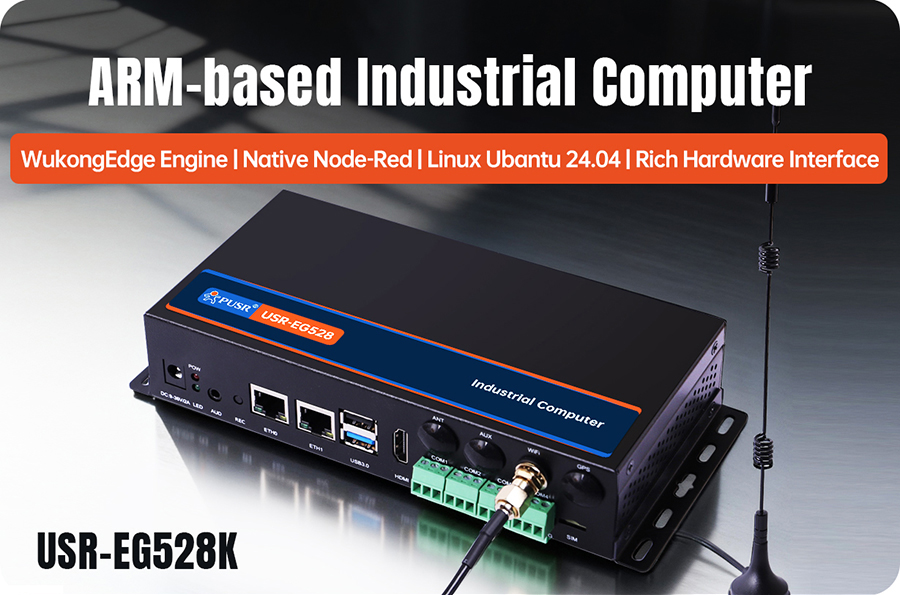
Among numerous ARM industrial PC products, Jinan UROVO's USR-EG528 stands out with three key features:
Extreme Computing Power: Equipped with a Rockchip RK3562 quad-core processor (2.0GHz) and 1TOPS NPU, it processes LiDAR point cloud data in real-time, reducing path planning delays to below 30ms.
Industrial-Grade Reliability: Certified for wide temperature operation (-20°C to 70°C), vibration resistance (5Grms), and 7×24 continuous operation with an MTBF exceeding 50,000 hours.
Flexible Expandability: Rich interfaces including 4×RS485, 2×CAN, 2×Ethernet, and 2×USB 3.0 enable rapid integration of UWB positioning modules, infrared thermometers, and other new sensors, supporting functional iterations.
In real-world tests at an automotive component factory, USR-EG528 improved AGV positioning accuracy from ±5cm to ±1cm, increased task response speed by 40%, and reduced power consumption to 60% of previous solutions.
By 2026, AGV trolleys embedded with stable ARM industrial PCs are reshaping the DNA of manufacturing. At BYD's Shenzhen factory, the AGV network has achieved:
98% automated material delivery
100% traceable transportation processes
0.5-hour emergency response times
40% labor cost savings
This transformation not only enhances operational efficiency but also fundamentally alters production models. As a recent Harvard Business Review study notes, "Intelligent logistics systems enable factories to allocate more resources to core manufacturing processes, a key lever for improving product competitiveness."
In this quiet revolution, manufacturers that embrace technological innovation and dare to break from traditional thinking are reaping dual benefits of efficiency gains and cost optimization. As AGV wheels roll across factory floors, they crush not only logistics bottlenecks but also the heavy shackles of outdated production systems.


















