From X86 to ARM: A Migration Guide for AGV Vendors on How to Choose an Embedded Single Board Computer Architecture for Cost Optimization
— Written for AGV Product Managers and Hardware Engineers Who Are Being Tortured by "Selection Anxiety"
Have you ever had one of those late nights?
Sitting in front of your computer, opening the supplier's quote, staring at a string of numbers, with only one voice spinning in your head:
"X86 boards — the performance is there, but so is the cost. ARM boards — cheap, yes, but are they enough? What if I pick the wrong architecture and the whole project blows up in my hands?"
What makes you even more anxious is — you know the industry is changing. You know everyone is migrating to ARM. You know Intel itself is pushing low-power platforms. But you don't dare move. Because an AGV isn't a phone. It isn't a tablet. The second it stops in the middle of a warehouse, you're losing real money.
You don't not want to switch. You're afraid to switch.
This article is here to make you brave.
We're not talking architecture philosophy. We're not running benchmarks. Just one thing: in the specific context of AGV, how do you actually choose between X86 and ARM? When should you stay? When should you migrate? What pits do you step into during migration?
Read this, and you'll have a clear decision map in your hands.
Everyone in AGV knows that the embedded single board computer is the "brain" of the entire vehicle. And for a long time, that brain had only one option — X86.
Intel Atom, Core i-series, AMD embedded platforms… You've been using them for years, and you've been paying for them for years.
But have you ever actually run the numbers?
| Cost Item | X86 Solution (Typical) | ARM Solution (Typical) |
|---|---|---|
| Board + CPU | ¥1,200–2,000 | ¥400–800 |
| Cooling Solution | Needs fan/heatsink, extra cost | Fanless passive cooling, no fan cost |
| Power Draw | 15W–45W TDP | 3W–12W TDP |
| Annual Electricity (per unit × 365 days) | ~¥130–390 | ~¥26–109 |
| 5-Year Total Cost of Ownership | High | 40%–60% lower |
Save ¥500 on one AGV, and 1,000 units means ¥500,000. That's not pocket change — that's your profit.
But here's the real question: can you trade that saved money for "good enough"?
That's where your real anxiety lives.
If your impression of ARM is still stuck at "can only run Linux, can't run Windows, not powerful enough" — it's time to update your mental model.
Referencing industry data and the product roadmaps of leading industrial PC vendors like AAEON and OnLogic, you'll notice a clear trend:
New-generation ARM platforms are now powerful enough to cover 90% of AGV application scenarios.
Why? Let's look at what an AGV actually does:
| AGV Core Task | Compute Need | X86 Required? | ARM Enough? |
|---|---|---|---|
| Motion Control (motor drive, path planning) | Medium, real-time | Enough | More than enough |
| Navigation (SLAM, visual nav) | High, needs GPU/NPU | Enough | Better with NPU |
| Comms Management (WiFi/4G/CAN/RS485) | Low, I/O-heavy | Enough | More power-efficient |
| Touchscreen HMI | Low–Medium | Enough | More than enough |
| Edge AI (obstacle detection, OCR) | High, needs AI acceleration | Enough | NPU-native, more efficient |
| Running Windows Desktop Apps | High | Only choice | Mostly unsupported |
See that? Except for the "must run Windows" scenario, ARM has almost no weaknesses on an AGV. And the "must run Windows" scenario? It's actually rare in AGV.
Today's ARM SoCs — like Rockchip RK3588, NXP i.MX8 series, Qualcomm QCS series — already integrate:
AAEON states clearly in its product articles: with the launch of low-power X86 platforms like Intel Atom x7000E, N-series, and Core i3-N305, CPU TDP has dropped to 6W–15W — proving the entire industry is moving toward "low power." And ARM? ARM was born to be the king of low power.
OnLogic also emphasizes in its tech blog: industrial PCs are shifting from "chasing absolute performance" to "chasing performance-per-watt." Modular design + low-power platforms have become mainstream.
In plain English:the times have changed. ARM is no longer the "backup option." It's the "preferred option."
Not every AGV is ready for ARM. Blind migration is more dangerous than not migrating at all.
Based on real project experience, here's a decision table:
| Your Scenario | Recommended Arch | Why |
|---|---|---|
| AGV runs Linux only: nav + comms + HMI | ARM, strongly recommended | 50% cost reduction, performance fully sufficient |
| AGV needs Windows + vision software (e.g., Halcon) | X86, don't touch yet | Windows ecosystem on ARM is still immature |
| AGV runs complex AI models (large model inference) | Depends | ARM's NPU is great for inference, but training still needs X86 |
| AGV in cold chain / high-temp, 7×24 operation | ARM, strongly recommended | Low power = less heat = fanless still works |
| AGV interfaces with lots of legacy PLCs/devices | X86 is safer | Legacy devices mostly have Windows drivers |
| AGV exported to Europe, needs CE/UKCA | ARM is easier to certify | Low radiation + low power = easier EMC compliance |
| Budget-sensitive, need to control BOM cost | ARM, must switch | Board cost cut in half |
One-line summary: If your AGV runs Linux, does navigation, needs power efficiency, and needs cost control — ARM is your optimal choice. If you're locked into the Windows ecosystem — stay on X86 for now, but start planning your migration roadmap.
When most AGV vendors first switch to ARM, their mindset is:"It's just a different CPU, recompile the software and we're done."
Then they crash.
Based on industry experience and technical docs from OnLogic, AAEON, and others, the four most common ARM migration pitfalls are:
Fix: When picking a board, the first thing to check isn't the CPU — it's the driver support list. A reliable ARM embedded single board computer vendor provides a complete BSP (Board Support Package), including kernel, drivers, and sample code.
Fix: Evaluate software migration costs upfront. If your team has no ARM dev experience, find a vendor that provides a full SDK and technical support — it'll save you three months.
Fix: Don't just look at CPU clock speed. Look at NPU compute, memory bandwidth, I/O throughput. AAEON notes that hybrid architectures (big.LITTLE) let efficiency cores handle light tasks while performance cores kick in only when needed — this design is more mature on ARM.
Fix: Choose mainstream platforms with long lifecycle guarantees. Rockchip RK3588, NXP i.MX8M Mini — both have 5+ years of supply assurance.
After all that, you might still be thinking:"I get it, but I don't know which board to pick."
If you're running an AGV project, budget-sensitive, running Linux, needing nav + comms + HMI + optional AI —
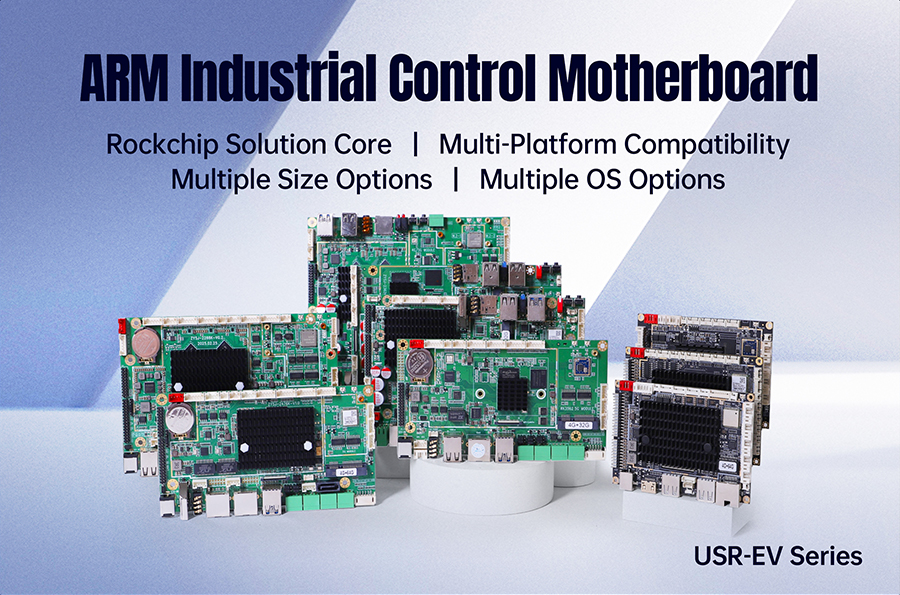
TheUSR-EV series embedded single board computerdeserves a serious look.
Why? Because it's basically built from the AGV vendor's migration checklist:
| Your Migration Pain Point | USR-EV Series Solution |
|---|---|
| Afraid of driver incompatibility | Full BSP support, mainstream Linux distros out of the box |
| Afraid software needs rewriting | Qt samples, ROS2 support, AI inference SDK provided |
| Afraid performance isn't enough | RK3588/i.MX8M mainstream ARM SoC, 6 TOPS NPU |
| Afraid cooling won't work | Fanless passive cooling, -20°C~60°C wide temp |
| Afraid not enough interfaces | Native CAN Bus, RS485, multi-USB, dual Ethernet, M.2 expansion |
| Afraid of supply chain断裂 | Mainstream platform, long lifecycle supply guarantee |
| Afraid cost won't come down | Board cost 40%–60% lower than same-perf X86 |
The USR-EV series isn't letting you "try ARM." It's letting you"switch to ARM with confidence."
It solves the hardest parts of migration — drivers, software adaptation, cooling, interfaces — for you. All you need to do is put your algorithms on it and run.
The AGV industry is going through a "silent architecture revolution."
On the surface, everyone's still comparing payload, speed, navigation accuracy. But what's really creating the gap is who brings down BOM cost first, who brings down power draw first, who replaces the production line's "brain" with something smarter, more efficient, and cheaper.
AAEON says it clearly in its Industrial PC article:"Industrial PC" is not a monolithic product — it's an umbrella term. Its value lies in its ability to adapt to different scenarios.
OnLogic says it too:"The ideal industrial computer for your application will vary depending on factors such as performance benchmarks, available power source, and the environment it's being deployed in."
Translation:There's no best architecture. Only the best architecture for your scenario.
For most AGV vendors, 2024–2025 is the optimal window to migrate from X86 to ARM. The chips are mature. The ecosystem is complete. The supply chain is stable. The cost advantage is too big to ignore.
You don't need to switch everything today. But you need to start planning today.
Because by the time your competitors finish switching, it'll be too late for you to catch up.
If you're evaluating ARM solutions and unsure whether your scenario is ready to switch — or don't know which SoC to pick — come talk to us.
We can build a complete architecture migration recommendation based on your AGV's actual configuration — navigation stack, OS, connected devices, operating environment.
After all, every penny of BOM cost you save is extra profit in your next order.