Convenience Store AGV "24-Hour Service": How Critical Is the Low-Power Design of a Fanless Industrial PC?
——How Much Extra Does a Fanless Industrial PC Cost You Per Year? 90% of People Have Never Run the Numbers
You run a convenience store. You've deployed AGVs for restocking.
They run fine during the day. They hold up at night, too. But have you noticed something weird —
The AGV is rated for "24-hour continuous operation," yet the moment it hits the late-night hours, it starts "losing its mind." Routes drift, obstacle avoidance slows down, and sometimes it just stops dead in the middle of an aisle. You assume it's the AGV itself. You swap it out. Same thing.
You swap three AGVs. You spend over a hundred thousand. The problem persists.
Then one day, the repair tech opens the AGV's control cabinet, points at the fanless industrial PC inside, and says:
"This thing is hot enough to fry an egg. You expect it not to fall asleep at 3 AM?"
You freeze.
You never thought the thing dragging down your 24-hour service was the AGV, the battery, or the algorithm — it was that fanless industrial PC you never even looked at twice.
Most people think: an AGV is an AGV. If it runs in a factory, it can run in a convenience store.
Dead wrong.
A factory AGV runs fixed routes in a controlled environment. Constant temperature. No people around. If it breaks down, half an hour of downtime — nobody cares.
A convenience store AGV?
It runs in a"living"environment.
Customers walking. Lights changing. Cold cabinet doors opening and closing. Floors switching between dry and wet. The AGV has to shuttle through all of this, 24 hours a day — restocking shelves by day, delivering drinks to cold cabinets by night, refilling the register with change in the early morning.
What does that mean?
It means the fanless industrial PC behind that AGVcannot go down. Not for a single second.
And a regular fanless industrial PC? Power consumption is easily 30 to 40 watts. Let's do the math: 40W × 24 hours × 365 days = 350 kWh. One machine costs you over 300 yuan a year in electricity alone. If you've deployed five AGVs in your store, that's 1,500 yuan just on fanless industrial PC power bills.
And that's not even the worst part.
High power consumption means high heat. And heat means what? Accelerated component aging, crashes, reboots, communication packet loss. You think the AGV "losing its mind" at 3 AM is an algorithm problem? No. It's the fanless industrial PC getting so hot it can't cope — the CPU starts throttling, response times slow down, sensor data starts dropping.
You spent over a hundred thousand on AGVs, and a fanless industrial PC that costs a few hundred bucks is the one holding you back.
Have you ever run that calculation?
When people hear "low-power fanless industrial PC," the first reaction is usually: it's just about saving on the electric bill, right?
Way too shallow.
The phrase "low power" carries an entire chain of cause and effect. Once you see that chain clearly, you'll understand why it's the "lifeline" of a convenience store AGV.
Link 1: Low Power → Low Heat → High Stability.
This is the most critical link. What's the number one killer of electronic devices? Heat. For every 10°C rise in internal temperature, component lifespan cuts in half. Low power means low heat. Low heat means components operate in a cool environment, and the probability of crashes, reboots, and communication dropouts plummets.
For a convenience store AGV running 24/7, stability is everything. Customers won't forgive you because your AGV "died of heat."
Link 2: Low Power → Fanless → Zero Failure Points.
Traditional fanless industrial PCs rely on fans for cooling. What's a fan? A mechanical part. Mechanical parts mean wear, dust buildup, noise, and failure. What's a convenience store environment? Food area — dust, grease, moisture. The moment a fan clogs with dust, cooling efficiency drops, temperature spikes, and you're in a vicious cycle.
A low-power fanless industrial PC can achieve a completely fanless design. No fan means no failure point. Silent operation, no dust intake, no cleaning maintenance. For a convenience store — a "nobody's watching" environment — this isn't a bonus. It's a requirement.
Link 3: Low Power → Wide Temperature Range → Full Scenario Compatibility.
How complex is a convenience store environment? In summer, the cold cabinet area can dip below zero. In winter, cold air blasts in through the entrance. A regular fanless industrial PC operates between 5°C and 45°C — step outside that range and it quits.
Low-power fanless industrial PCs are designed with a wider operating temperature range from the ground up. Some models run stably from -10°C to 70°C. That means whether your AGV is running next to a cold cabinet or getting blasted by wind at the door — it doesn't miss a beat.
Link 4: Low Power → Long Lifespan → Low Total Cost of Ownership.
Buy a regular fanless industrial PC — replace it every two years. Buy a low-power fanless industrial PC — don't touch it for five years. On the surface, the low-power version might cost a few hundred more. But factor in electricity, maintenance, downtime losses, and replacement costs — over five years, you save enough to buy a new AGV.
That's not saving money. That's making money.
I've talked to many convenience store owners, and I've found their fear of AGVs isn't "it will break" — it's"I don't know when it will break."
A factory has a maintenance department. Three-shift repair crews. What does a convenience store have? You. Maybe you and your spouse. The AGV dies at 3 AM — you're not calling a repair crew, are you?
So the demands a convenience store AGV places on a fanless industrial PC are ten times harsher than a factory's:
No surprises allowed.
Low-power design is, at its core, about eliminating surprises.
Lower power means less heat. Less heat means components don't overheat. No fan means no mechanical failure. Wide temperature range means it handles environmental shifts. And lower power means the battery lasts longer too — in some scenarios, a low-power fanless industrial PC can even run directly off battery power, completely ignoring mains power fluctuations.
See? Low power isn't a spec. It's an entire "nothing goes wrong" guarantee system.
For a 24-hour unattended convenience store,"nothing goes wrong" is the biggest competitive advantage there is.
A team in Shenzhen running unmanned convenience stores originally used regular x86 fanless industrial PCs — 35 watts each. After three months, problems piled up: summer overheating crashes, winter communication dropouts in the cold cabinet area, fan dust buildup killing cooling efficiency, and fan replacements every quarter.
Then they switched to low-power ARM fanless industrial PCs. Power consumption dropped to single digits. The result?
Zero failures in one year. Zero.
Not "way fewer failures." Zero.
The team lead said something I think is spot-on:
"We used to dread getting a phone call at 2 AM. Now? I've forgotten AGVs even need anyone to manage them."
That's the real value of low power — it doesn't make your AGV run faster. It makes you completely forget it exists.
For a convenience store owner, that's worth more than anything.
I know what you're thinking right now.
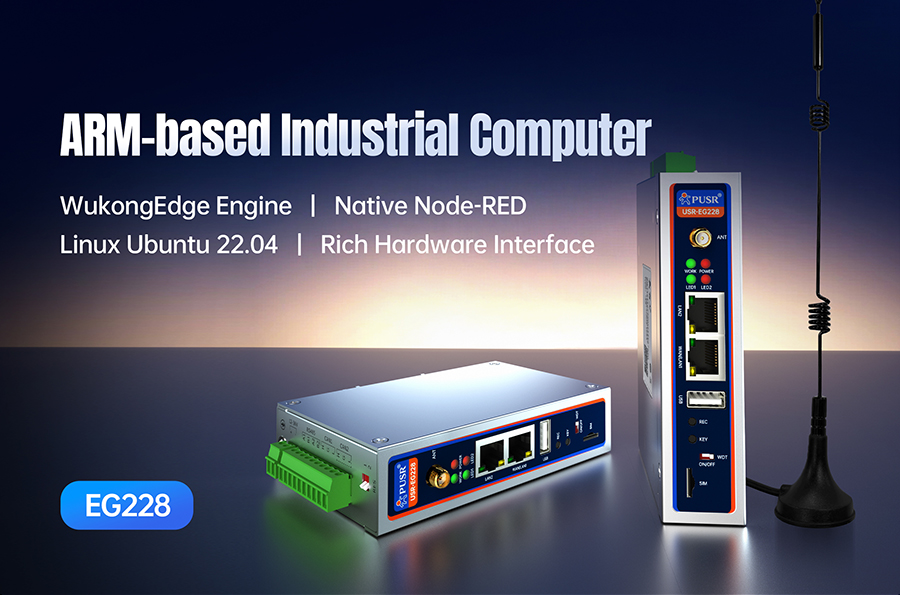
You're thinking: "Are low-power fanless industrial PCs expensive?" — Not really. ARM-based low-power fanless industrial PCs have dropped to half the price of traditional x86 models, or even lower. PUSR's EG228, powered by the RK3506J processor, draws just a few watts, comes with Ubuntu 22.04 and Node-RED pre-installed, has 4G/WiFi/Ethernet all built in, plus 2 RS485 ports and 2 CAN FD channels — it plugs directly into your AGV's communication protocol. Out of the box, ready to go. You don't need to know Linux. You don't need to write code.
You're thinking: "My current fanless industrial PC holds up fine, no need to switch." — Holding up and holding upfor realare two different things. You haven't had a problem yet. That doesn't mean you won't at 3 AM. You haven't replaced a fan yet. That doesn't mean you won't next month. Low power isn't something you need after a problem shows up — it's what keeps the problem from ever showing up.
You're thinking: "What if I switch and it still fails?" — Low-power design eliminates most failure roots at the physical level. Less heat. No fan. Components don't overheat. 80% of the "surprises" you can think of? It's already blocked them for you.
What you're really afraid of isn't spending money. You're afraid of spending money and still getting that 3 AM phone call.
A low-power fanless industrial PC is what makes sure younever get that call again.
Convenience store competition isn't about "who stays open later" anymore. Everyone's 24 hours. Why should customers pick you?
Because your shelves are always full. Because your cold cabinets always have stock. Because your register always has someone — even if that someone is an AGV.
And the precondition for all of that? Your AGV doesn't die at 3 AM.
The precondition for your AGV not dying at 3 AM? The fanless industrial PC behind it doesn't overheat, doesn't crash, doesn't drop offline.
The precondition for the fanless industrial PC not overheating, crashing, or dropping offline? Low-power design.
See? All of "24-hour service" ultimately comes down to one thing you never even looked at twice — that palm-sized fanless industrial PC.
It's unremarkable. But it decides whether your convenience store truly runs 24 hours, or just "open by day, pray by night."
Don't wait until 3 AM, when your AGV is stalled in the middle of an aisle and you're crouched on the floor rebooting the fanless industrial PC, to remember this.
Fix the foundation now. Let low power handle the late-night shifts.
You just count the money.


















