From Film Set to Stage: How Does an ARM Industrial PC Make AGVs the "Creative Assistants" of the Entertainment Industry?
— The Director Yelled "Action," the AGV Didn't Move. The Whole Set Waited 40 Seconds.
You've definitely been in a moment like this.
Not in a factory. Not in a warehouse. In a film studio. At a concert rehearsal. In that moment when the lights are set, the cameras are rolling, and everyone is waiting — your AGV is stopped where it shouldn't be.
Or worse: it moved, but wrong. Two meters off course, it crashed into a prop cart. The director cursed. Your heart sank.
You start thinking:Why did I ever think I could just shove any ARM Industrial PC in there and call it a day?
This article isn't about spec sheets. It's about something more real — when AGVs go from "hauling cargo" to "creating art," your entire understanding of ARM Industrial PC might need to be torn down and rebuilt.
Let's start with a fact most people haven't realized:
The entertainment industry is becoming one of the fastest-growing application scenarios for AGVs.
Film crews use AGVs to transport camera dolly tracks. Concerts use AGVs to dispatch lighting rigs. Variety shows use AGVs as interactive props. Even Disney's theme parks — AGVs have become "actors" — they move on their own, interact with people, and perform in sync with the lights.
But have you ever stopped to ask yourself one question:
Factory AGVs run fixed routes, execute deterministic tasks. What about entertainment industry AGVs?
One second it's carrying a light rig, the next the director shouts "change it" — now it has to "follow the actor." It weaves through a stage piled with cables and props, dodging obstacles at every turn, stopping on a dime, rerouting at a moment's notice.
It's not executing a program. It'simprovising.
AAEON wrote a line in their tech article that fits here perfectly:
"Industrial PCs are not a monolith... their functions, purposes, deployment viability, and value added can often lead to such a broad range of functionality that 'Industrial PC' is more suitably used as an umbrella term."
Entertainment industry AGVs are exactly the most special umbrella under that "umbrella term."
They don't need "good enough to run." They need —changeable at any moment, durable at any moment, never dropping the ball at any moment.
Let me make a checklist for you. This is a checklist that every person who's ever done an AGV project in the entertainment industry silently checks off in their head:
| What You Think the Environment Is | What It Actually Is |
|---|---|
| Clean studio | Cables everywhere, dust, fog machine haze |
| Constant 25°C | Stage lights roasting — local temps hit 50°C+ |
| Flat floor | Rail seams, carpet edges, temporary ramps |
| Fixed route | Director shouts "change it" — route changes on the fly |
| Runs 8 hours | Rehearsal 4hrs + show 4hrs + teardown 2hrs — non-stop |
| Can stop to fix if it breaks | Live broadcast / recording — not a single second of downtime allowed |
OnLogic puts it plainly in their tech article:
"Industrial PCs are engineered from the ground up with the features necessary to survive in the type of industrial automation environments that might destroy off-the-shelf computers."
Film sets and stages are exactly that "might destroy off-the-shelf computers" environment.
And what's even more deadly — you don't have time to fix it.
A concert won't pause because your AGV crashed. A live broadcast won't restart because your ARM Industrial PC overheated. A variety show won't say "let's take another one" because the AGV hit a prop.
In the entertainment industry, when an ARM Industrial PC fails, the cost isn't "downtime for repair." It's a"broadcast accident."
Go search the technical debrief of any major live event — you'll almost always see the same word: "redundancy."
But true redundancy isn't carrying a spare machine. It's that the machine you chosenever breaks in the first place.
I've talked to many technical leads in the entertainment industry. When they pick an ARM Industrial PC, they say "need performance, need I/O" out loud. But what they're really thinking about is this:
Entertainment industry requirements change too fast. Today the AGV carries a light rig. Tomorrow it chases an actor. The day after it coordinates with drones for a formation performance. You can't swap out an ARM Industrial PC every time the creative direction shifts.
OnLogic says:"Industrial PCs are highly configurable... allowing for easy customization and scalability to adapt to evolving industrial requirements."
What you need is an ARM Industrial PC that"grows with your creativity"— not one that falls behind the moment your creativity outpaces it.
This is the most overlooked problem.
Standard ARM Industrial PCs are rated for 0–50°C. But under direct stage lighting, local temperature easily breaks 55°C. Add the machine's own heat — CPU, GPU, motor drivers — all trapped in one sealed chassis.
AAEON's product line covers-40°C ~ 85°Coperating range. Why go that wide? Because they know: spec sheet numbers are lab data. The real world is the real exam.
The "0–50°C operating temp" you see during selection might be 10 degrees lower than what your AGV actually endures on stage.
That 10 degrees is the difference between"running"and"dead in the water."
This is what a lighting director told me. He said:
"I don't need it to be fast. I need it to not fail tonight. If it fails, tomorrow's headline is about us."
ARM Industrial PC selection in the entertainment industry isn't fundamentally a technical problem. It's aconfidence problem.
You need a machine you don't have to worry about. You need to know that once you install it in the AGV, connect the sensors, program the route — you can go handle everything else.
After all that anxiety, let's look at the solution.
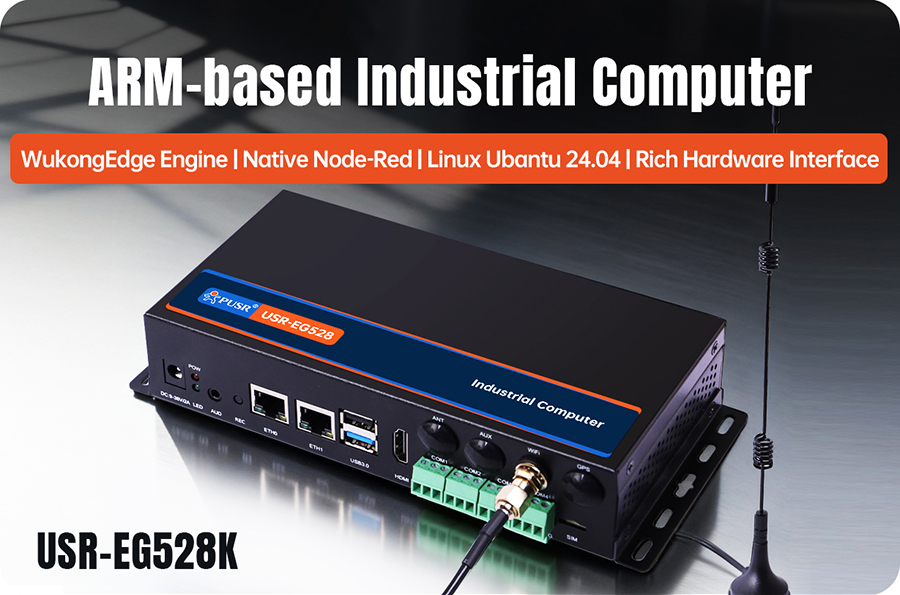
If your AGV is for the entertainment industry — film sets, stages, variety show floors, theme park interactions — I'd seriously recommend you look at theUSR-EG528.
Not because it has the strongest specs. Because every design choice it makes answers those three anxieties above.
| Your Anxiety | USR-EG528's Answer |
|---|---|
| Requirements keep changing, don't want to swap hardware | Modular I/O design — USB3.0, RS232/485, CAN, GPIO combinable on demand. LiDAR today, vision module tomorrow — no motherboard swap needed |
| Stage hits 50°C, machine throttles | Fanless passive cooling + wide-temp design — full speed in extreme heat, no fan sucking in dust, no throttling to survive |
| Can't stop during a show, need "zero worry" | Industrial-grade components, 24/7 continuous operation design, long lifecycle architecture, won't be obsolete in 5 years — one deployment covers multiple shows |
| Too many devices to connect, not enough ports | Rich expansion I/O — LiDAR, vision camera, dispatch system, VR module — all on one machine, no external adapter boards needed |
| Budget is tight, can't go top-tier | Enough performance with headroom — don't pay for compute you won't use, spend the money onreliability |
AAEON mentions a trend in their article:"With such advancements, meeting the demands of industrial automation has been made easier, thanks to the very combination of features that make industrial PCs unique."
The USR-EG528 is the embodiment of that "combination of features" — it doesn't chase a single spec to the top, but it makes sure every problem you'll face on-site has an answer.
Imagine this scene:
8 PM. The concert begins.
Center stage, three AGVs each carrying lighting equipment, moving slowly along pre-programmed routes. The lighting technician adjusts the AGVs' positions in real-time from the console — the AGVs receive the command, re-plan their paths in 0.5 seconds, and dock precisely at the new coordinates.
At the same time, the interactive screens on top of the AGVs are streaming real-time audience comments. That means the ARM Industrial PC is running navigationwhiledecoding video streams, rendering UI, and processing network data.
Two systems. One machine. Zero latency. Zero stutter. Zero failure.
This isn't science fiction. This is the real working state of entertainment industry AGVs in 2024.
And what's powering all of it? Not some supercomputer. Just a well-chosen ARM Industrial PC.
OnLogic says:"Through their robustness, versatility, and intelligence, Industrial PCs epitomize the convergence of technology, innovation, and industrial growth."
In the entertainment industry, I'd change one word:
The Industrial PC is the unbreakable bridge between creativity and the live moment.
Creativity can be wild and free. But the bridge can't break.
People in the entertainment industry are perfectionists to their bones.
You have standards for the visuals, the pacing, the experience. So your standard for an ARM Industrial PC shouldn't just be "it works."
You should demand this:in the moment you need it most, it's always online.
Next time, when you watch an AGV stop perfectly on its mark point on a film set, when you see lights follow the music precisely at a concert, when you watch an AGV and an actor perform in perfect sync on a variety show —
You'll know that the unassuming ARM Industrial PC behind it all got every single thing right.
Go look at theUSR-EG528.
It won't let your creativity hit the ground.


















