Heavy-Load Capability of Concrete Batching Plant AGVs: How Does an Arm Industrial PC Support 10-Ton Transport?
—You think heavy-load AGVs compete on motors and batteries? No. The most overlooked "weak link" is the lifeline of the entire production line.
4 AM. A concrete batching plant in Guizhou.
Shift engineer Lao Zhang gets an alarm—AGV #3 is completely dead on the channel between the discharge area and the pump truck. Not out of battery. Not a sensor fault.
The arm industrial PC crashed.
Lao Zhang climbs onto the AGV, opens the arm industrial PC cover. A wave of heat hits his face. He touches the casing—burns his hand. He opens it up: CPU throttled to minimum, dust mixed with moisture on the motherboard has formed a thin conductive film on the PCB.
This arm industrial PC has been running non-stop for 14 hours.
10 tons of concrete, from the mixer to the pump truck, 80 meters one way, over 200 round trips daily. Every trip, the arm industrial PC simultaneously processes: SLAM navigation, obstacle avoidance decisions, motor control commands, weight sensor data, communication with the host computer…
It's not "running." It's"enduring."
Lao Zhang swaps in a spare board. AGV resumes operation. But he knows: this spare won't last long either.
The problem isn't the AGV's mechanical structure. Not the motor power. Not the battery capacity.
The problem is—you gave a 10-ton "body" a "heart" that can't take it.
People building heavy-load AGVs focus on:
Is the motor torque enough?
Is the battery range enough?
Is the sensor precision enough?
But almost nobody seriously asks:Can the arm industrial PC endure it?
The working conditions at a concrete batching plant are a completely different world from those "lightweight" AGVs in factories.
| Challenge Dimension | Real Batching Plant Conditions | What It Means for the Arm Industrial PC |
|---|---|---|
| Continuous High-Load Operation | Under 10-ton load, motors output high current continuously; arm industrial PC must process control commands 24/7 | CPU can't throttle, memory can't overflow—any stutter could cause AGV to lose control |
| Extreme Temperature Swings | Summer tank surface 70°C+, winter dawn -10°C; AGV shuttles between outdoors and semi-open sheds | Arm industrial PC must run stably from -20°C to 70°C—no crashes from overheating, no startup failures from cold |
| Dust + Moisture Double Strike | Cement dust, sand particles everywhere; water splashes when washing mixers | Dust clogs cooling, moisture causes shorts—a fan-equipped arm industrial PC won't survive a month here |
| Vibration Is Constant | 10-ton load over speed bumps, uneven ground—continuous high-frequency chassis vibration | Internal solder joints, interfaces, PCB must withstand long-term mechanical shock |
| Communication Can't Drop | AGV must communicate in real-time with MES and pump truck dispatch—any delay affects production rhythm | Communication interfaces must be stable—no disconnection from vibration-induced poor contact |
You see, heavy-load AGVs don't just need the arm industrial PC to "run." They need it to"run continuously in hell for three years without stopping."
And the biggest mistake most integrators make when selecting an arm industrial PC:
"The arm industrial PC I used on my last light-load AGV worked fine. I'll just get a bigger one for this, right?"
No.Light-load and heavy-load are two different species for an arm industrial PC.
Let's do the math.
A 10-ton batching plant AGV's arm industrial PC daily workload:
| Time Slot | What the Arm Industrial PC Is Doing | Load Level |
|---|---|---|
| 06:00–12:00 | Peak: one trip every 3 min, navigation + avoidance + motor control + comms all on | 90%+ |
| 12:00–14:00 | Midday lull, but still on standby for dispatch commands | 60% |
| 14:00–22:00 | Evening peak, continuous full-load operation | 90%+ |
| 22:00–06:00 | Night lull, but comms must stay online, receiving commands | 40% |
Average high-load operation: over 14 hours per day.
What does this mean?
According to OnLogic's technical documentation:"Industrial grade components are designed to run 24/7, even in harsh environments where a consumer desktop PC could be damaged, or even destroyed."
But "can run 24/7" and "can run 24/7 under heavy load + high temp + high dust" are two completely different things.
The death path of a standard arm industrial PC under these conditions:
Month 1: Dust enters through cooling vents, coats the heatsink. CPU temp rises from 60°C to 80°C. Throttling begins. AGV slows down. Dispatch system reports "delay."
Month 2: Moisture condenses on the PCB, mixes with dust to form a conductive layer. A comm port makes poor contact. AGV loses connection with dispatch. Operator manually reboots.
Month 3: CPU overheat protection triggers. Arm industrial PC forces shutdown. AGV dies in the middle of the channel. 10 tons of concrete blocks the entire production line.
Your project manager is cursing on site. Your client is cursing on the phone. Your profit is evaporating in repair invoices.
Back to selection.
If you're selecting an arm industrial PC for a 10-ton batching plant AGV, tape this table to your desk:
| Selection Dimension | Standard Arm Industrial PC | What Heavy-Load AGVs Actually Need | Why |
|---|---|---|---|
| Cooling Method | With fan | Fanless passive cooling | Fan = vacuum cleaner. Batching plant dust will clog it in 30 days |
| Operating Temp | 0°C~50°C | -20°C~70°C+ | Summer 70°C+, winter -10°C—thermal shock is normal |
| Protection Rating | IP40 | IP65+ | Cement dust + washdown water—IP40 won't last a week |
| Vibration Resistance | Standard | Industrial-grade | 10-ton load over speed bumps—high frequency, high amplitude |
| CPU Architecture | Chase high performance | Low-power + high-performance hybrid | Under continuous high load, high perf ≠ high power consumption. Efficiency ratio is key |
| Lifecycle | 2–3 years | 5 years+ | Batching plant projects are long—mid-project board swap = downtime = lost money |
| I/O Interfaces | "Good enough" | Rich and direct-connect | Motor controller, weight sensor, comms module, avoidance radar… all must connect directly, no adapter boards |
| Touchscreen | "Can tap" | High-sensitivity, supports dirty-hand operation | Operator's hands are covered in cement dust—must work on first tap |
You'll notice: heavy-load AGV requirements for an arm industrial PC are almost theextreme versionof the "industrial PC" concept.
As AAEON describes:"Industrial PCs are not a monolith, varying to such an extent that their functions, purposes, deployment viability, and value added to the environments in which they are deployed can often lead to there being such a broad range of functionality in so many spheres, 'Industrial PC' is more suitably used as an umbrella term than a proper noun."
And the concrete batching plant heavy-load AGV scenario?That's the harshest measuring stick.
Only an arm industrial PC that passes this stick deserves to carry 10 tons.
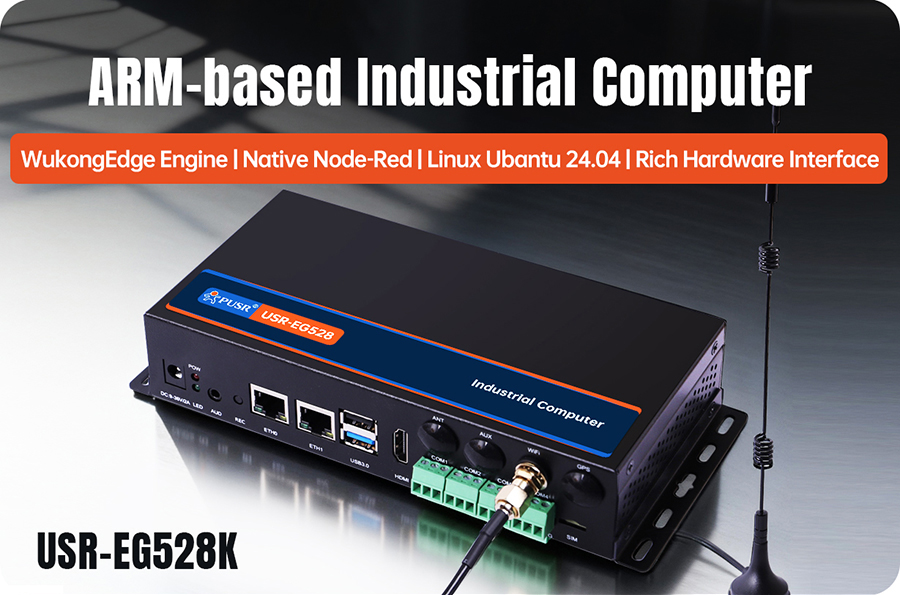
After all that—is there an arm industrial PC that can simultaneously endure the batching plant's dust, heat, vibration, heavy load, and long lifecycle?
Yes.
USR-EG528.
Not because it has the strongest specs. But because on"every dimension a heavy-load AGV needs most,"it hits the sweet spot.
| Dimension | USR-EG528's Performance | What It Means for a 10-Ton Batching Plant AGV |
|---|---|---|
| Stable Performance | Industrial-grade platform, low-power high-perf hybrid architecture, no throttling under continuous high load | Navigation + motor control + comms all on, 14 hours no stutter, no slowdown |
| Fanless Passive Cooling | No mechanical fan, pure passive cooling | Cement dust can't get in, won't become a "vacuum cleaner," cooling efficiency doesn't degrade after 30 days |
| Wide Temperature Range | -20°C~70°C+ | No crash in summer sun, no shutdown in winter dawn |
| IP65 Protection | Dustproof and waterproof | Washdown water splashes directly on it—no problem |
| Rich Size Options | Multiple specifications available | Batching plant AGV models vary—there's always one that fits |
| High-Sensitivity Touchscreen | Supports dirty-hand/glove touch, response <10ms | Operator's hands full of cement dust—one tap works, no need to poke repeatedly |
| Rich Interfaces | USB, COM, RS232/RS485, CAN Bus, GPIO/DIO, HDMI, Gigabit Ethernet | Motor controller, weight sensor, radar, 4G module—all direct connect, zero adapters |
| Long Lifecycle | 5 years+ stable supply | From batching plant opening to closing—no mid-project board swap |
| Cost-Performance | Extremely competitive in the "fanless + wide temp + IP65 + rich I/O + high-sensitivity screen" combo | Batching plant margins are thin—batch deployment math works out |
One sentence:USR-EG528 isn't the most expensive arm industrial PC. But it's the most "right" one for heavy-load batching plant AGVs.
| Batching Plant Challenge | How USR-EG528 Endures It | Underlying Logic |
|---|---|---|
| 10-ton full load, 14 hours continuous | Fanless + low-power architecture, no throttling under high load | No fan = no dust entry; high efficiency = no overheating |
| Summer tank surface 70°C+ | -20°C~70°C wide temp, passive cooling | Temperature rises? No panic. Heat dissipates naturally. |
| Cement dust + washdown water | IP65 protection, fanless sealed design | Dust can't get in, water can't splash in |
| Vibration from 10-ton load over speed bumps | Industrial-grade vibration resistance, no mechanical rotating parts | No fan = no mechanical failure points |
| Operator dirty-hand operation | High-sensitivity touchscreen, wet-hand/glove usable | One tap works, doesn't delay production rhythm |
| Motor + sensor + comms all connected | Rich I/O direct connect, CAN Bus + multi-port COM | Zero adapter boards, zero intermediate failure points |
| Project cycle 3–5 years | 5 years+ lifecycle, continuous supply | From opening to closing—no board swap |
The concrete batching plant industry: thin margins, brutal conditions, demanding clients.
You've seen too many projects like this: AGV demo runs beautifully. Hit the production line—arm industrial PC starts failing in three months. Six months later, mass downtime. The integrator pays repair costs, loses the client, and never touches this track again.
It's not that heavy-load AGVs don't work.It's that the "heart" you gave them doesn't work.
10 tons of weight doesn't just press on the AGV's chassis. It presses on every chip, every solder joint, every heat dissipation path of the arm industrial PC.
Arm industrial PC chosen right?The AGV is the batching plant's most dependable "workhorse."
Arm industrial PC chosen wrong?The AGV is the production line's most expensive "roadblock."
USR-EG528 isn't the most powerful arm industrial PC on the market. But in the 10-ton heavy-load AGV scenario at a concrete batching plant, it might be the most"built to endure"heart.
The motor decides if the AGV can carry the load. The arm industrial PC decides if the AGV can carry it for long.
If you're selecting an arm industrial PC for a heavy-load concrete batching plant AGV—especially for 24/7 continuous operation in high-dust, high-temp-swing, high-vibration environments—contact us for USR-EG528 detailed specs and deployment support. Let your AGV go from "demo room strongman" to "production line workhorse."


















