The "Smart Brain" of 7-Axis Robotic Arms: How Industrial Panel PC Enable Complex Surface Grinding via Force Control Algorithms
In precision manufacturing, complex surface grinding is tough. Traditional manual grinding is labor-intensive, inefficient, and inconsistent. Conventional automated grinding also struggles with complex shapes. Here, 7-axis robotic arms with advanced industrial panel PC and force control algorithms offer a key solution.
Manual grinding is common but has many flaws. It's highly labor-intensive, causing fatigue and quality drops. For example, at a medical device factory, workers grinding heart stents had a 70% pass rate due to fatigue. Quality also varies with workers' skills, increasing costs and risks.
Traditional automated equipment like rigid robotic arms fails with complex surfaces. They use point-to-point control, unable to adjust force and angle in real-time, leading to uneven grinding and product damage. For instance, a car parts factory had over-grinding issues with engine cylinder heads.
Complex surface grinding demands high precision. In aerospace, engine blade grinding requires micron-level accuracy. Traditional methods can't meet this. Manual grinding is error-prone, and traditional automated equipment lacks effective force control.
Force control algorithms are core to 7-axis robotic arm grinding. High-precision force sensors on the arm sense contact force and adjust motion and force based on preset strategies, enabling smooth and precise grinding like human hands.
Compared to point-to-point control, force control algorithms are highly adaptive, precise, and safe. They adjust to various surface curvatures, ensure consistent contact force, and prevent collisions.
Take a high-end electronic product casing grinding. The complex surface had different curvatures. The 7-axis robotic arm with force control algorithms adjusted grinding force according to curvature. For large-curvature areas, it reduced force; for small-curvature areas, it increased force. The pass rate reached over 98%, improving efficiency and quality.
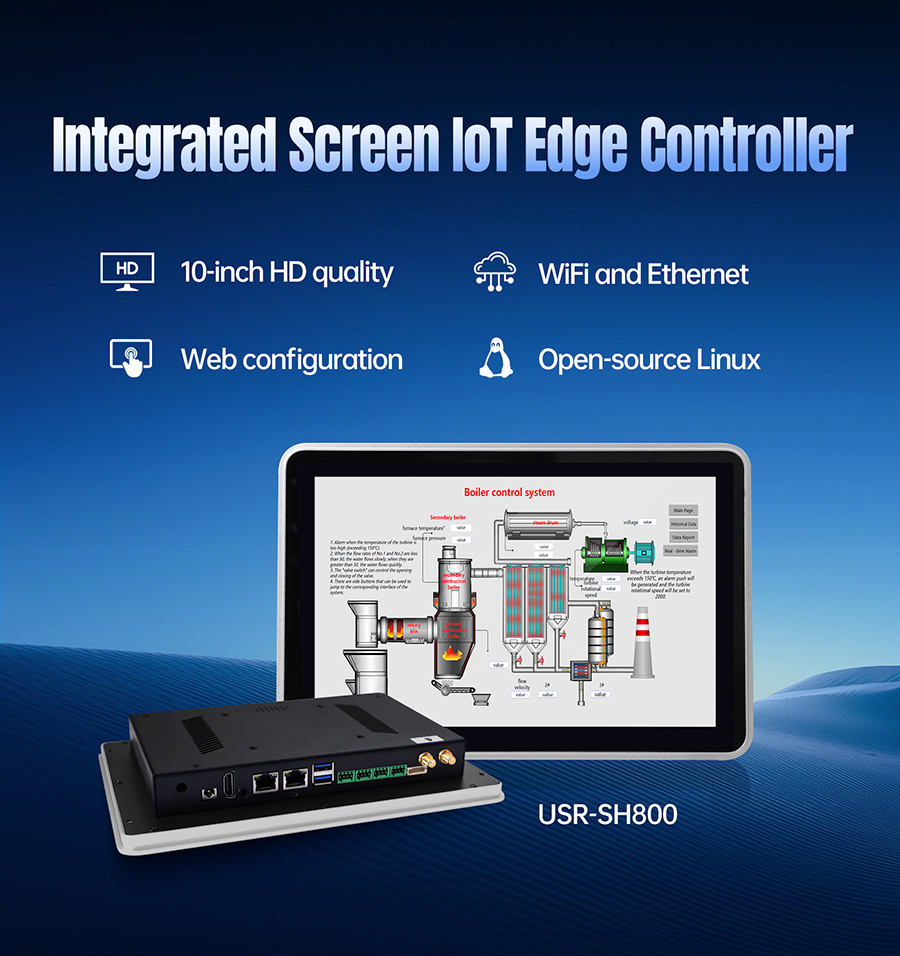
Industrial panel PCs are the core control devices for 7-axis robotic arm force control systems. They receive force sensor data, run algorithms, and send control commands to the drive system for precise control.
They have strong computing power and rich interfaces, enabling real-time algorithm operation and integrated system control. For example, they can connect to PLCs and sensors for intelligent process management.
Among industrial panel PCs, USR-SH800 stands out. With a high-performance RK3568 chip and 1.0TOPS AI NPU, it meets algorithm requirements. Its rich interfaces support various connections, and the built-in WukongEdge platform enables easy data handling and device integration.
In a car parts factory's engine cylinder head grinding project, USR-SH800 controlled the 7-axis robotic arm precisely. Its local configuration function allowed real-time monitoring and parameter adjustment. Integration with the MES system improved production management. The pass rate rose from 75% to over 95%, and efficiency increased by about 30%.
7-axis robotic arms with industrial panel PCs and force control algorithms offer a new solution for precision manufacturing. They overcome traditional drawbacks, improving precision, efficiency, and reducing costs. USR-SH800 is an ideal choice. In the future, this system will be widely used, driving manufacturing towards intelligence and high quality. Let's embrace this change for a better manufacturing future.


















