In scenarios such as urban and rural water supply, municipal drainage, and industrial water treatment, unattended pump station operation combined with PID constant-pressure water supply is a core requirement for reducing operation and maintenance costs and ensuring water supply stability. However, many practitioners building such systems for the first time easily fall into the trap of stacking multiple devices—"PLC + protocol gateway + industrial router"—which not only results in high costs and numerous failure points but also frequently causes issues such as untimely constant-pressure control response and disconnection of remote monitoring.
This article will start from the actual pain points of pump station sites, combined with extensive front-line implementation experience, to systematically outline the complete realization logic for unattended operation and constant-pressure water supply, providing professional, actionable selection references for beginners choosing an IoT gateway device.
All solution designs must revolve around the real, long-standing pain points existing at pump station sites—this is foundational experience validated through hundreds of water supply pump station projects.
First is the challenge of multi-device protocol compatibility: conventional pump stations simultaneously contain PLCs, pressure sensors, flow meters, variable frequency drives, electric valves, level gauges, and other equipment from different brands. These devices use a variety of communication standards such as Modbus RTU and proprietary frequency converter protocols. Traditional solutions require additional protocol conversion devices, resulting not only in complex wiring but also frequent protocol incompatibility issues between equipment from different vendors, leading to data collection interruptions.
Second is the real-time performance shortfall of constant-pressure control: many projects implement PID constant-pressure control logic in the cloud. When on-site network fluctuations occur, cloud commands cannot be delivered in time, causing significant fluctuations in pipeline water pressure—insufficient pressure during peak water usage and overpressure in the pipeline during low nighttime demand. This not only affects the water supply experience but may also pose safety risks such as pipeline rupture.
Third is the O&M dilemma of unattended operation: numerous pump stations are located in suburban outskirts, underground garages, and remote riverside areas, with single on-site maintenance trips incurring extremely high transportation and labor costs. Traditional multi-device combined solutions have multiple management interfaces, requiring separate logins to different device backends for fault diagnosis, making issue localization time-consuming. Often, after traveling to the site, maintenance personnel discover that only a small peripheral device has gone offline—an inefficient and frustrating cycle.
Finally, there is the lack of flexibility for future expansion: many pump stations later need to add monitoring points such as level sensors, security cameras, and smoke detectors. Traditional PLC solutions require purchasing expensive expansion modules for additional I/O, or even replacing the PLC with a higher-tier model entirely. Retrofit costs are high, commissioning cycles are long, and it is difficult to adapt to subsequent functional upgrades of the pump station.
Moving beyond the traditional approach of stacking multiple devices, using a single high-performance IoT gateway device to replace the combination of "PLC + protocol gateway + industrial router" is currently the most cost-effective and stable solution for pump station scenarios.
The core logic of this solution integrates three major functions—data acquisition, local PID constant-pressure control, and remote monitoring—all within a single edge gateway, eliminating the need for multi-device coordination. The gateway directly connects to all on-site pressure sensors, flow meters, variable frequency drives, and electric valves, collecting real-time pipeline pressure data in real time. It performs PID calculations locally, automatically adjusting the VFD's operating frequency based on pressure deviations, and dynamically regulating pump speed to achieve millisecond-level closed-loop stable pressure control. This is entirely independent of the cloud network—even if the public network is temporarily interrupted, the constant-pressure water supply logic continues to operate normally.
At the same time, the gateway directly connects to touchscreens for local on-site operation and interfaces with cameras for visual security monitoring inside the pump station. After aggregating all equipment operational data, it uploads the information to a remote monitoring cloud platform via 4G/wired network. O&M personnel can view real-time water pressure, flow rates, and equipment status of all pump stations from the office, receive alarm notifications, and truly achieve unattended operation without requiring 24-hour on-site staffing.
Compared with traditional multi-device combinations, this solution not only eliminates numerous intermediate failure points but also reduces overall hardware costs by over 60%. When adding new monitoring points later, modular expansion modules can be plugged in directly without replacing core equipment, and commissioning cycles are shortened from several days to a few hours.
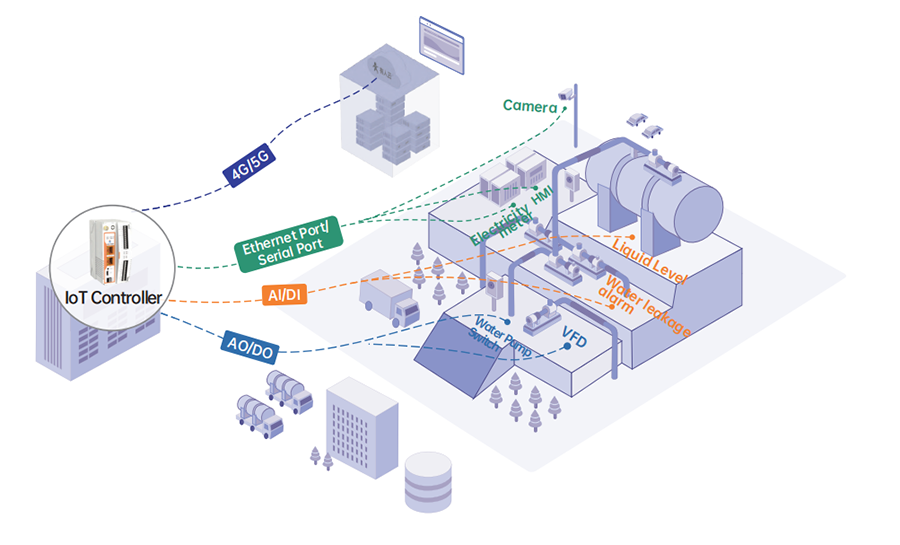
From the perspective of authoritative industry standards for field implementation, edge gateways suitable for unattended pump station scenarios must meet several hard requirements to ensure long-term stable system operation.
First, they must possess full protocol compatibility, with a built-in library of hundreds of industrial protocols supporting direct connection to mainstream VFDs, sensors, and instruments without requiring additional protocol conversion devices. A single device can complete data acquisition from all on-site equipment.
Second, they must have local millisecond-level linkage capability, with PID control logic computation latency below 200ms to ensure real-time pressure regulation and avoid significant pressure fluctuations.
Third, they must support graphical programming, allowing rapid creation of PID constant-pressure logic and alarm interlock logic through drag-and-drop connections without requiring professional PLC programming experience, enabling ordinary O&M personnel to quickly get started with debugging.
Finally, they must support rapid integration with mainstream cloud platforms, with built-in configuration monitoring capabilities that eliminate the need to develop monitoring pages from scratch, significantly shortening project implementation cycles.
The USR-M300 IoT gateway device, widely used in numerous domestic water supply pump station projects, fully matches all the above scenario requirements.
It features a 1.2GHz dual-core CPU and a built-in library of hundreds of industrial protocols. Dual RS485 serial ports can simultaneously connect to sensor arrays and VFDs. It comes with 2 DI, 2 DO, and 2 AI interfaces, directly接入 pressure, liquid level, and other analog signals as well as smoke detection, access control, and other digital signals. The LAN port can directly connect to network devices such as touchscreens and cameras.
It embeds a Node-RED graphical programming environment, enabling users to write various control logic—including PID constant-pressure water supply, over-limit alarms, and fault interlocks—just like a traditional PLC, without complex coding. Measured local linkage latency is below 200ms, fully ensuring real-time constant-pressure water supply performance.


















