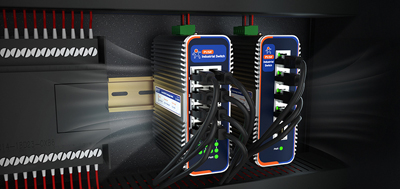
Every workshop runs into this at some point: an old PLC speaking RS232, a power meter on RS485, and the host computer sitting in the office. You want all of them on the network for unified monitoring — but the interfaces don't match. So which Serial-to-Ethernet Converter do you pick? This guide walks through the practical, on-site way to match each device to the right converter.
RS232: point-to-point, one cable per device, short distance (usually within a dozen meters). Old instruments, old controllers, and serial printers are the typical users.
RS485: two-wire, half-duplex. One bus can carry multiple devices, and transmission distance can stretch to over a kilometer. It's the workhorse interface for power meters, sensors, and VFDs.
RS422: four-wire, full-duplex, point-to-multipoint. It's less common in the field than the other two, and shows up where full-duplex communication is required.
The decision logic is simple: check the distance, count the devices, and note whether you need full or half duplex. Short distance and one-to-one — probably RS232. Lots of devices and long runs — probably RS485.
People regularly walk up holding a converter marked "RS232 only" and ask whether it can talk to an RS485 power meter. It can't. RS232 and RS485 use completely different electrical levels and wiring. Forcing it would mean bolting on an external RS232-to-RS422/485 converter board — and every extra connection is another potential failure point. The reverse is equally true: an RS485 converter won't drive an RS232 legacy device.
So the first step of selection is never the price tag. It's confirming what interface your on-site devices actually use.
All legacy RS232 devices on site: pick the single-port RS232 to Ethernet Converter USR-TCP232-302. Connect the DB9 to the old PLC or instrument, and the host computer keeps communicating normally over Ethernet. It not only meets the requirement but also offers great value for money.
RS485 meters and instruments on site: pick the single-port RS485 to Ethernet Converter USR-TCP232-304. It supports Virtual Serial Port, which effectively "extends the serial cable infinitely." The office PC can reach the field devices through its existing SCADA software — no more running out to the site every time.
Both RS232 and RS485 on site: pick the dual-port USR-TCP232-410s (or USR-N520 / N540 / N580, depending on the number of serial ports you need). Its RS232 and RS485 ports work simultaneously, so one unit replaces two and saves cabinet space.
RS422 devices: rarer in the field. Before ordering, confirm the converter's spec sheet explicitly lists RS422 four-wire full-duplex wiring support.
A classic one is the unattended weighbridge: gate barrier, serial camera, weighing instrument, LED display, RFID reader, and ticket printer — all with different interfaces. Each connects to its own serial device server, and everything converges over Ethernet to the control center. The control center can open and close the gate remotely and read weighing data, without keeping staff on site around the clock.
Smart traffic is similar: traffic signal controllers are connected to Ethernet through serial device servers, and the control center remotely collects signal operation data as the basis for traffic command and scheduling.
There's also electrical fire monitoring: fire alarm sensors connect to converters over RS485/RS232, and alarm information is reported to the remote server in real time, so duty staff respond immediately instead of waiting for the next patrol to find it.
RS485 is two-wire: daisy-chain A and B, don't wire it in a star. When many devices sit at the end of the bus, pay attention to termination resistors and grounding.
Baud rate, data bits, and other parameters differ from site to site. The 302 and 304 support RFC2217, so you can remotely change baud rate, stop bits, and parity over the network from the office — when field parameters change, no dedicated trip required.
With Virtual Serial Port software, the converter shows up as a COM port on the PC. Legacy host software keeps working without a single line of code changed.
RS232, RS422, and RS485 — none is "better" than the others. There's only what fits and what doesn't. Identify the interface first, then match the model: RS232 → USR-TCP232-302, RS485 → USR-TCP232-304, both → USR-TCP232-410s. Get the interface right, and the rest of working with a Serial-to-Ethernet Converter is just routine wiring, configuration, and going live.